
“You can’t go swimming in a baseball pool.”
Seven Terms from the Pecan Park Eagle’s Special Thesaurus for Corporate Baseball Speak at the Big League Level:
1) A Player To Be Named Later: (1) One of our South American Baseball School signees who bombs out in the Arizona Rookie League; (2) One of our long term contract, but pricey pitchers who started getting hit about as often as a bottle of cheap bourbon* , but was unmovable until he reached the last year of an eight-year deal and also agreed to pay for 80% of his due contract pay, plus the cost of Tommy John surgery; (3) Any fellow we cannot announce by name until we learn how to pronounce it without embarrassment.
* (Does the name “Tom Moore” ring a bell?)
2) Baseball Pool: A term first used as an expression for the “talent” made available by draft from the existing National League clubs to the brand new Houston Colt .45s and New York Mets prior to their first 1962 season as members of the senior circuit. Today the term is best remembered as this lyric from the 1962 C&W hit by Roger Miller, “You Can’t Roller Skate in a Buffalo Herd”:
“You can’t go swimming in a baseball pool,
But you can be happy, if you’ve a mind to.”
3) Deselecting: A “let him and his family down easy” path that a team chooses when the player they picked as No. One in the Amateur Player Draft turns out to be a guy whose too-late-received genetic study shows that his killer fastball and curve have a shelf life of no more than three years – or the time equivalent of how long it would have taken him in the minors to hone these assets into MLB weapons, had they not failed him at that level from the git-go. Upon discovery, the team effectively “deselects” the draft choice by showing him and his parents the fine print in the initial contract that reads: “Drafted and signed players who later show some kind of defect that was not obvious from the start, but was revealed as a potential problem prior to ever pitching in the big leagues, shall be free to stay with the club, but only if they are willing to remain under this contract for 10% of the contractual amount specified in their original document – or else, they may deselect themselves from ever having any contractual relationship with the club by returning 100% of the funds paid to them by the club beyond a $50.00 per day cost of living subsidy already paid to them for all the days that have passed since this instrument was signed and notarized.”
4) Misremembering: (1) In arbitration, a condition in play in which general managers forget all the assets a subject player brings to the team goal of winning, but remember very well all of the reasons that he’s now as unwelcome in the clubhouse as someone with all the symptoms of Ebola.
5) On-The-Same-Page: Whenever a general manager says of his newly hired field manager that he has found a guy who is on the same page with the general manager’s goals, it simply means that he has hired someone for the field who will not offer disagreement to anything the GM does, even if the GM’s actions effect the team on the field in a way that the field manager later feels is negative to the club’s morale and/or production.
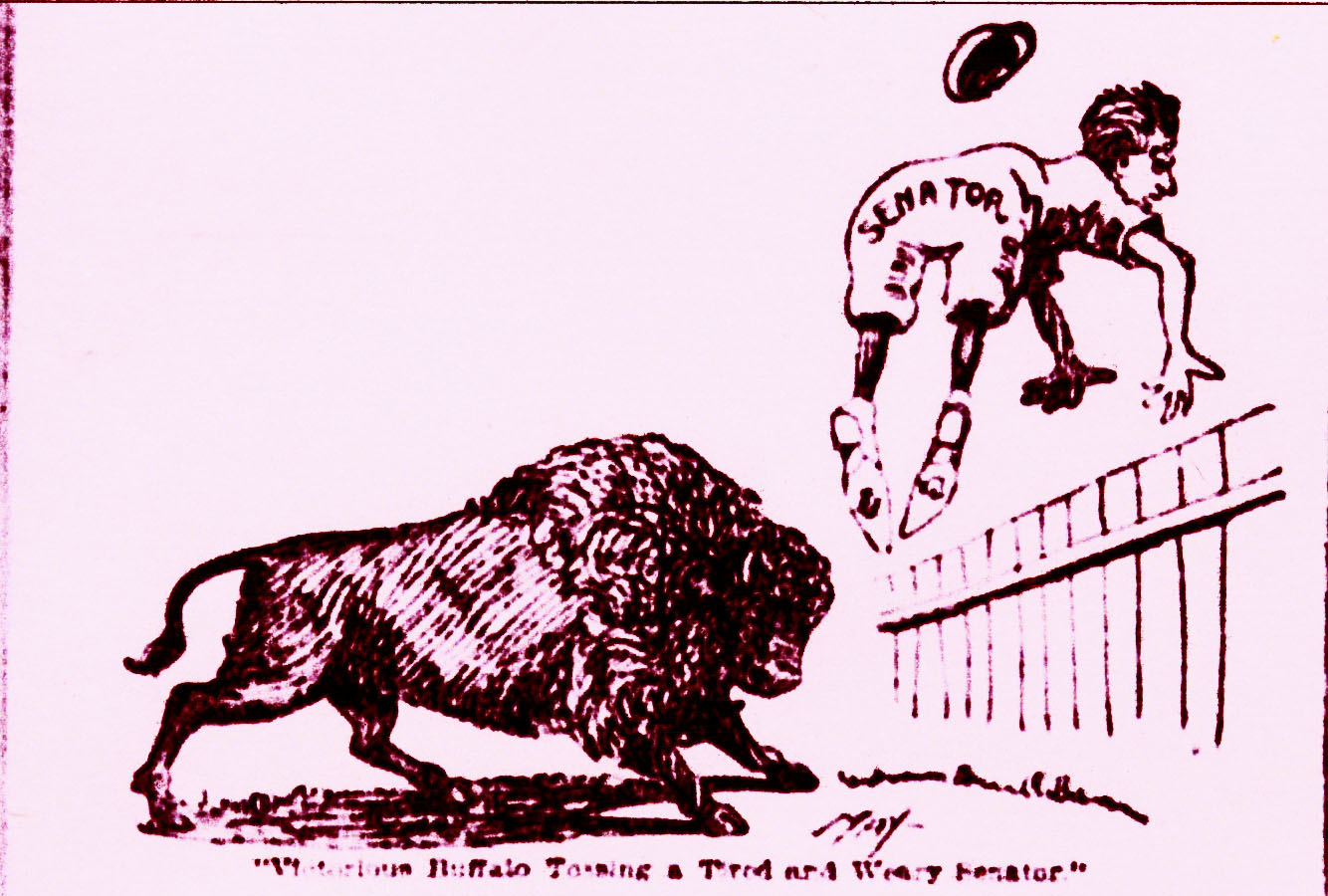
You also can’t play baseball in a buffalo herd.
6) Rebuilding Process: Germane especially to small market clubs, the rebuilding era “R” word is a term used by club administrators in the little towns of big league baseball when the club is trying to save what’s left of a fan base that is fed up with losing and 100-plus loss, last place finishes in their division. An often misunderstood term here is the word “rebuilding” itself. To better understand what rebuilding is – it is first important to understand what it is not.
Rebuilding IS NOT a restoration of the small market club to the dynastic winning level of the New York Yankees, or, more recently, the Boston Red Sox. In the first place, small market clubs cannot return to a level they never have achieved, anyway. They will they likely not have the money to get there for a first or only time – and they certainly will not have the income potential for anything resembling so much as an orange-blossom scent of dynasty winning over several consecutive seasons.
Rebuilding IS, however, the restoration of hope among the fans that “winning it all” is not only possible, but probable. Season ticket holders must buy into the idea to a degree in which they are no longer able to discern the difference that still exists between giving up on the club and giving up on themselves. For season ticket holders to be attracted on the basis of a a three to five year rebuilding plan, they must be sold on the idea that “patience with losing for the sake of the future” is the club’s real drumbeat – and they must never begin to see the campaign as a plan to restore fans without really changing anything on the field that significantly alters the club’s realistically slim chances of winning big with a small budget roster.
The concepts of “Money Ball” are the small market teams’ greatest booster shots. To believe in “Money Ball” is to believe it is possible that a mathematical shortcut to affordable young talent is both a producer of champions – and a process for regenerating talent at the same level once the established producers become too expensive to keep at the lower budget club salary level.
In the end, “Money Ball” or not, rebuilding is just what we said it is: It is the restoration of hope in the fan base. Only one club has been able to maintain a fan base based upon the quaint station of suffering with a perennial loser, but we don’t have to name them. They haven’t won a World Series since 1908. And someday, these same fans also shall get to add to the patina of their cherished anguish by adding this piercing cry: “We couldn’t even win with Epstein ad Maddon at the wheel.”
7) Reimagining: Whenever a club owner and president say that they are “reimagining the direction and plan that their team has in place, it means that they are about to fire the current field manager, his staff, and several non-productive players by season’s end. Whenever the club owner alone muses that he is reimagining, it simply means that he is about to fire the guy who now serves as president and everyone else beneath him.
Invitation: Please feel free to leave your own germane terms and definitions as a comment below on this column.
Tags: corporate baseball speak
 The Pecan Park Eagle
November 28, 2014 at 6:38 pm |
“We were lucky to get someone with his experience this late in the process. ” This bit of GM-speak emanates from the front offices of teams that are too cheap to sign good free agents or that have been spurned by the players they really wanted and actually means, “We know this guy is over-the-hill and that we paid too much for him, but we.hope that you (fans) are ignorant enough to believe that he might somehow help and that we are genuinely trying to improve the team.”
December 7, 2014 at 3:37 pm |
That was “watermelon patch”….not ‘baseball pool” from Roger Miller….
December 7, 2014 at 5:10 pm |
Correction, Wayne! It seems “you can’t go swimmin’ in a baseball pool,” but you also “can’t go fishin’ in a watermelon Patch.” Either way, you can be happy, if you’ve a mind to.”
Here are the lyrics:
http://www.cowboylyrics.com/lyrics/miller-roger/you-cant-roller-skate-in-a-buffalo-herd-1163.html
February 9, 2015 at 4:51 am |
[…] https://bill37mccurdy.wordpress.com/2014/11/28/corporate-speak-at-the-big-league-level/ […]