By signing an eight-year, $248,000,00 contract with the Detroit Tigers, first baseman Miguel Cabrera, who turns 31 on April 18, now jumps from a four-way tie for 9th and 10th on the annual highest salary list at $21 M to first place ahead of Alex Rodriquez at $31 M per season.
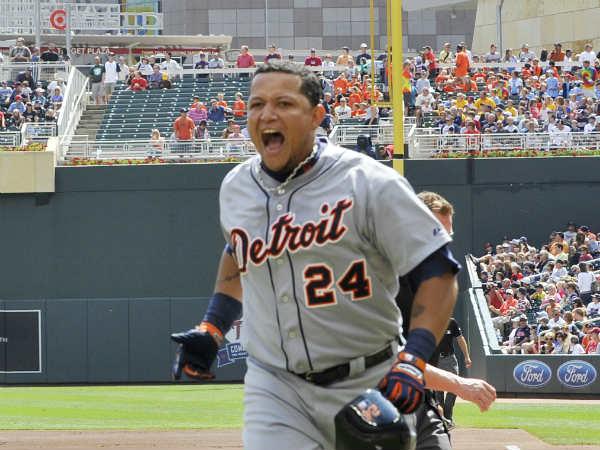
We can’t blame Miguel Cabrera. The Tigers made him an offer that none of us could have refused.
They’ve got to be kidding, right? – Yeah, for sure, there’s no way you pay a guy Cabrera’s age – and I don’t care if many see him as the arguably best hitter in baseball today – that much money over time through age 38. At 31, he could bust into that over-ripe phase at any time. But if he does, the only thing rounder than his bowlegged swinging and fielding and throwing and running efforts will be those six zeros that follow the dollar sign and the number “31” on his annual paycheck.
The really crooked thing it adds to the great Rangers and Rodriguez cash bath of recent times is the additional damage it does to the “average” salary of the not-so extraordinary roster fillers of every major league team. The Astros broke open the vault to give $12,000,000 to 31-year old Scott Feldman as a pitcher for 2014. And what’s wrong with that? – After all, the guy has a 51-56 record and a 4.62 ERA for 9 seasons in the big leagues. Shouldn’t all “near .500” career starters get millionaire bucks to pitch each season? It’s no longer a matter of “do they deserve it?” Thanks to the largesse vision of the Detroit Tigers and the plug they just gave to Cabrera, guys like Feldman should be getting even more per season from here on forward.
Who would you rather have on your roster? Scott Feldman at $12 M per? Or Walter Johnson at $9,000 per?
Yeah, I understand. Baseball has its own trinity. (1) The beautiful game it is. (2) The legendary bond that millions of us have with the game and its great teams and players., and (3) The business side.
Today, the bonds that our children form with the game, ii any, have to survive the exposure and the cynicism of the new and ever-expanding social media culture. The days of the simpler, far more naive sandlot era bond with baseball are dead and gone forever. Kids today see the game as one of the many organized seasonal activities in their lives – not as the cathedral of their dawn to dusk summer dreams on the same level that we once did. Kids today also are aware of the money and ethical issues that continuously shroud the business side of things.
So, what did the Detroit Tigers just do to make things better for the future of the game of baseball by their business deal with Miguel Cabrera?
My hope for the future of the game we love is starting to run on fumes. Had it not been the Tigers, it would have been someone else dealing with some other superstar. If baseball survives as a business, with none of the heart that made it great, I will be grateful that I wasn’t around to see it totally happen. A worse thought – maybe it’s already happened and some of us simply don’t want to face it.
Come on, Opening Day! Hurry up and get here! At least we can put aside the weight of these heavier thoughts for the day and simply feed upon those simpler sounds, sights, tastes, and smells of the ballpark for a little while. Hope in the name of love never dies.
 The Pecan Park Eagle
March 29, 2014 at 3:11 pm |
Baseball has always been a business. Why do you think the Players League of 1890 formed? Or the Federal League in 1914? There was money to be made and redistribution to be sought. If an observer of baseball history doesn’t see the arbitrary parsimony of the owners prior to the 1970s as just as much reason to be cynical (if that’s what they like to look for) as high salaries of today, then they are not being intellectually honest with themselves.
The current ownership groups are not idiots. If they believe that these salaries are sustainable, then perhaps it should speak to how they view the economic strength of the game, not to any weakness.
For the record, I’d like 20 cent gasoline.
March 30, 2014 at 12:33 am |
For the record, if you want the true plain intent of my column today, check out Patrick Lopez’s comment below. He got it.
For the record too, if you want that twenty cent gas, we are going to have to consult Dr. H.G. Wells
Regards, Bill
March 29, 2014 at 3:35 pm |
I say, “Let the owners who forked out the money worry about it.” If Team A can pay and Team B can’t afford to so be it. Sure, that will keep some clubs annual contenders and others having to scrape by by rebuilding all the time, but baseball history has been littered with examples of that scenario. And they began to be seen way before free agency. Where it hurts here is that we, despite the population of our region, are one of the Team B’s that can’t afford to spend. Its not really just TV contracts or tickets or advertising, but how deep the pockets of ownership and how many risks they can afford to take. The richest owners and clubs can always afford to take more risks. They can afford to “eat” long term contracts if they have to. The other clubs have to be both smarter and much luckier to keep winning. Let’s hope things start getting lucky around here!
March 29, 2014 at 3:40 pm |
Yes, you are right Bill ,Baseball’ survival is under duress, as kids the game we grew up with, no longer exists. Wages , TV money,have all but made the game a sport of Million heirs , some talent yes but mostly average players eager for that payday ,and honestly who can blame them.
What will the future of Baseball bring us fans , what kind of game and how expensive will it be to see a game at the park, or just tune and watch on TV ? ,some day will prices get cheaper ? Do Rich players become better athletes ? Will the Astros ever return to the National League ?,,,,,dream on.