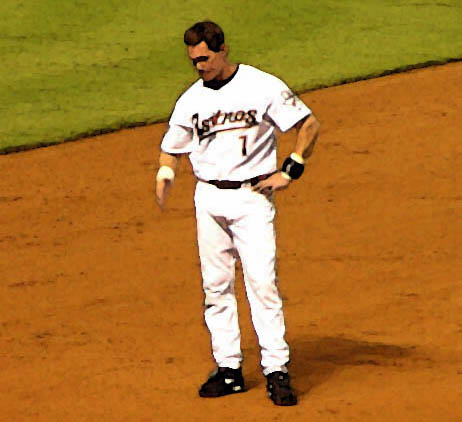
Craig Biggio never liked getting nailed at 2nd on a potential double. We can only imagine how he feels this week.
“If I have doubts about a guy for the Hall of Fame, I don’t vote for a guy,” said veteran MLB.com writer Marty Noble, who said he decided to omit Biggio from his ballot after some former players accused the Astro of using steroids. “I know what I heard and know the tone of voice that I heard from a lot of players. I really don’t know how many I spoke with over the course of a week.”
… Jesus Ortiz, The Houston Chronicle, Thursday, January 9, 2014, Page c4.
By his reported remarks, writer Marty Noble stands out as an example of the problem facing Craig Biggio in search for that rightful and deserved place in the Baseball Hall of Fame. Please note that Noble did not omit Biggio from his 2014 ballot for any reasons that cast aspersions upon his qualifications and accomplishments as a player. Noble was hastened to caution by the ways in which some of Biggio’s player contemporaries spoke of him through a series of uncounted contacts that Noble had with them “over the course of a week.”
Week? What week? If you cannot tell us who these people were, Marty Noble, can you, at least, tell us what they said? Did they make clear accusatory statements? Or did they simply speak in hushed innuendo – with suspicious eyes darting left and right as they spoke? Did they present hard evidence of their charges? Or were they merely talking in “a guy told me” tones? Did they get together and conduct a trial of Biggio as an accused PED user, giving him a chance to defend himself as accusers showed convicting proof of his guilt? Or were they simply doing what a lot of people, players and non-players alike are doing – just treating almost everyone from the era who performed well as guilty unless the day comes that each suspect can prove himself innocent?
The PED Era legacy is spreading its cancer of distrust in ways we hate to even acknowledge as the foulest of legacies. PED use is now the sin that can be visited upon innocent people and harm them for life in some instances. A ballplayer does not necessarily have to be convicted in court to be found guilty of PED use. Sometimes, all he has to do is be accused of it by loose talk that plants the virulent seed of suspicion. Once that happens, all the accused needs to do to clear his name is make all those lingering thoughts go away from the minds of millions who’ve already convicted him on the basis of what they’ve either heard or seen in the body language of storytellers.
Craig Biggio deserves to be in the Hall of Fame. He does not need to be victimized by the steroid era syndrome that convicts innocent people by careless speech and innuendo.
In the meanwhile, it continues to be impossible to have a civil discourse on what the writers are doing to some of the greatest, most accomplished stars of the game because of the greater evidence against them as PED users. As far as I know, players like Barry Bonds and Roger Clemens have never been convicted of drug abuse in a criminal court. The writers’ response to Bonds and Clemens is preponderantly what a few did this year to Biggio. They simply ignored them.
OK, on the larger scale, if we are not going to have a Hall of Fame that includes Pete Rose and Barry Bonds, the two guys with the most hits and most home runs in history, I’m thinking we, at least, need to have a forum discussion on the need for a name change. – How can we continue to call it the Hall of Fame if its going to exclude the two greatest hitting total achievers. Their records are important to any complete history of baseball.
Maybe we should keep “Hall of Fame”, but add the “Hall of Shame” wing for those people who’ve done things on the field that should never be ignored, but who also have done some proven things off the field that most people wish we could ignore.
 The Pecan Park Eagle
January 10, 2014 at 6:00 pm |
I always thought that the Hall of Fame was supposed to be a museum that highlighted both the great players of the game and all of baseball history. Like it or not, the steroid era is now part of that history, and it’s ridiculous that the BBWAA voters are burying their heads in the sand and trying to pretend that the era never existed. Players like Biggio should not be considered guilty by association or simple suspicion. As for players like Bonds and Clemens, who have smoking guns of PEDs in their hands, the fact remains that they were Hall of Famers before the periods in their careers during which they are alleged to have taken PEDs. The players that I don’t want to see in the HoF are guys like Sammy Sosa and Gary Sheffield – while their career numbers are high in the HR/RBI categories (whether that was due to PEDs or other factors in the era or both), they fall into the category of players like Don Mattingly, Dave Parker, Rusty Staub, or Al Oliver as far as I’m concerned; they were well above average players but not quite HoFers.
The late Buck O’Neil, when asked about baseball players’ use of PEDs, simply said, “Everyone’s always trying to get an edge.” Truer words were never spoken. Whether it’s saliva, vaseline, or scuffs on a ball for a pitcher; a corked bat or little extra pine tar (think George Brett) for a batter; or amphetamines, steroids, or HGH for any player, everyone has always been trying to get an edge. The game has never been 100% clean in any era, and it never will be. We may as well accept what happened in the so-called Steroid Era, elect the best players from that era to the Hall, and move into the future.
January 10, 2014 at 6:16 pm |
I forgot to add that I believe that Pete Rose and “Shoeless Joe” Jackson should be in the Hall as well. Rather than an entire Hall of Shame, all that needs to be done is to include a mention of what thing(s) a player has done that have been detrimental to baseball. Again, I thought the Hall was supposed to be a museum not a shrine for saints. As long as Rose is excluded from the institution, the Hall is incomplete. The proper thing to do is simply to give mention to both the positives and negatives that he brought to the game, but it is ludicrous to exlude Rose and to pretend as though he brought nothing at all , or nothing but shame, to baseball.
January 10, 2014 at 6:05 pm |
BIGGIO has been my hero since he first took the field. Clean cut, wholesome, ALL AMERICAN, great hustle, catcher to 2nd base to outfield, four Gold Gloves, 4 Silver Sluggers, Roberto Clemente 2007, not to mention the 3060 hits – NO SCANDALS – and a handful of idiots are responsible for him not getting in.
There was an informal proposition/suggestion on 610 AM the other morning. The statement was that the HOF is a museum of sorts and that it should represent the HISTORY of Baseball and its greatest players. Another suggestion was to have plaques inscribed under players photos “played during the steroid era” or “not the nicest guy in the game but one hell of a player” – but by all means to acknowledge their contribution to Baseball.
In my opinion, they don’t have a big enough plaque to site all of the on and off the field accomplishments achieved by CRAIG BIGGIO.
January 10, 2014 at 9:02 pm |
I sincerely expect over time this obsession with keeping PED era players out of the Hall whether they ever admitted, were convicted or proved without a shadow of the doubt they used the stuff will pass. It has to. How the the Hall of Fame BE a real Hall of Fame without the top players of a whole era? I agree with Bill and others. Simply note on their plaques that they played during the era they did. Unless they were actually found guilty there is no reason to make any note stronger than that on their plaque. ALL of the great stars must be in the Hall (including Joe Jackson and Pete Rose). Their achievements–or transgressions should be duly noted.
January 11, 2014 at 6:40 am |
There are two things in the midst of all this that I would like to see addressed one day. One is the difference between harmful gossip and responsible journalism. Is it really okay to say whatever you like about someone whether you can prove it or not? Why is a writer who makes a decision based only on what he heard, rather than on proof, taken seriously at all? Why does his irresponsible passing on of what he heard not cause him to lose all credibility? He isn’t a journalist; he is only a gossip. Related to this are the questions of why it is okay for everyone else to gamble, fans and sports journalists alike, while it also can get a player banned for life – and the other question – why so many fans and journalists can openly and freely abandon the principle of ‘innocent until proven guilty’? The other thing is the question of whether there are any different degrees of seriousness to the offense of gambling. Should betting on yourself to win really be regarded as just as bad as betting against yourself and then deliberately losing? Should a failure to report someone else’s gambling be considered just as bad as betting against yourself and deliberately losing? That is the way Judge Landis saw Buck Weaver’s case. I don’t hear these questions talked about much, but to me they are at the heart of the matter.