Archive for 2013

Our Super Highway Dream Went South All Right

October 11, 2013
The Super Highway

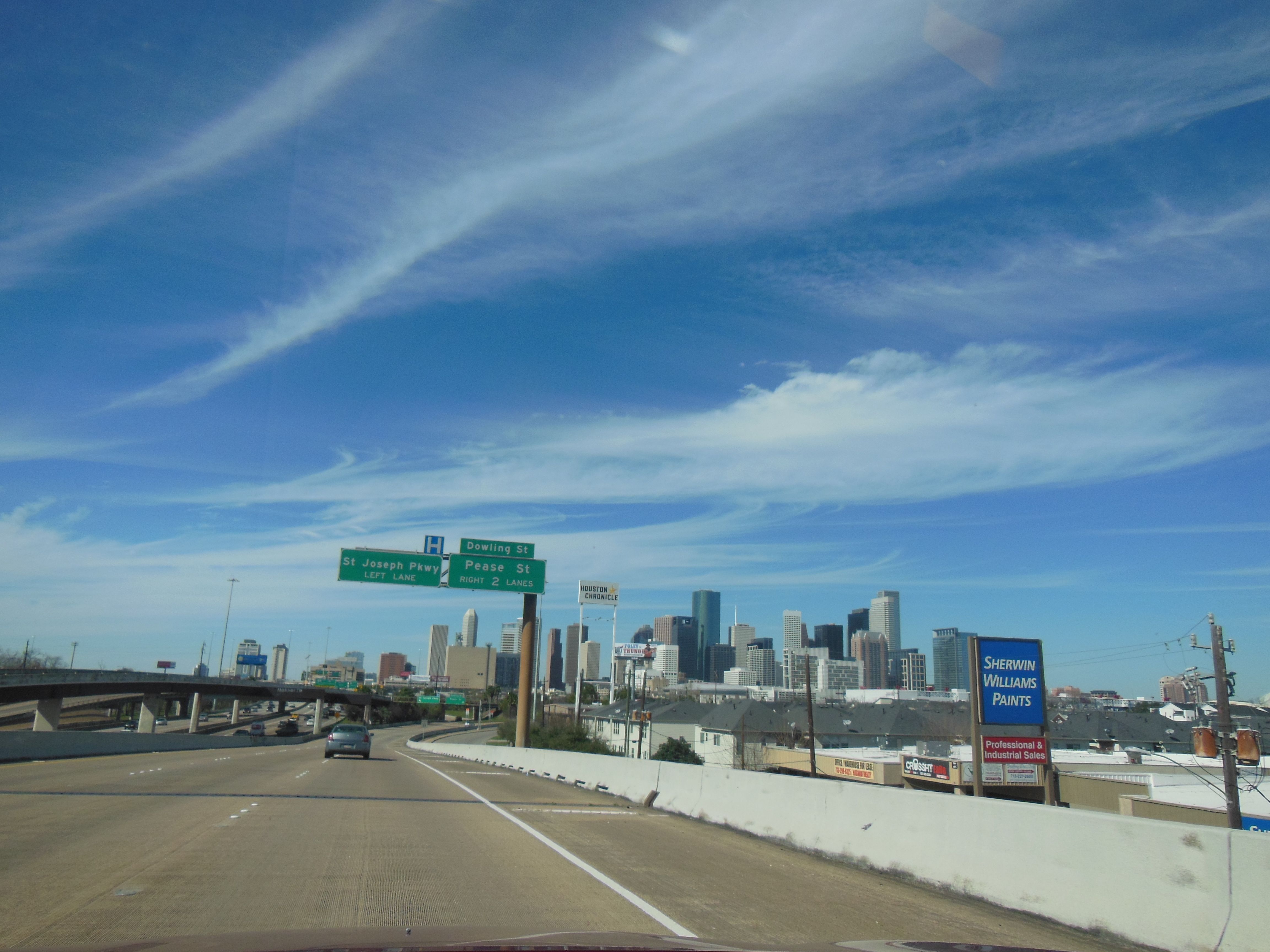
The Super Highway in Houston.

Back in our less enlightened days, just after the end of World War II, we called that new big street they were going to build in Houston by the best name anyone around here could imagine. That original name of the IH-45 South, Gulf Freeway, was nothing less than wonderful tribute to magical wishes. They called it “the super highway”.

Here’s how its humble beginnings were reported in the Galveston Daily News on Page 2 of their August 7, 1947 edition:

SUPER HIGHWAY

Houston Tex., Aug. 6, (AP) – The first concrete has been poured on the new Houston-Galveston super highway. J.C. Dingwall, urban design engineer with the state highway department has announced. The concrete was poured at Pierce and Crawford streets in Houston where a #1,000,000 widening project is underway.

After the super highway was completed, it took on a more modest identity as the Gulf Freeway, but it’s job was done by early 1949. It had solved all traffic flow problems between Houston and Galveston, given all of us in southeast Houston a new easy five to ten minute sight-seeing drive to downtown from our homes, and established itself as the model design for all the other freeways that were soon to come in service to all of Houston. – The Southwest Freeway, the EastTex Freeway, the North Freeway, and the lovely 610 Loop eventually rang in as Houston’s easy new way to get around town painlessly without trains or any plan to preserve the integrity of inner city, near downtown life.

What a wonderful world!

Now, if you will excuse me, I’ve got to run to the store. This stuff I’ve been smoking this morning is a little strong.

World Series Team Marks

October 10, 2013
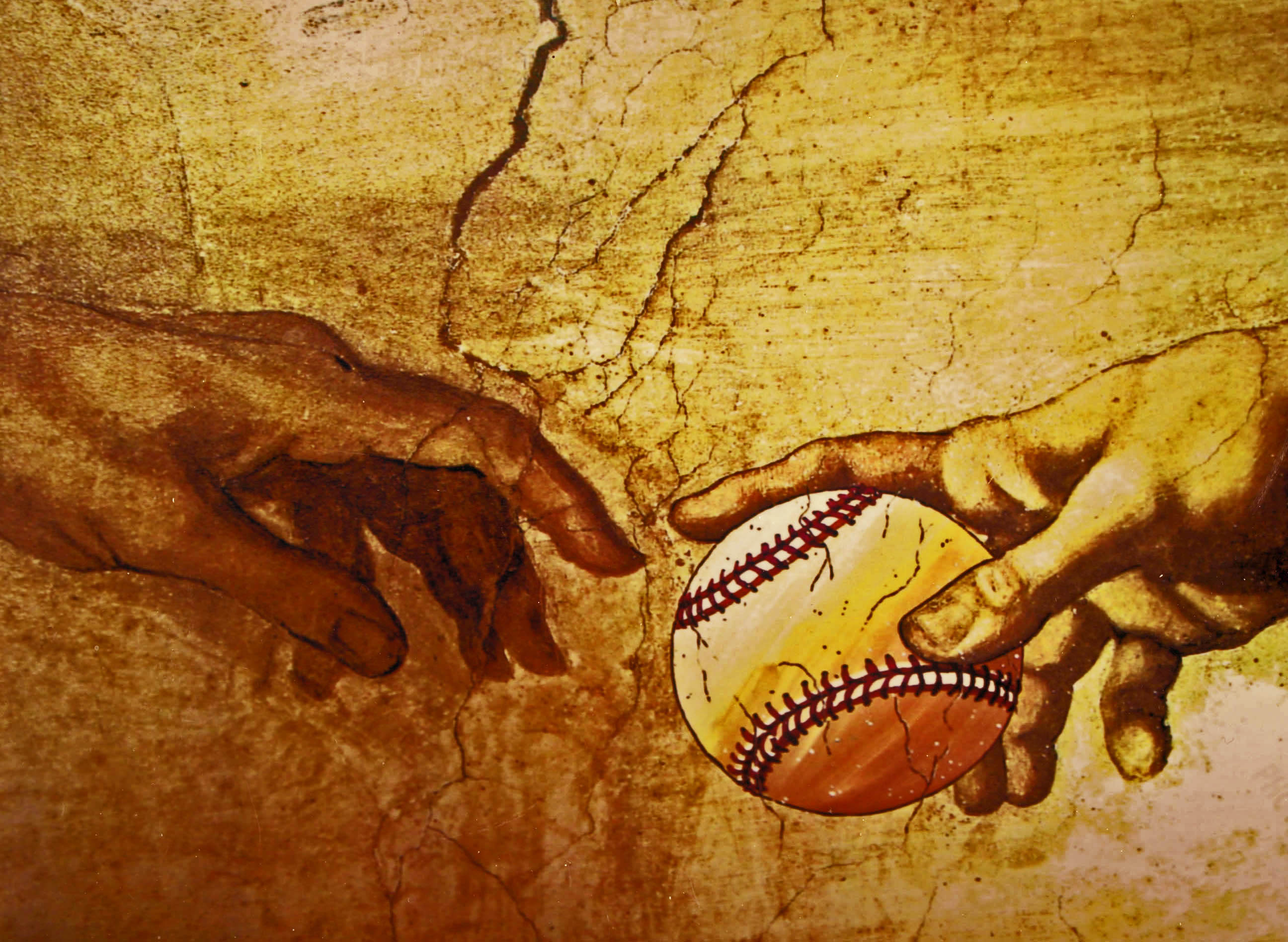
"In the big inning, the Lord Said to Adam: 'Beyond your love for me, family, and friends, this gift is to remind you of what else is really important in life.'"

“In the big inning, the Lord Said to Adam: ‘Beyond your love for me, family, and friends, this gift is to remind you of what else is really important in life.'”

On a day spent celebrating my little sweetheart Norma’s birthday, The Pecan Park Eagle pauses to put first things first: Love and Family own the lead here, even over baseball.

I did have time to work up a little sketch this morning, with the help of a table I constructed from data compiled by Baseball Almanac. The chart below shows the World Series record of every present and defunct team since the 1903 inception of the first such contest.

My categorizations are not pure. or example, I treat the entire Dodgers record as including all the time in Brooklyn, even those early years they were known as the Robins, through present day Los Angeles, because that franchise seems to prevail forever in our hearts and minds as “Dodgers then ~ Dodgers now. ~ Dodgers forever.” On the other hand, when a team like the old Senators moved to Minneapolis and became the Twins, when the Browns moved to Baltimore and became the Orioles, et cetera to all other city and name change examples,  those such moves are treated here as the end of one identity and the beginning of another. The A’s life in three cities left the A’s, like Dodgers, still the A’s, but the Pilots early move to Milwaukee to become the new Brewers, was another identity shift, – in my mind, at least.

In addition to win/loss records, the table graph denotes the years that each team last reached and last won a World Series, if ever.

IN THE CHART BELOW, X DENOTES A TEAM IDENTITY THAT NO LONGER EXISTS.

Hope you find some enjoyment with this information.

Gotta go now. My lady awaits.

WORLD SERIES RECORD OF PRESENT AND PAST MAJOR LEAGUE TEAMS IN THE MODERN SERIES, 1903-2012:

TEAMS WON LOST WIN % LAST WS LAST WON
BLUE JAYS 2 0 1.000 1993 1993
MARLINS 2 0 1.000 2003 2003
ANGELS 1 0 1.000 2002 2002
DIAMONDBACKS 1 0 1.000 2001 2001
PIRATES 5 2 .714 1979 1979
ATHLETICS 9 4 .692 1989 1989
YANKEES 27 13 .675 2009 2009
RED SOX 7 4 .636 2007 2007
CARDINALS 11 7 .611 2011 2011
WHITE SOX 3 2 .600 2005 2005
REDS 4 3 .571 1990 1990
TWINS 3 3 .500 1991 1991
METS 2 2 .500 2000 1986
ROYALS 1 1 .500 1985 1985
TIGERS 4 7 .455 2012 1984
ORIOLES 3 4 .429 1983 1983
INDIANS 2 3 .400 1997 1948
GIANTS 7 12 .368 2012 2012
DODGERS 6 12 .333 1988 1988
BRAVES 3 6 .333 1996 1995
X – SENATORS 1 2 .333 1933 1924
PHILLIES 2 5 .286 2009 2008
CUBS 2 8 .200 1945 1908
PADRES 0 2 .000 1984 never
RANGERS 0 2 .000 2011 never
ASTROS 0 1 .000 2005 never
BREWERS 0 1 .000 1982 never
RAYS 0 1 .000 2008 never
ROCKIES 0 1 .000 2007 never
X – BROWNS 0 1 ,000 1944 never
MARINERS never
NATIONALS never
X- EXPOS never
X – PILOTS never

Houston: Death on a Football Afternoon

October 9, 2013
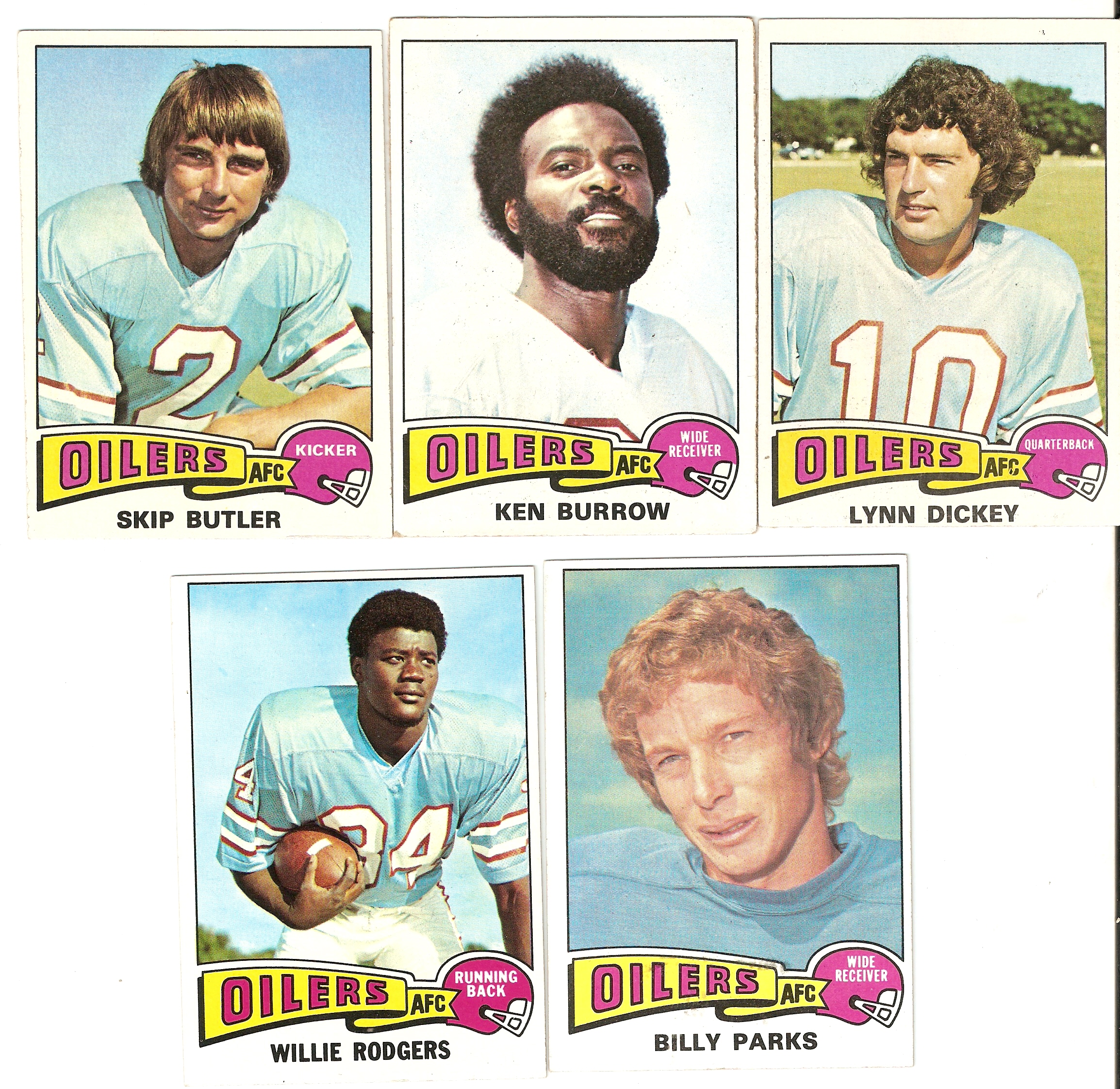
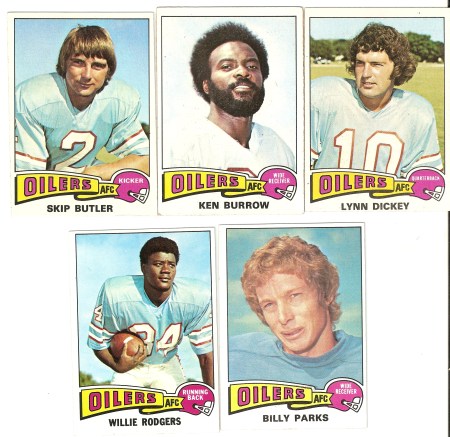
The good old days of early pro football in Houston weren't always so bright - and the darkest of these was October 9, 1960, long before even the guys in this picture were around.

The good old days of early pro football weren’t always so bright – and the darkest of these was October 9, 1960, involving the death of a New York Titans lineman in an AFL game in Houston, long before even the guys in this picture were around to play against them as the first Houston Oilers.

Today the University of Houston announced that senior quarterback David Piland was being dropped from the Cougars football team because two concussions had left him vulnerable to the imminent possibility of serious illness, injury, or even death, if he continued to play. UH didn’t use that specific language in describing the potential dangers to Piland, should he continue to play and take hard hits on the field, but that’s what they meant and we all know it.

“It was not easy to hear that I can no longer play the game that I love,” said Piland, “but I know our medical staff has my best interests in mind.”

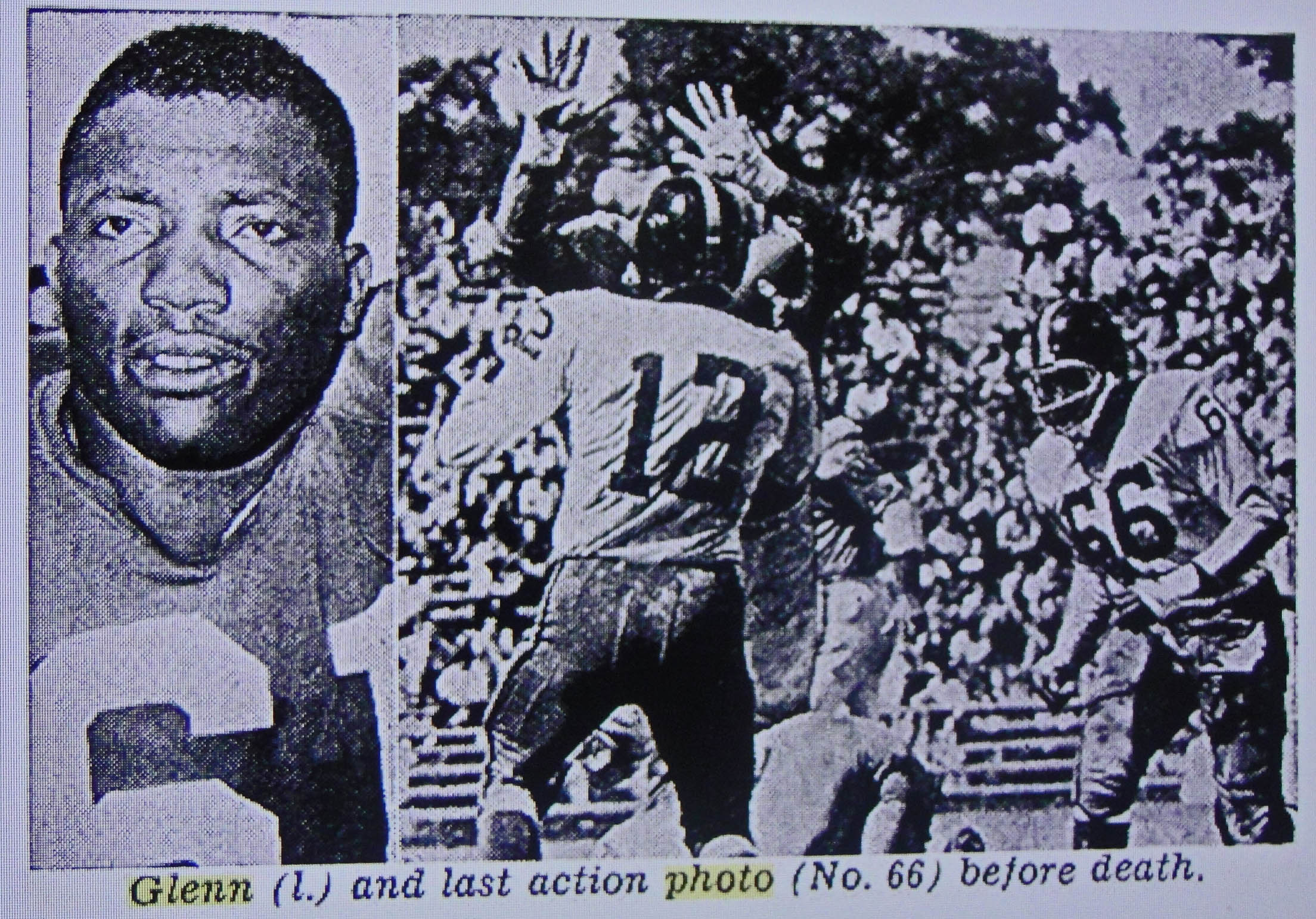
How times have changed. We only have to go back in time fifty-three years to the same physical place were young David Piland took many of his hits, if not the career-ending ones, to find the identity of the only man officially recorded as the solely diagnosed player ever killed directly in major level professional football from a game injury. His name was Howard Glenn, a 26-year old offensive guard who played for the New York Titans of the American Football League. The Titans were in town to play a game with the Houston Oilers on a Sunday, but let’s allow an eyewitness to start our story about that day. Tom Hunter, then an 8th grade student in Pearland, Texas  and a future graduate of UH, saw it all unfold before him. Now a longtime resident of Denver, Hunter has never forgotten that fated afternoon when death rode into the mix of heat, humidity, and rules-prescribed violence to stop Howard Glenn at the toll booth.

“On Sunday, October 9, 1960, I sat near midfield in the front row of the east stands at Jeppesen Stadium for a football game between the Houston Oilers and the visiting New York Titans and saw Titans offensive guard Howard Glenn–who had been injured on a play–come out of the game and sit on the bench directly below me. His bare head lolled from side to side until two trainers came over and aided him as he walked off the field under his own power just before halftime. Later that night I learned that he had died at Hermann Hospital. He was twenty-six years old. Nowadays when a player is seriously injured on the field, he is immobilized, placed on a cart, and taken for medical evaluation. Whenever I see this, I am haunted by the memory of number “66” with his arms around the shoulders of two trainers walking towards the Jeppesen Fieldhouse locker rooms. R.I.P.” – Robert Thomas Hunter, Denver, Colorado.

As many of you know, “Jeppesen” was the name that formerly identified the old WPA constructed football stadium on Cullen at the UH campus that was later changed to “Robertson”. It was torn down after the end of the UH 2013 football season to be replaced by a modern playing facility that will open for UH in 2014. Back in 1960, it was the original home of the Houston Oilers. Their New York Titan opponents would soon enough be renamed the “Jets”, and that new nickname would stick as the lasting identity of that original AL club.

Unlike today, football clubs played variable to light to no attention to the possibility of life-threatening injury during games in 1960. The local Oilers had a couple of physicians, but the Jets traveled to Houston with no doctors to help them with in-game diagnosis and treatment of critical injuries or game-induced illnesses. And remember too. These were the days when coaches and trainers prescribed salt tablets, limited water, and no rest for fatigue on the field. Players were expected to simply suck it up and be men by playing through minor pain, injury, and fatigue.

Real men were the last men standing. – Men who took themselves out of games due to injury, pain, or nausea were simply wimps. Nothing more.

Sunday, October 9, 1960 was one of those Houston fall days that felt more like the jungle of a southeast Texas August. Temperatures reached into the 90’s and the humidity was so high that players were soaking wet in their heavier-than-these-days uniforms and helmets of that even more primitive era. It had to have been tough on everyone, but especially for the New York players. Unlike the Oiler guys, the Titans had not been in town long enough to have developed the secondary breathing gills that Houstonians needed for summer-survival in the days prior to ubiquitous air-conditioning.

As in baseball, if not even more so, because of the even lesser employment opportunities, football players put up with it. A top star like future Hall of Fame pass-catching ace Don Maynard may have made something under $10,000 a season, tops, while also working the off-seasons as a master plumber, a teacher of high school math, or a salesman of cars – or whatever.

In 1960, it was a different day and more of a plantation mode for player thought. “”You just show up when you’re supposed to play and do what you’re supposed to,” said Don Maynard. “That’s the business.”

On October 9, 1960, the football culture of bad medicine, no medicine, player dedication to pain denial, the absence of proper hydration and game rest, inferior protective equipment, and the basic violence of the game came together to kill a man who probably could have been saved in 2013. And it happened in Houston, at Jeppesen (later Robertson) Stadium, to a young fellow named Howard Glenn,  a New York Titan lineman who would not live to see his other aspirations as an artist ever develop as they might have.

Ernie Barnes described the decline of Howard Glenn quite graphically in an article by Sandy Pawde for the March 17, 1967 edition of the Sarasota Evening  Journal. Shortly after kick off on this hot sweaty day, Glenn began to say, “I don’t think I can make it.” He was greeted with butt -slap support and “suck it up” words by his teammates. Teammate Barnes, lined up next to Glenn, says he began to notice a putrid smell coming from Glenn. It wasn’t normal and it just got worse as the game wore on.

Glenn continued to say, “I don’t think I can make it,” adding, “I’m sick. I need to come out of the game.” All he got was more hang in there words and butt-slapping until the offensive drive stalled and the Titans kicked the ball away. Only then did  Howard Glenn leave the game with the rest of the offensive team. He was sweating profusely, gasping for breath, smelling awful, with a white foam building around his mouth, and about to fall. In spite of these worsening conditions, the Titans had no team doctor present to examine him – and New York Coach Sammy Baugh just kept sending him back into the game each time the offense again took the field.
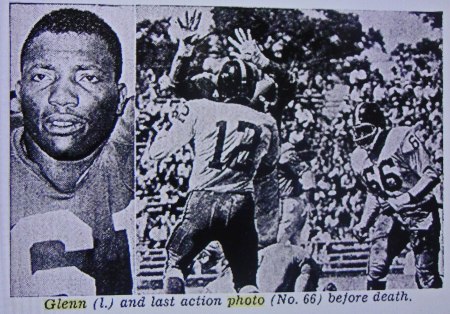
Howard Glenn

Glenn finally collapsed and had to be lifted and walked (not stretchered) to the bench by two teammates. He spent most of the second half on the bench and walked to the locker room under his own power, just before the half. At game’s end, however, Howard Glenn collapsed as he returned to the locker room. The cry “get him a doctor” started, but was soon quieted by “just sit him on a stool. He’ll be all right. It’s just football and fatigue.” Sitting dazed and glassy eyed on a stool. Howard soon slumped to the floor, as a very drunken man might,  landing flat on his back, with his eyes still open, but only staring blindly at the ceiling. He began coughing up thick green mucous, which fellow players tried to clear from his mouth with their fingers as he seemed to be strangling on it. That reeking smell from Glenn’s body filled the room. Only then did New York officials call for help from the Oilers’ two stadium-present physicians. Some time was lost finding and retrieving medical help that could have been called when Glenn first was taken out of the game, but that was not the practice of this team in that era on a fateful Sunday.

It wasn’t rocket science medicine. The two Oiler doctors quickly determined that Howard Glenn needed to be immediately transported to Hermann Hospital in the nearby Texas Medical Center. The plan was this simple: Howard Glenn would stay in Houston for emergency and critical care treatment while the team flew back to New York after the Houston game. It would not take long for that last dire denial of the reality to be swept away by the darkest rider in all our lives, eventually.

Howard Glenn was taken to the hospital for treatment at 5:30 PM. He was pronounced dead at 6:10 PM, Sunday, October 9, 1960. The stunned New York players got the sad news at Hobby Airport, shortly after boarding their plane for home. All were shaken, but the death got little attention nationally and not much changed in the almost universal neglect of an adequate medical approach to football safety until more recent times.

The next day, Harris County Medical Examiner Dr. Joseph A. Jachimczyk signed off on the loss of Howard Glenn as an “accidental death” that stemmed from a broken neck. It was subsequently first determined that Glenn had broken his neck the previous week in a game that New York played against the Dallas Texans. However, further opinion concluded that it was more likely that Glenn had suffered the broken neck in New York’s 27-21 loss to the Oilers in Houston.

Howard Glenn became the first and only, so far, man to die directly from an identified game injury. Two others, Stan Mauldin of the Chicago Cardinals (1948) and Dave Sparks of the Washington Redskins (1954), also died after games, but their deaths were due to heart attacks.

What a sad day in Houston sports history, but it brings clear attention to why football now has in place some new strong rules to protect players from concussions – and the kinds of tackling that often causes broken necks. And it is the reason that fine young men like David Piland of UH must now learn to deal with the fact that he can no longer play the game he loves.

The Pecan Park Eagle wishes to thank Tom Hunter of Denver for bringing to light the story and the research material that brought it to life, along with his open personal eye-witness comment, to the telling of this timely story.

Fifty-three years ago today, a good man lost his life playing football in Houston. His name was Howard Glenn. And he deserves to be remembered  as the man who lost his life playing football in the prehistoric era of sports medicine.
Bill Gilbert: Astros Finish Worst Year in History

October 8, 2013

Bill Gilbert 05

Astros Finish Worst Year in Club History

By Bill Gilbert, 10/07/2013

The Astros finished the season with a 15-game losing streak, capping off the worst year in their 52-year history. The 51-111 record continues a streak of three straight years with the worst record in the team’s history and also the worst record in the major leagues.

Can it get any worse? Astro fans, or what’s left of them, are asking again as they did after the 2012 season, when it appeared that it was time for the rebuilding project to start showing some results. I expected some improvement in 2013 and I feel safe in forecasting some improvement in 2014. How can it possibly get worse than a 51-111 record culminating in a 15-game losing streak?

Almost anything that could go wrong for the Astros in 2013 did so. First was the forced move to the American League which was about as unpopular as Obamacare. The anticipated rivalry with the Texas Rangers turned out to be a dud as the Rangers won 17 of the 19 games between the two teams. The new TV deal with Comcast which was supposed to bring in a big increase in revenue failed when the Comcast network was unsuccessful in negotiations with major providers leaving viewers in Houston and other Texas cities unable to see Astro games. In view of the team’s performance, maybe that was a good thing.

The Astros were well below average in essentially all aspects of the game. They were last in the major leagues in on-base percentage (.299), slugging average (.375) and ahead of only the White Sox in the AL with an average of 3.77 runs per game. The pitchers ERA was 4.79, worst in the major leagues and the team’s fielding percentage of .979 was the lowest in the major leagues as they led the major leagues in errors.

The Astros set some other dubious records along the way. They set a major league record with 1535 strikeouts and led the major leagues by being caught stealing 61 times. Chris Carter led the majors in strikeouts with 212.

Jose Altuve had another productive year, batting .283 with 35 stolen bases. Jason Castro led the team with an on-base percentage of .350 and a slugging average of .485. Carter led in home runs with 29, RBIs with 82 and walks with 70. Jordan Lyles led the pitchers in wins with only 7. Jared Cosart had a 1.95 ERA in his 10 starts after being promoted to the major leagues but he walked more batters than he struck out.

Houston minor league teams had an excellent year in 2013. Their six top minor league teams all made the post-season playoffs and two of them, Low Class A Quad-Cities and Short-Season, Tri-Cities, won league championships. While the farm system has been greatly fortified by good draft picks and trades, it hasn’t yet produced a significant number of players at the major league level that appear to have the potential to be solid major leaguers. The Astros used 25 position players and 25 pitchers at the major league level this year but only Altuve and Castro have established themselves as being the type of players that could be productive on a contending team. Third baseman Matt Dominguez is strong defensively and has some power but doesn’t hit for average. Carter has power but has pitch recognition problems resulting in strikeouts and a low batting average. Center fielder George Springer had an outstanding season split between AA Corpus Christi and AAA Oklahoma City batting .303 with 37 home runs and 45 stolen bases and should be in Houston in 2014.

Of the pitchers, Cosart and Brett Oberholtzer showed promise after being promoted late in the season and Jordan Lyles remains as a prospect. There are some promising pitchers in the minors but they are mostly a couple of years away. The big concern is that there may not be enough high-ceiling players in the system to field a contending team in the next few years.

I expected some improvement in 2013 with at least 60 wins but it didn’t happen. Part of that was due to the move to the American League where the team was even more overmatched than they were in the National League. However, some improvement must be shown in 2014 to begin recovering the dwindling fan base. A minimum of 63 wins in 2014 should be attainable to stop the string of 100-loss seasons followed by 70 wins in 2015.

Pecan Park Eagle Footnote: Bill Gilbert was a long-time Houston area resident during his years of employment at Exxon and a stabilizing leader of the Larry Dierker Chapter of SABR (The Society for American Baseball Research) during its early years in southeast Texas. Now retired in the Austin area, Bill remains active with the Rogers Hornsby Chapter of SABR, where he continues his “passionate dispassionate” ongoing evaluation of Houston Astros baseball. Thank you, Bill Gilbert, for making your assessments available to an even larger base of fans through the readership of The Pecan Park Eagle. God Willing in favor of us all, we shall look forward again to both your monthly Astros evaluation contributions in 2014 – and to whatever else you care to write for us, anytime, along this joyful baseball  way.

Bill Gilbert may be reached at billcgilbert@sbcglobal.net

Mike Mulvihill: An Old School Champion

October 7, 2013
Mike Mulvihill Football & Baseball Oklahoma State St. Thomas St. Anne's 1950s

Mike Mulvihill
Football & Baseball
Oklahoma State
St. Thomas
St. Anne’s
1950s

Mike Mulvihill is a both a friend and fellow 1956 graduate of St. Thomas High School. He was an old school good guy and terrific athlete then, and a guy today who has long deserved induction into our St. Thomas Hall of Honor for Athletics. And we are hoping to get him there when the next ballot comes up in January 2015. In our earlier parochial school days, Mike attended St. Anne’s Catholic School, located at the corner of Shepherd and Westheimer. My school was St. Christopher’s, off the Gulf Freeway at Broadway in the East End. Back in those days, St. Anne’s was our local version of the New York Yankees. Those guys rolled over just about everybody.

This morning, I found the following report on the St. Anne’s upcoming championship game against St. Patrick’s of Galveston in 1950 and just had to do this article. Mike Mulvihill, who went on to further championship experience with the Town House Buffs in baseball, state Catholic school championship glory in both baseball and football for St. Thomas, and a national championship major moment in baseball as a pitcher for Oklahoma State University in 1959, where he also played Division I football. In this November 23rd article from the Galveston Daily News, Mike Mulvihill was also prominently mentioned as the St. Anne’s leader in the upcoming 1950 championship game scheduled for Sunday, November 26, 1950.

My problem today is – I could not find a report on the outcome of this reported game through my computer research sources, even though my dime is firmly put down on the idea that the Galveston boys weren’t going to be able to do anything we other Houston schools couldn’t do to stop Mulvihill and Company from the big prize. I still don’t know the final outcome, but, as I just wrote, I would not lay a late dead man’s vote against St. Anne’s. Mike was one of those guys who could either run around or over a defender, depending on the kind of threat an opponent posed.

Mike, or anyone else, if you know who won the big game described here, please post your information below as a comment story with scoring specifics, if you have them.

Thanks!

**********************************************************************

St. Patrick’s Greenies (of Galveston) will meet St. Anne’s of Houston here (in Galveston) Sunday afternoon (11/26/1950) in a game matching the Parochial champions of the two cities. 

St. Anne’s thumped St. Christopher’s 41-0 Sunday afternoon (11/19/1950) to annex the Houston title for the third year in a row. St. Patrick’s won the local (Galveston) championship last month.

The game will mark the renewal of the inner-city rivalry which began in 1948 when St. Mary’s Rams journeyed to Houston a suffered a 7-0 setback at the hands of St. Anne’s. No game was played in 1949.

Both teams will enter the game with undefeated records. The Greenies won three league games against one tie and also took a 21-7 decision from St. Mary’s of Houston. St. Anne’s has won eight straight games without a loss, averaging about 30 points per game and allowing but 7 points all season. St. Patrick’s scored 103 points against 45 for the opposition.

Roy Garrett has paced the Greenie attack during the year, racking up 42 points to tie for high scoring honors in the Galveston loop. Raymond Valdez, St. Patrick’s quarterback, has twp touchdowns to his credit, to rank second to Garrett.

St. Anne’s will be led by Mike Mulvihill, who starred in Sunday’s game against St. Christopher’s. Rounding out the (St. Anne’s) backfield will be Jim Byman, Jim Rughstrom, and Bill Allen.

Knights of Columbus officials announced that the game will be played Sunday at 3 p.m. Sunday at Public School Stadium. Admission Prices will be 50 cents for adults and 25 for children.

~ Galveston Daily News, November 23, 1950, Page 9.

**************************************************************************

The Only “Rain Out” in Astrodome History

October 6, 2013
Three Astros Who Were There for the 1976 Astrodome Rainout: Centerfilder Cesar Cedeno, General Manager Tal Smith, and Third Baseman Enos Cabell. (Photo by Bill McCurdy, 2007.)

Three Astros Who Were There for the 1976 Astrodome Rainout: (L>R) Centerfilder Cesar Cedeno, General Manager Tal Smith, and Third Baseman Enos Cabell.                         (Photo by Bill McCurdy, 2007.)

Seems like yesterday, but it was now long ago, way back on Tuesday,  June 15,1976. Unrelenting hard rain came up in the Houston summer afternoon and just flooded the streets around town, generating special traffic problems in the area four miles south of downtown and the even nearer Texas Medical Center located just north of the Astrodome. Cars were flooding out and the rains were still falling as darkness descended. Fans, Astrodome employees, and game officials were not gong to be able to reach the ballpark safely, if at all, for the scheduled evening game between the Houston Astros and the visiting Pittsburgh Pirates, even though the players were already there. They arrived prior to the deluge that was about to descend, but nobody wanted to play a game in front of the only twenty or so hard-core fans who somehow managed to reach the Astrodome in spite of all the weather obstacles. We think they may have all been U.S. mail men.

The game had to be cancelled due to rain, the first and only time that ever happened for reasons weather in the history of the Astrodome, and here’s how the Associated Press handled the story on Wednesday, June 16, 1976:

***************************************************

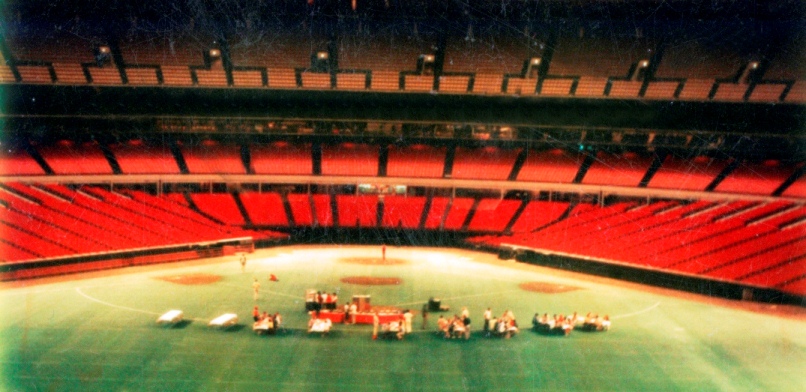
Astros and Pirates at their exclusive Astrodome infield dining room on the evening of July 15, 1976.

Astros and Pirates at their exclusive Astrodome infield dining room on the evening of July 15, 1976.

Astros Dine at Dome Rain In

Houston (AP) – There used to be a baseball saying that went like this: You win some, you lose some, and some are rained out – except in the Astrodome.

They can’t say that any more.

Torrential rains – more than seven inches – flooded streets around the Astrodome Tuesday night – forcing postponement of the scheduled game between the Houston Astros and the Pittsburgh Pirates.

It was the first postponement of a sporting event because of weather in the Astrodome’s 11-year history and only the second postponement for any reason.

The Astros and Pirates were on hand when the deluge flooded the streets and freeway around the Astrodome, preventing fans, employees, and even umpires from arriving at the stadium.

Since the players had nothing better to do after the game was called, the participated in a sitdown dinner on the infield.

“It wasn’t exactly a rain-out – it was a rain-in,” an Astrodome spokesman said. “We were bone dry inside. The Pirates and Astros put up banquet tables on the infield and sat down to dinner.”

Astros General Manager Tal Smith said the primary reason for the postponement was the safety of fans and employees.

“We could have played the game,” Smith said. “But if we had announced it was on, we would have become stranded. We just felt it best to postpone it.”

Smith said the umpires scheduled to work the game tried to drive to the stadium, but their car stalled in high water. They had to wade back to their hotel.

An Astrodome official said, “Probably less than 20 fans made it – just a handful of real diehards.”

He said those who did were treated to a dinner at the Astrodome cafeteria.

Players, who were seated up and ready to play when the game was postponed, arrived three or four hours before game time, thereby avoiding much of the water build up.

It was the second time a game has not been played on schedule in the Astrodome, but the first weather postponed event.

An April 7, 1968, exhibition game between the Astros and Minnesota Twins was cancelled because of a day of mourning for the Rev. Martin Luther King, who was assassinated three days earlier.

Because of it’s all weather features, Monday night games in the Astrodome are usually designated the television back up games.

Tuesday’s postponement came a little more than a year after a five-inch downpour delayed the start of a game between the Astros and the Chicago Cubs (on) June 9, 1975. That game was delayed 54 minutes because players as well as fans were late arriving.

Astrodome officials said Tuesday’s postponed game will be rescheduled at a later date in August.

~ Associated Press, Freeport Brazosport Facts, Wednesday, June 16, 1976, Page 6

*****************************************************************************************

1963: Colts End Season with Big Win

October 5, 2013
The 1963 Houston Colt .45's said goodbye to the season with an explosive rookie lineup.

Two days earlier, 9/27/63, the 1963 Houston Colt .45’s put a late cap on the season with an all rookie lineup, but they still lost to the Mets, 10-3.

The 1963 Houston Colt .45’s ended their season at Colt Stadium on Sunday, September 29th, with a 13-4 bashing of the New York Mets. Two days earlier, on Friday, September 27, 1963, Manager Harry Craft had sent out an all rookie lineup, the one featured above in the photo, but they were soundly beaten by the old Metros, 10-3, in a game that will be talked about forever among diehard Houston fans.

Here’s how the Baytown Sun reported this last 9/29/63 game mauling win and the only amazing day in the one-game career of young Mr. John Paciorek. A subsequent injury would keep Paciorek from every playing a second game in the major leagues, leaving him with among the rare few who finish with a 1.000 batting average for their entire career:

***************************************************************************

Trounce Mets 13-4 —

COLTS END SEASON WITH A BANG

Houston (AP) – New York Mets pitchers generously contributed 12 hits and 11 walks and the Houston Colts galloped to a 13-4 win in their baseball season finale.

Only twice all year had the Colts produced as many as nine runs. While it lasted, it was quite a party.

Manager Harry Craft was thumbed out. Rookie John Paciorek won the unofficial major league batting title with an average of 1.000. And Jim Umbricht completed a storybook year by picking up an easy victory in relief.

Eight rookies started for Houston. Bob Aspromonte, 24, was the lone oldtimer in the lineup.

(John) Paciorek, an 18-year-old strong boy from Michigan, played his first major league game in right field. He had a perfect day with three singles, two walks, four runs scored, three runs batted in and an average of 1.000.

Catcher John Bateman also knocked home three runs with a triple and a single. His three-bagger found two on in the second.

Four pitchers saw service on each side.

Chris Zachary started for the Colts and yielded in turn to (Jim) Umbricht, Turk Farrell, and Dizzy Jackson (Dickson, not Jackson).

Umbricht worked only two-thirds of an inning, but he was the pitcher of record as Houston rallied for five runs and a 7-4 lead in the last of the fourth.

~ The Baytown Sun, Monday, September 30, 1963, Page 6.

*********************************************************************

Baseball Almanac Box ScoresNew York Mets 4, Houston Colt .45s 13
Game played on Sunday, September 29, 1963 at Colt Stadium
New York Mets ab   r   h rbi
Kranepool rf 5 0 1 1
Carmel cf 3 0 0 0
Hunt 2b 3 0 2 0
Harkness 1b 3 1 1 0
Hickman 3b 4 1 1 0
  Schreiber 3b 0 0 0 0
Hicks lf 4 0 0 0
Coleman c 2 1 1 1
  Cannizzaro c 2 0 0 0
Moran ss 2 0 0 0
  Fernandez ph,ss 2 0 0 0
Bearnarth p 2 1 2 2
  Bauta p 0 0 0 0
  Stallard p 0 0 0 0
  Thomas ph 1 0 0 0
  Powell p 0 0 0 0
  Smith ph 1 0 1 0
Totals 34 4 9 4
Houston Colt .45s ab   r   h rbi
Vaughan ss 2 0 0 0
  Runnels ph 0 0 0 1
  Farrell p 2 0 0 0
  Dickson p 1 0 0 0
Morgan 2b 2 1 0 0
Wynn lf 3 0 1 2
Staub 1b 4 1 1 1
Aspromonte 3b 4 3 2 1
Murrell cf 5 1 1 0
Paciorek rf 3 4 3 3
Bateman c 3 2 2 3
  Adlesh ph,c 1 0 0 0
Zachary p 1 0 0 0
  Umbricht p 0 0 0 0
  Spangler ph 1 0 1 0
  Lillis ss 2 1 2 2
Totals 34 13 13 13
New York 0 0 1 3 0 0 0 0 0 4 9 2
Houston 0 2 0 5 4 1 1 0 x 13 13 2
  New York Mets IP H R ER BB SO
Bearnarth  L (3-8) 3.0 6 7 7 3 5
  Bauta 1.1 4 3 3 1 1
  Stallard 0.2 1 1 1 3 1
  Powell 3.0 2 2 2 4 1
Totals
8.0
13
13
13
11
8
  Houston Colt .45s IP H R ER BB SO
Zachary 3.1 5 4 4 1 3
  Umbricht  W (4-3) 0.2 1 0 0 0 1
  Farrell 3.0 2 0 0 1 1
  Dickson  SV (2) 2.0 1 0 0 0 0
Totals
9.0
9
4
4
2
5

E–Carmel (6), Hicks (3), Wynn (8), Bateman (23).  DP–New York 2, Houston 2.  2B–New York Hunt (28,off Farrell).  3B–New York Bearnarth (1,off Zachary), Houston Bateman (6,off Bearnarth); Aspromonte (5,off Bauta).  HBP–Hunt (13,by Zachary).  Team LOB–6.  SF–Runnels (4,off Bauta).  Team–9.  SB–Coleman (5,2nd base off Umbricht/Bateman).  WP–Powell (9).  HBP–Zachary (3,Hunt).  U-HP–Paul Pryor, 1B–Frank Secory, 2B–Frank Walsh, 3B–Ken Burkhart.  T–2:28.  A–3,899.

Game played on Sunday, September 29, 1963 at Colt Stadium
Baseball Almanac Box Score | Printer Friendly Box Scores

Gilbert vs. Gipson, A 1968 Clash of Champions

October 4, 2013
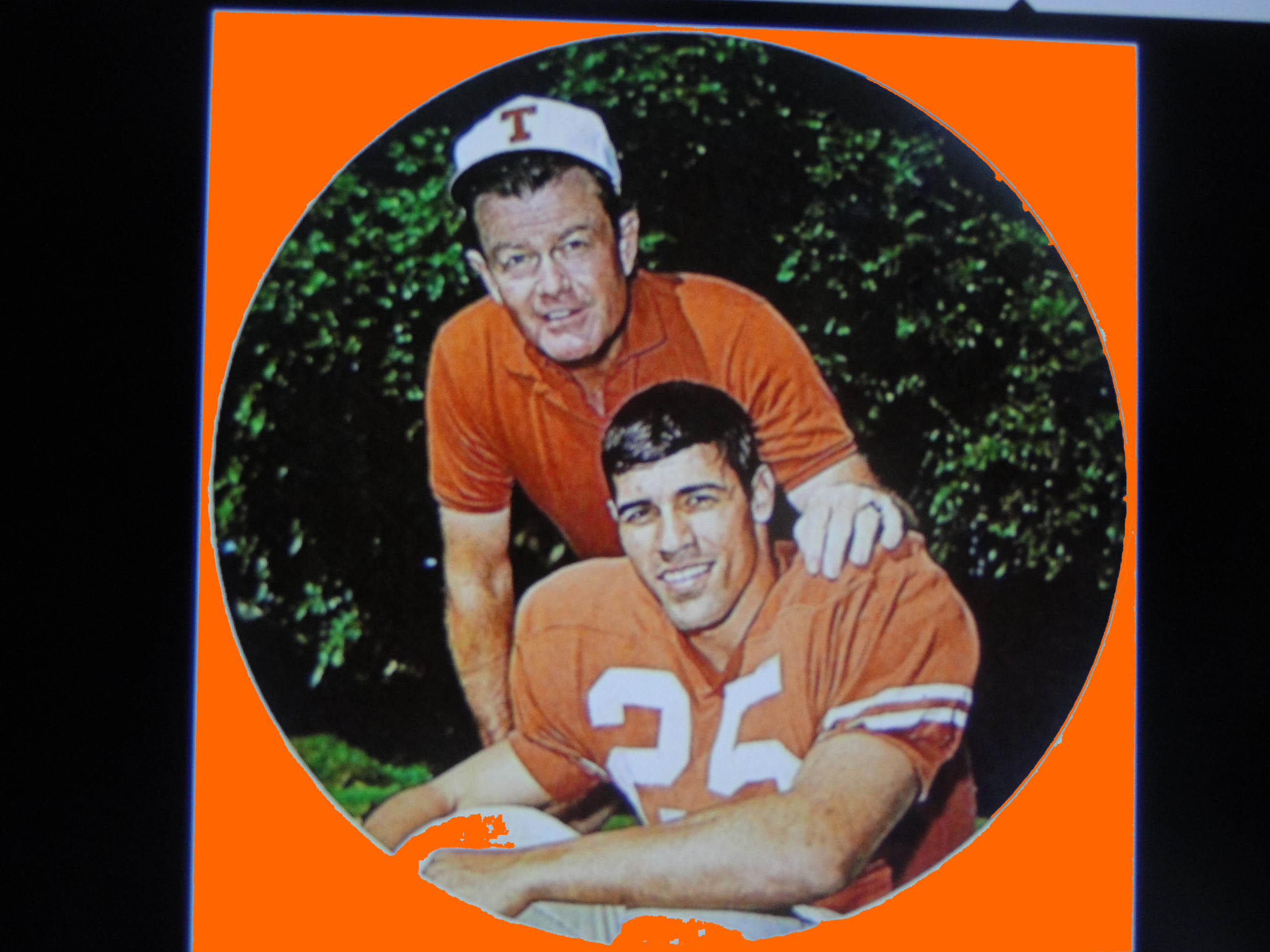
UT Star Running Back Chris Gilbet and Coach Darrell Royal, 1968.

UT Star Running Back Chris Gilbet and Coach Darrell Royal, 1968.

Way back on Saturday night, September 21, 1968, at Memorial Stadium in Austin, a titanic challenge battle took place between the visiting University of Houston Cougars of Coach Bill Yeoman and the home town Texas Longhorns of Coach Darrell Royal. It was the UH Veer offense versus the UT Wishbone in college football for the first time with a lot riding on the outcome. As per usual, UH had everything to gain, but not much to lose but the opportunity from a defeat. For UT, however, it was their often served sip of not much to gain from victory, but everything to lose from defeat. Every fan from UH or UT at the stadium that night had a lot riding emotionally on that outcome. And your humble reporter from The Pecan Park Eagle was there among those Cougar fans who had driven over from Houston as a UH alum – and seven years before I also added my UT degree. I was totally partisan for UH and still am today. Can’t help it. It’s in my blood.

What nobody counted on was what happened. – The game ended in a 20-20 tie and, as was the rule back then, there was no protocol for an overtime playoff to sudden victory for one team over the other. Everybody just had to go home with that not-so-great “kissing your sister” sensation that Bear Bryant used to ascribe to feelings generated by games that end in ties.

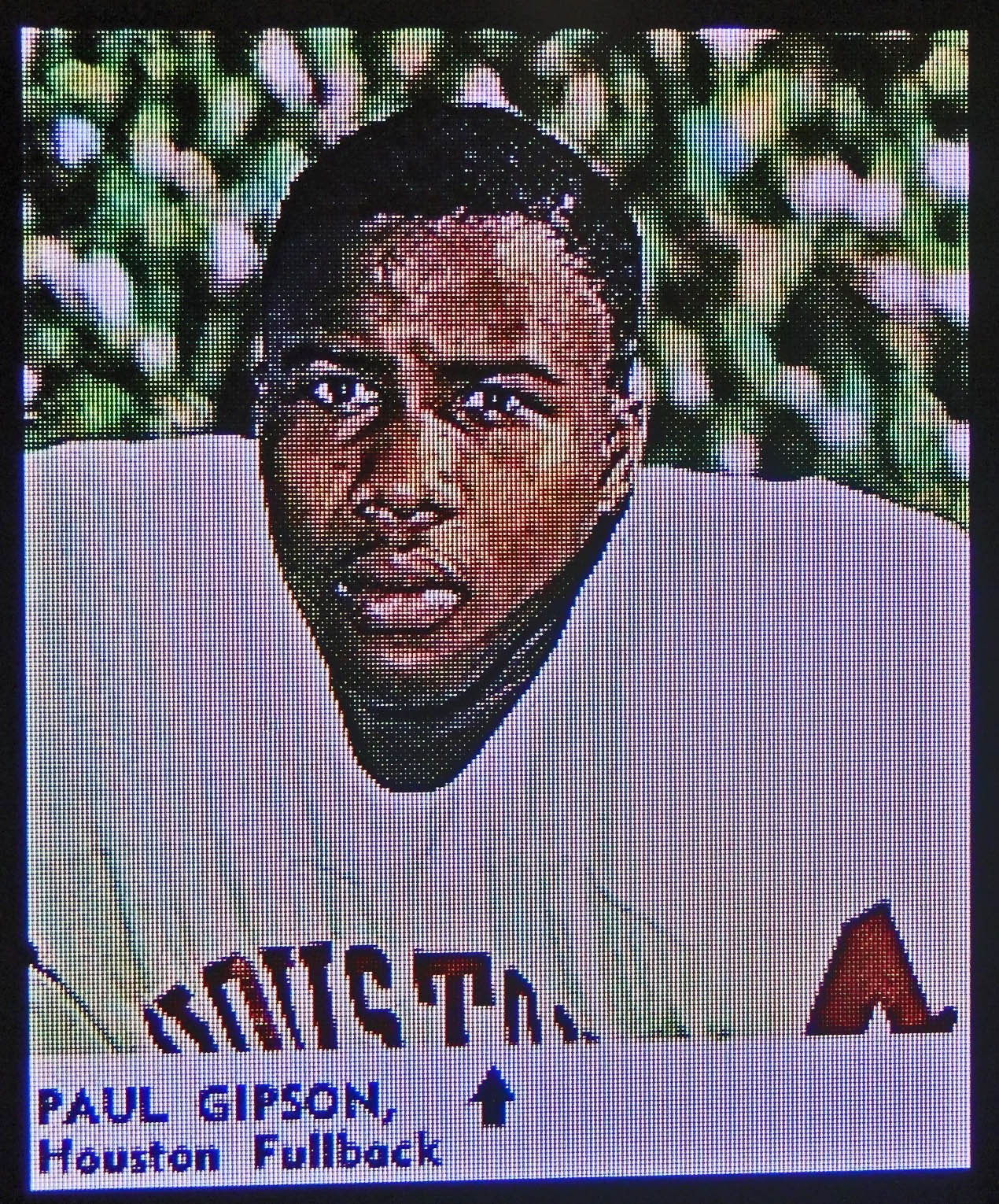
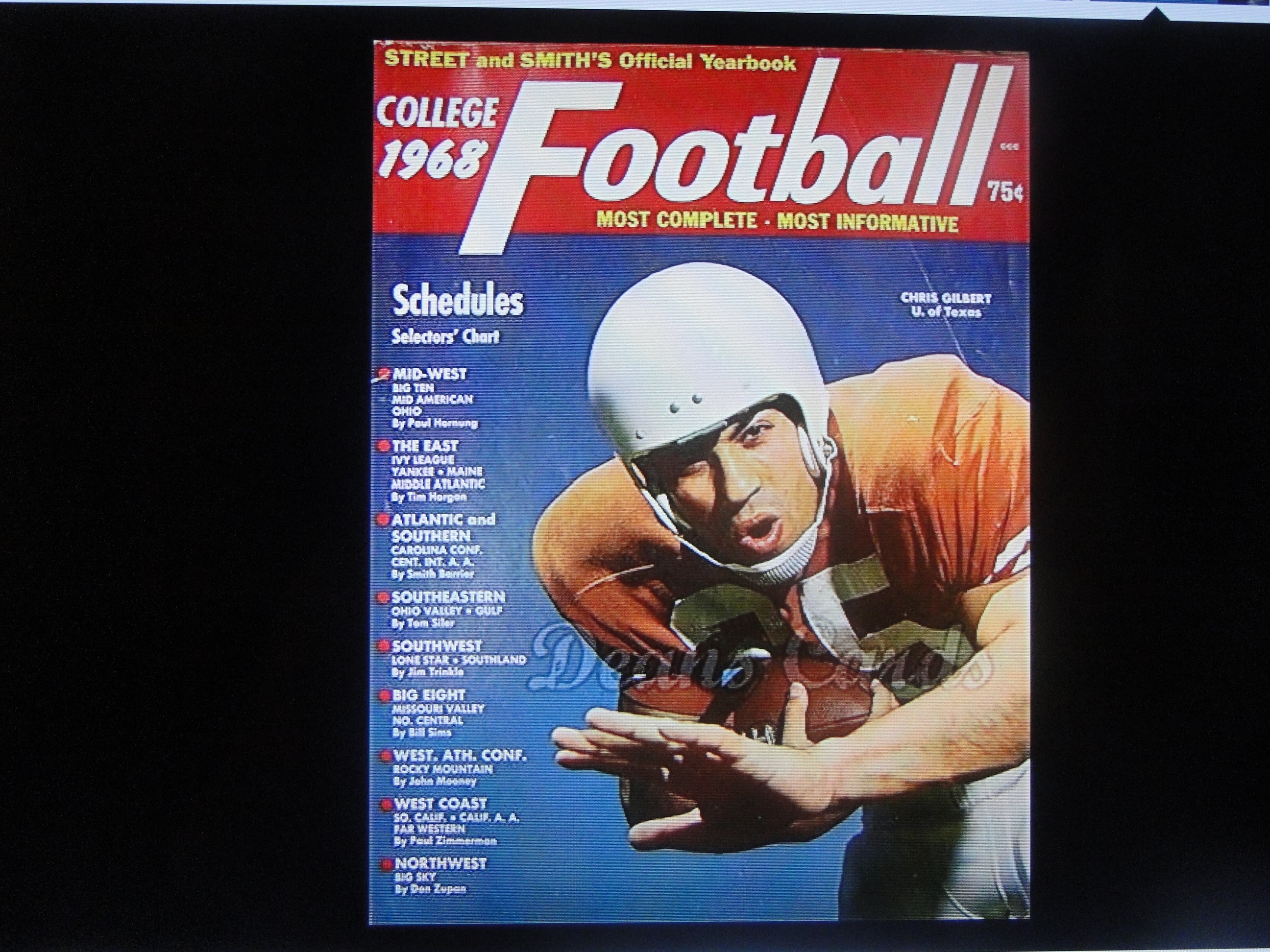
Tie outcome aside, the game had been a mighty showcase battle between two great running backs from UH and UT. Senior fullback Paul Gipson of Jacksonville, Texas and UT Senior halfback Chris Gilbert of Spring Branch High School in Houston both lived up to their advance game billing.

Chris Gilbert had finesse and speed. - Paul Gipson had power and speed.

Chris Gilbert had finesse and speed. – Paul Gipson had power and speed.

Here’s how Associated Press sports writer Murray Chass described the star running back face-off a couple of days later:

******************************************************************************************

Texas U. Star Runs for 195 Yards

SIMPSON, GILBERT, GIPSON PRAISED

By MURRAY CHASS, Associated Press Sports Writer

O.J. Simpson of Southern California was a first team All-American halfback last year. Chris Gilbert of Texas and Paul Gipson of Houston only made the second team.

On college football’s first big Saturday, Simpson scored four touchdowns and rambled for 236 yards on 39 carries as second-ranked Southern California defeated Minnesota, 29-20.

O.J., however, did not overshadow the play of Gilbert and Gipson in what some people called the championship game of the Southwest. Both had a lot to do with the 20-20 tie that resulted from the clash between the nation’s Number 4 team, Texas and the Number 11 team, Houston.

Star Performances

Chris Gilbert lived up to his pre-season tout on the night of 9/21/1968.

Chris Gilbert lived up to his pre-season tout on the night of 9/21/1968.

Gilbert ran for 195 yards on 21 carries; Gipson gained 173 yards on 28 tries. Simpson’s average was six yards per carry, the same as Gipson’s. Gilbert finished with a nine-yard average.

Included in Gilbert’s gains were touchdown runs of 57 and 8 yards. Gipson scored all three of Houston’s touchdowns on runs of one, 66, and 5 yards.

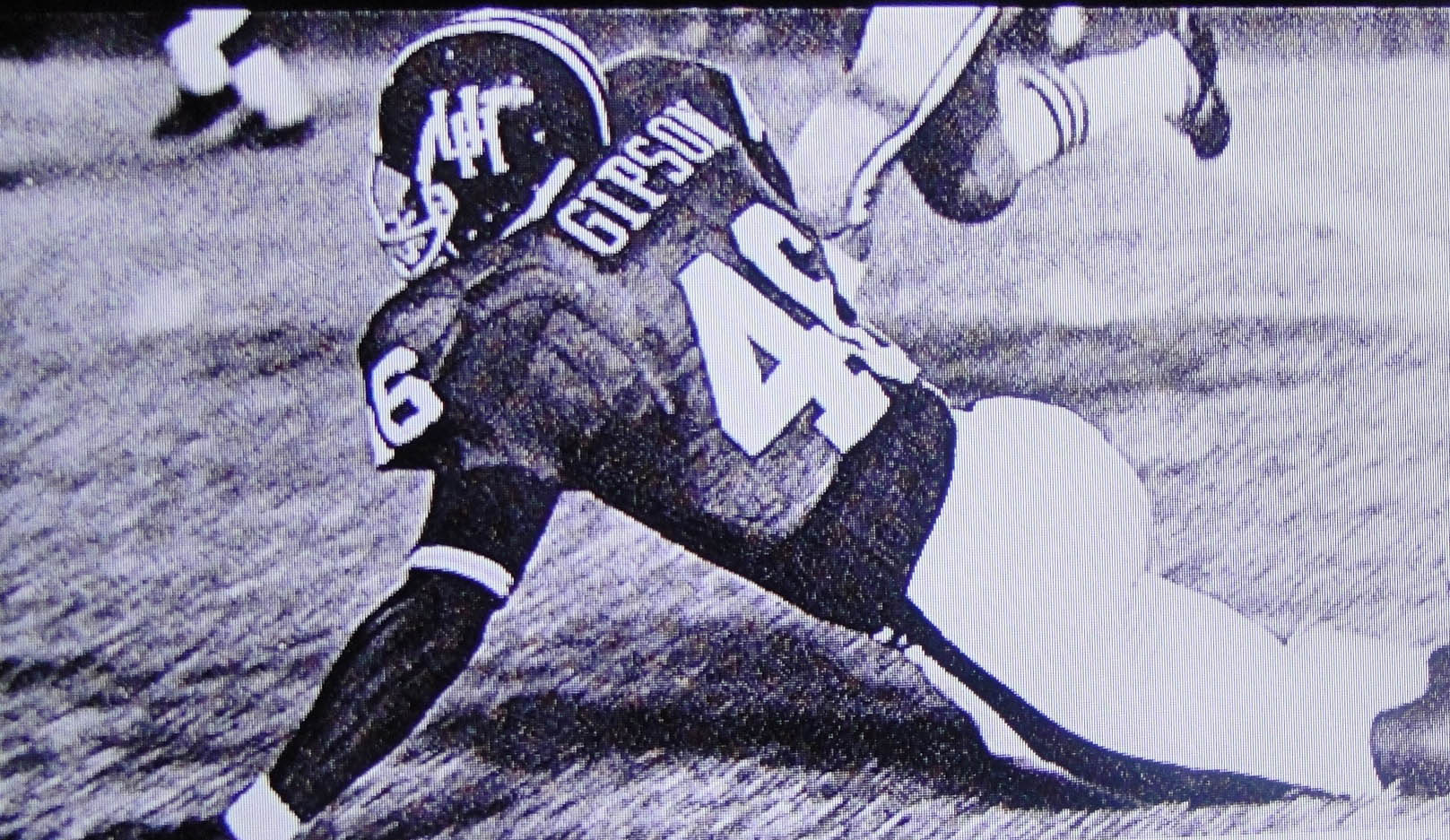
Paul Gipson above, going down hard in an earlier UH win over Florida State. - In the UT game, did Paul Gipson lose the call on his late game goal line run and dive that would've given UH the win? AS ONE WHO SAT DIRECTLY ON THAT LINE, I WILL FOREVER SWEAR THAT I SAW HIS HEAD, ARMS, AND THE BALL ALL BREAK THE PLANE BEFORE UT PUSHED HIM BACK FOR AN OFFICIAL "STOP".

Paul Gipson, above, going down hard in an earlier UH win over Florida State. – In the UT game, did Paul Gipson lose the call on his late game goal line run and dive that would’ve given UH the win? As one who sat directly on that goal line from the lower stands, I will swear forever that I saw Paul’s head, shoulders and the ball break the TD plane before UT pushed him back for an official “stop”. But that’s just how things go sometimes.

There was one time (late in the 4th quarter), however, when Texas stopped Gipson (at the goal plane) and that (“stop”) meant the difference between a tie and a Houston victory. The Cougars had the ball at the Texas two with a fourth down and the Longhorns stopped Gipson at the (goal) line.

~ excerpt from the Murray Chass article, as it appeared in the Lubbock (TX) Avalanche Journal, Monday, September 23, 1968, Page 47

******************************************************************************************

When we asked the referee after the game about how many inches Gipson had missed on his dramatic 44th quarter failed TD dive for a UH victory, the ref just flashed us the above hand signal to denote the difference maker.

When we asked the referee after the game about how many inches Gipson had missed on his dramatic 4th quarter failed TD dive for a UH victory, the ref just flashed us the above hand signal to denote the failed distance.

April 15, 1968: Astros 1 – Mets 0 (24 Innings)

October 3, 2013
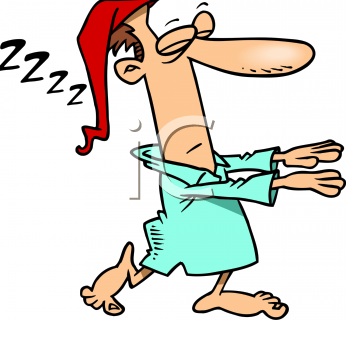
Astros baserunner  4/13/1968:Astros runner Norm Miller sleepwalked home in the bottom of the 24th on a Mets muff  in the field to give Houston a record 1-0 longest night game in history win over New York.

4/15/1968: Astros runner Norm Miller sleepwalked home in the bottom of the 24th inning on a Mets muff in the field to give Houston a record 1-0 “longest night game in history” win over New York.

Once Upon a Time, the 1968 Houston Astros preferred to get all their sleepwalking done in one game rather than spread it out over the whole year like the 2013 Astros club has done.

The time and place was Monday, April 15, 1968 as the Houston Astros entertained the New York Mets in a night game at the Astrodome.

And what a night it would be. The Mets and Astros would post nothing but goose eggs for 21.5 innings before the homies finally pushed across the only crooked run number in the game, with a little help from a somnolent New York defense in the wee small hours of the next day. Here’s how the Associated Press wrote up that historic marathon:

***********************************************************************************

Astros Win Longest Night Game Ever, 1-0

Aspro’s Grounder, Weiss’ Error Ends in Astro Win

Win Keeps Astros on Top in NL

HOUSTON (AP) – The Judge was ready for bed, a coach had only one chew of tobacco left and the bats weighed more than the trees from which they were hewed.

It was at this critical point in the 24th inning that Houston’s Bob Aspromonte stroked one of Les Rohr’s pitches toward Al Weiss near second base and the New York Mets’ shortstop muffed to let in the only run in the Astros 1-0 win earlier today.

The error ended the longest night game in major league history and cut short by two innings of equalling the longest baseball game ever played.

Fired Aspro

“The bat felt like eight and a half pounds,” Aspromonte said. “That was the longest week I ever played I’ve just won three of five ball games for this club, do you realize that?”

The victory was the fifth in six games for the National League leaders since the season started last Wednesday.

About 3,000 persons of a game opening crowd of 24,219 was still around in the huge Astrodome when the finish came.

One of those was Judge Roy Hofheinz, president of the Astros.

When the home half of the 22nd inning started, the $2 million dollar scoreboard flashed: “The Judge says he’s ready to go to bed. …  Let’s score a run.”

Miller Singles.

Two innings later (24th) Norm Miller led off with a single and advance to second on a balk. Rohr, the eighth Mets pitcher, gave Jim Wynn and intentional pass. Rusty Staub was thrown out, the runners advancing. The John Bateman was intentionally walked to fill the bases.

At that point Aspromonte hit the grounder that Weiss bobbled.

“No it didn’t take a bad hop,” Weiss said. “I just blew it. It went right between my legs,”

The longest night game previously played was Washington’s 22 inning 6-5 victory over Chicago on June 12, 1967. The longest National League night game was played September 1, 1967 when San Francisco defeated Cincinnati 1-0 in 21 innings.

The Astros-Mets game also broke the record time consumed for a National League night game, requiring six hours and six minutes to complete.

3 Packages

“That was a three-package of tobacco game,” said Astros coach Buddy Hancken, “and I just got one chew left.”

Staub said: “After about the 17th inning, everything got funny.”

The longest game in innings ever played took seven hours and twenty-three minutes when the Giants beat the Mets 8-6 on May 31, 1967.

The 24-inning affair overshadowed two-hit pitching by the Mets’ Tom Seaver, who retired 22 in a row at one stretch in his 10-inning stint.

“My arm was still lively in the 10th, but there was no use in straining it,” Seaver said. “That’s the longest game I ever played in. I’m sorry we had to lose it.”

Don WIlson, first of five Astros pitchers scattered five singles before leaving in the ninth.

The eight New York pitchers fell one short of the record number ever used in a game.

Both teams got eleven hits. The victory went to Wade Blasingame.

~ The Port Arthur News, Tuesday, April 16, 1968, Page 14.

Baseball Almanac Box ScoresNew York Mets 0, Houston Astros 1
Game played on Monday, April 15, 1968 at Astrodome
New York Mets ab   r   h rbi
Weis ss 9 0 1 0
Boswell 2b 10 0 1 0
Agee cf 10 0 0 0
Swoboda rf 10 0 0 0
Shamsky lf 4 0 2 0
  Jones pr,lf 6 0 1 0
Kranepool 1b 8 0 2 0
Buchek 3b 2 0 0 0
  Charles 3b 6 0 1 0
Grote c 7 0 2 0
Seaver p 3 0 1 0
  Taylor p 0 0 0 0
  Linz ph 1 0 0 0
  Koonce p 0 0 0 0
  Short p 0 0 0 0
  Selma p 0 0 0 0
  Bosch ph 1 0 0 0
  Jackson p 0 0 0 0
  Harrelson ph 1 0 0 0
  Frisella p 1 0 0 0
  Cardwell ph 0 0 0 0
  Rohr p 0 0 0 0
Totals 79 0 11 0
Houston Astros ab   r   h rbi
Davis cf 10 0 1 0
Miller rf 8 1 1 0
Wynn lf 8 0 1 0
Staub 1b 9 0 2 0
King c 9 0 1 0
  Bateman ph 0 0 0 0
Aspromonte 3b 9 0 0 1
Gotay 2b 9 0 2 0
Torres ss 8 0 3 0
Wilson p 2 0 0 0
  Thomas ph 1 0 0 0
  Buzhardt p 0 0 0 0
  Rader ph 1 0 0 0
  Coombs p 0 0 0 0
  Murrell ph 1 0 0 0
  Ray p 2 0 0 0
  Blasingame p 2 0 0 0
Totals 79 1 11 1
New York 0 0 0 0 0 0 0 0 0 0 0 0 0 0 0 0 0 0 0 0 0 0 0 0 0 11 1
Houston 0 0 0 0 0 0 0 0 0 0 0 0 0 0 0 0 0 0 0 0 0 0 0 1 1 11 1
  New York Mets IP H R ER BB SO
Seaver 10.0 2 0 0 0 3
  Taylor 1.0 1 0 0 0 1
  Koonce 0.1 1 0 0 0 0
  Short 1.0 1 0 0 2 1
  Selma 0.2 0 0 0 0 0
  Jackson 3.0 1 0 0 0 4
  Frisella 5.0 4 0 0 1 4
  Rohr  L (0-1) 2.1 1 1 1 4 2
Totals
23.1
11
1
1
7
15
  Houston Astros IP H R ER BB SO
Wilson 9.0 5 0 0 3 5
  Buzhardt 2.0 0 0 0 0 1
  Coombs 2.0 3 0 0 0 2
  Ray 7.0 2 0 0 1 11
  Blasingame  W (1-0) 4.0 1 0 0 1 1
Totals
24.0
11
0
0
5
20

E–Weis (1), Wilson (1).  DP–New York 1, Houston 1.  2B–New York Charles (1,off Ray), Houston King (1,off Seaver).  SH–Buchek (1,off Wilson); Grote (1,off Ray); Kranepool (2,off Ray); Cardwell (1,off Blasingame); Miller (1,off Koonce).  IBB–Grote (2,by Wilson); Charles (1,by Ray); Wynn 2 (2,by Short,by Rohr); Aspromonte (3,by Rohr); Bateman (1,by Rohr).  Team LOB–16.  Team–16.  SB–Charles (2,2nd base off Ray/King); Jones (1,3rd base off Ray/King).  CS–Gotay (1,2nd base by Frisella/Grote); Miller (1,2nd base by Frisella/Grote).  WP–Seaver (1), Rohr (1), Wilson (2).  BK–Rohr (1).  IBB–Short (1,Wynn); Rohr 3 (3,Aspromonte,Wynn,Bateman); Wilson (1,Grote); Ray (1,Charles).  U-HP–Ed Sudol, 1B–Lee Weyer, 2B–Bill Williams, 3B–Tom Gorman.  T–6:06.  A–14,219.

Game played on Monday, April 15, 1968 at Astrodome
Baseball Almanac Box Score | Printer Friendly Box Scores

***************************************************************

Thomson’s Shot: How It Played in “Peoria”

October 2, 2013

The MLB playoff season never fails to remind me of Bobby Thomson’s “Shot Heard ‘Round the World” from the Polo Grounds on October 3, 1951. As the baseball world now long remembers, Thomson’s three-run homer in the bottom of the ninth that day gave the destiny-driven  New York Giants a 5-4 comeback victory over their hated rival club, the Brooklyn Dodgers, a team they had trailed by 13.5 games in August, propelling Leo Durocher’s boys immediately into the World Series they would then lose to the New York Yankees, but not before carving themselves into baseball history as, perhaps, the games greatest iconic legend.

We also well know how Giants radio broadcaster Russ Hodges called the Thomson moment and himself into mythology with his “The Giants Win The Pennant” exclamations times six or seven recitations, but less is known of how that action played out in all the Peorias of this country’s hinterlands the following day. Here’s how the Ironwood (Michigan) Daily Globe handled this major quake in baseball history on October 4, 1951:

**************************************************************************

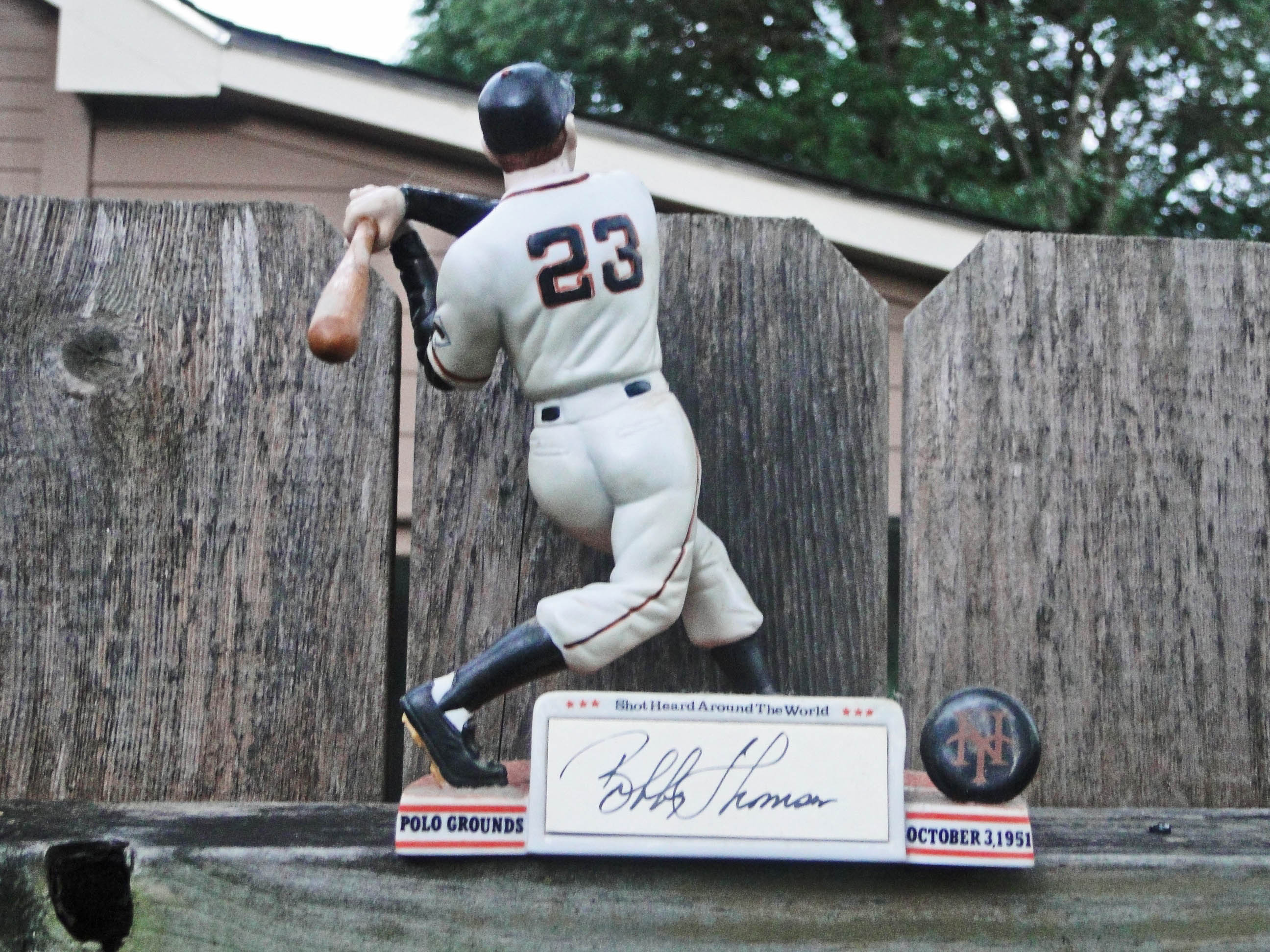
"THE GIANTS WIN THE PENNANT! ~ THE GIANTS WIN THE PENNANT! ~ THE GIANTS WIN THE PENNANT! ~ THE GIANTS WIN THE PENNANT! ~ THE GIANTS WIN THE PENNANT! ~ THE GIANTS WIN THE PENNANT! ~ THE GIANTS WIN THE PENNANT! ~ THE GIANTS WIN THE PENNANT! ~ THE GIANTS WIN THE PENNANT! ~ THE GIANTS WIN THE PENNANT! ~ THE GIANTS WIN THE PENNANT! ~ THE GIANTS WIN THE PENNANT! ~ THE GIANTS WIN THE PENNANT - THE GIANTS WIN THE PENNANT! ~ THE GIANTS WIN THE PENNANT!" ~ Russ Hodges.

“THE GIANTS WIN THE PENNANT! ~ THE GIANTS WIN THE PENNANT! ~ THE GIANTS WIN THE PENNANT! ~ THE GIANTS WIN THE PENNANT! ~ THE GIANTS WIN THE PENNANT! ~ THE GIANTS WIN THE PENNANT! ~ THE GIANTS WIN THE PENNANT!” ~ Russ Hodges. (Model in Storage with a Private Protective Service.)

Giant Miracle Men Win National Flag

Thomson Homer Climaxes Drive of Durocher Club

By Jack Hand

New York -(AP)- The Incredible New York Giants Miracle Men of ’51 charge into the World Series today in the familiar but becoming role of 8 to 5 underdogs to the seasoned New York Yankees.

Floating on a pink cloud all their own after the greatest comeback in baseball history, the Giants were to face the stern reality of Allie (double no-hit) Reynolds (17-8) in the Yankee Stadium (World Series) opener at 12 noon, CST.

To meet this challenge of the well-fed Yanks, accustomed to World Series hullabaloo, Manager Leo Durocher has named Dave Koslo (10-9), a journeyman southpaw who hasn’t started in two weeks. It’s another amble by take-a-chance Leo in a series of inspired managerial moves.

SOUTHPAW JINX?

Noting that left-handers gave the Yanks fits all season – and Yogi Berra in particular – Leo reached for the only lefty starter available on his arm-weary staff. Koslo spends at least half his time in the bullpen, except when his “cousins” from St. Louis are in town.

No matter what Leo does, the Yanks who watched the Giants clinch yesterday’s dramatic 5-4 clincher from Brooklyn will not take his club lightly. The records show the Giants often are down – but never out.

Bobby Thomson’s three-run homer into the lower left field seats in the ninth inning was one of the most dramatic blows ever struck. It rescued the Giants from the brink of disaster and wrenched a pennant from the grip of the desperate Dodgers. In dollars and cents it probably meant about $200,000 to the winning athletes in World Series money.

MISERABLE START

To appreciate the full drama of the occasion, you must know the background. How the Giants flopped in a miserable 11-game losing streak in April. How they were given up for dead August 11, trailing the Brooklyn master race by 13 1/2 games. How they clawed back, game by game, until they tied Brooklyn and forced the second National League playoff (in history).

Winning the first playoff game, 3-1, losing the second, 10-0, they were backed up against the wall in the (bottom of) the ninth inning of the final game.

After pulling up to tie in the seventh (1-1), they saw their hard work go down the drain in the eighth when Sal Maglie wild-pitched one run home (1-2) and the Dodgers hammered home two more with their bats (1-4).

DARK STARTS RALLY

Trailing 4-1 n the ninth with big Don Newcombe firing a four-hitter, Al Dark stirred a faint hope with a single off Gil Hodges’ glove. When Don Mueller singled, the Polo Grounds settlement of 34,320 began to stir. But Monte Irvin fouled to Hodges for out No. 1.

Whitey Lockman set the joint jumping with a double off the left field wall to score Dark, narrowing the gap to 4-2. Sliding into third on the hit, Mueller twisted his ankle and was carried from the field. On the way he (Mueller) passed Ralph Branca, striding in to replace the weary Newcombe.

(Clint Hartung replaced Mueller as the runner at third. Bobby Thomson was now the batter for the Giants. Ralph Branca was now pitching for Brooklyn. Willie Mays was in the on-deck circle with one out. The Dodgers still led by 4-2.)

Thomson, the goat on some (earlier) bonehead base running and inadequate fielding, looked at a called strike. The next pitch was a high fastball and the Scot from Staten Island slammed a sinking liner that just cleared the high green wall in front of the lower left field seats. (Giants won, 5-4.)

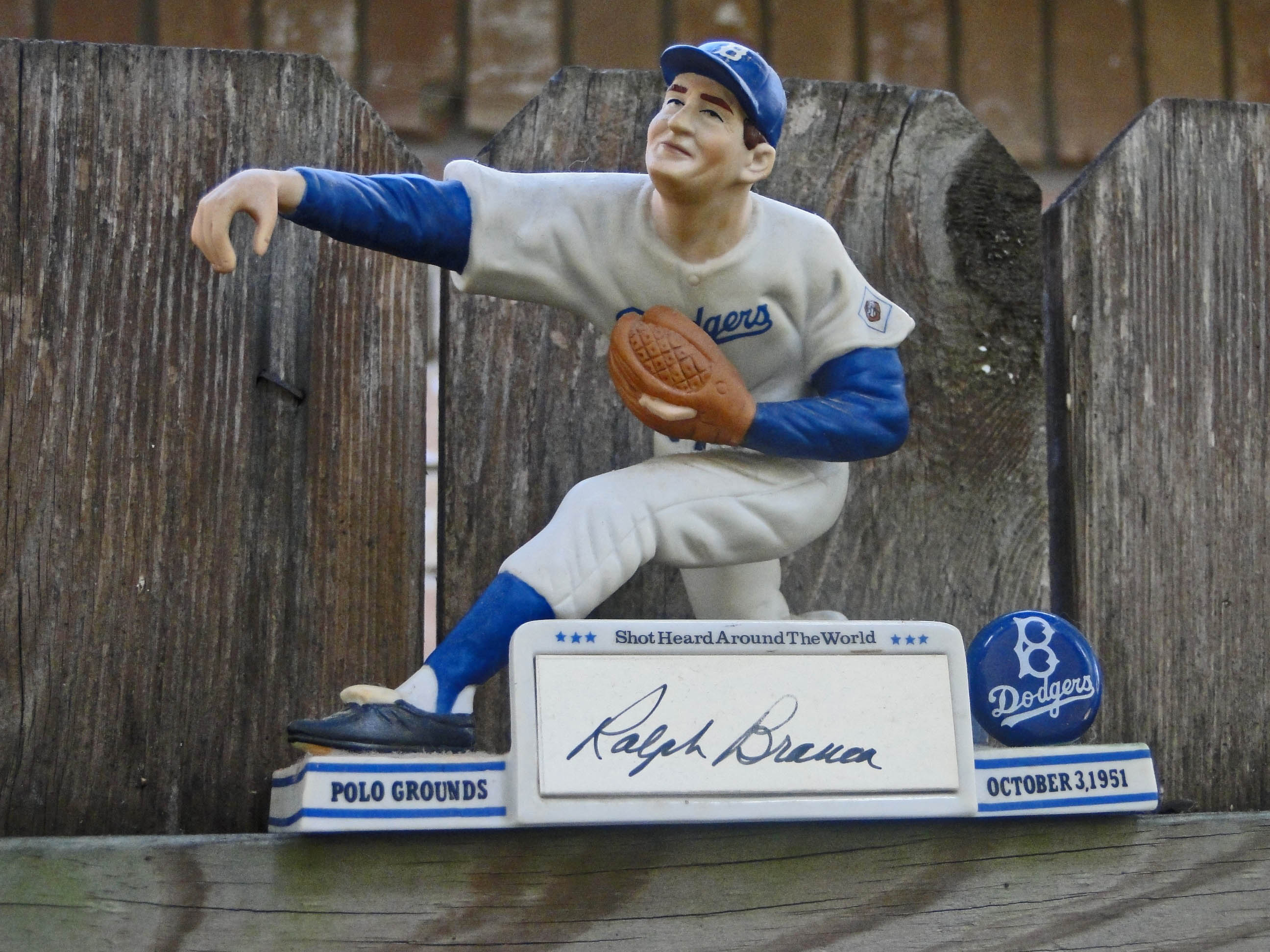
Ralph Branca, the guy who threw the most famous HR ball in baseball history.

Ralph Branca, the guy who threw the most famous HR ball in baseball history.
(Model in Storage with a Private Protective Service)

WILD VICTORY

A hoarse roar echoed off Coogan’s Bluff as Thomson rounded the bases with a wide grin. Wild-eyed Giants pounded his back and climbed on his shoulders as they loosened the pent up emotion of weeks of back-bending strain.

The old Polo Grounds which saw the great John McGraw’s teams of years ago never saw any wilder victory celebration than it did yesterday afternoon. Thousands grouped on the center-field grass and raised volleys of cheers toward the clubhouse windows.

They yelled for Thomson. They yelled for Durocher. They yelled for anybody. It didn’t make any difference. No pennant had flown from the Polo Grounds flagpole since 1937 and they were making the most of it.

~ excerpt from an (AP) article by Jack Hand, as it appeared in the October 4, 1951 edition of the Ironwood (Michigan) Daily Globe.

******************************************************************************