Archive for 2013

Remembering Sin Alley

March 9, 2013
"Sin City? Ah Yes! I remember it well!"

“Sin City? Ah Yes! I remember it well!”

Looking back to what it really was for Houston in the 1960’s, it really wasn’t such a big deal on the sin scale, unless you were a member of that fundamentalist group of world viewers who saw everything that led to dirty dancing (and all good dancing was dirty) as an act of immorality.

It was, on the other hand, the start of social change that was going to pound the beaches of American culture into a new shape for all times over the next half century. As a member of that coming of age Houston generation in the 1960’s that did not marry their high school sweethearts after graduation, or at all, I can only comment on what it was that made it easier for some older people from those days to write the time off as an era of sliding moral turpitude.

In Houston, we had a physical place back then that came to characterize the zeitgeist of the 1960’s as we crashed as an American culture into the Janis Joplin and Bob Dylan music driven, LSD-fed San Francisco Summer of Love in 1967. In Houston, the place where many young singles lived and partied was on a stretch of Mid Lane that descended south from Westheimer Road, inside Loop 610. It ran only a few blocks south of Westheimer, or all the way down Mid Lane to Richmond Avenue, depending on your personal experience.

We called it “Sin Alley,” but it bore little resemblance to the new drug-based, free love, hippie culture of the Haight-Asbury area in San Francisco that spawned out there in the summer of 1967. By 1969, that local legacy of the Haight had taken route in the Montrose area. Sin Alley was more for the mainstream middle class as a place for trying out new social roles and ways of life that didn’t involve going straight from one’s childhood homes and head-first into the land of anointed marriage and the land of happily ever after.

It was a different time. Back then, two young people of the same-sex could live together in a social apartment building and others would not automatically assume or suspect that the two roommates were homosexual. If a guy lived with two girls, on the other hand, he might sometimes be forced to convince the landlord that he was gay, just to allay their fears of unmarried sex taking place under the owner’s roof.

Got the picture on “Sin Alley” now folks? Yeah, there were some wild parties, heavy on alcohol consumption and with an increasing availability of cannabis and amphetamines as the decade rolled into the 1970s, but the heavier drugs of heroin, cocaine, and LSD were much more centered by supply and demand in the Montrose.

Sin City was a place where Houston’s new middle class of the 1960’s and early to mid-1970’s experimented with pre-marital sexual relations and first time love partnerships with people from other religions, and differing ethnic and racial backgrounds. Bi-racial dating was the hardest obstacle to overcome at that time, especially between whites and blacks. It’s embarrassing to remember too, but a number of Houston businesses, restaurants, clubs, and movie houses still segregated against the admission of blacks at that time.

I met my first Jewish girl friend in Sin City. What a neat woman she turned out to be, a tall beautiful brunette with an incredible brain. Alas! She finally moved to Israel and joined the Israeli Army. I never heard from her again, but I was still all the richer for having known her a short while back in my salad days.

Remembering Gail makes me appreciate the memory of Sin City all the more. In a very real way, Sin City was our Sim City. It gave us a place to connect experientially with people who were different from us by race, religion, and sociology. Some of those relationships lasted forever; others didn’t. What lasted for all time was the way each of us was changed because these relationships and experiences had a place to unfold.

Like the old song says: “If that’s a sin, then I’m guilty.”
A Big Idea May Be Coming Home to Roost

March 8, 2013
Astros Owner Jim Crane Thinking About Moving the Club's AAA Affiliate to the Woodlands Area.

Astros Owner Jim Crane Thinking About Moving the Club’s AAA Affiliate to the Woodlands Area.

Back on April 26, 2012, in an article I wrote about the new Sugar Land Skeeters, my mind moved quickly to the bigger possibility down the road that one day the Astros might be ready to entertain the idea of operating a AAA franchise in Sugar Land and a AA club in the general Woodlands area – or vice versa, by implication. The big plan would be to have the MLB Astros’ two highest minor league clubs located in the Metro area for the sake of killing two birds with one stone: (1) to make it easier and cheaper to option players back and forth between the MLB club and its two largest minor league affiliates; and (2) to give Houston fans and talent scouts a good shot look most of the time at upcoming talent.

Here’s a link to that 2012 column and what I actually wrote back then:

https://thepecanparkeagle.wordpress.com/2012/04/26/skeeters-buzzing-think-big-why-not/

It’s funny how ideas grow, isn’t it? Today there is an article out on the Internet that suggests that Mr. Jim Crane is also now thinking that it might be a good thing to relocate Houston’s AAA farm club to a new site just north of the Woodlands area.

http://blog.chron.com/ultimateastros/2013/03/07/astros-could-move-class-aaa-minor-league-franchise-to-woodlands-area-owner-jim-crane-says/

That would be a good start, Mr. Crane. Then we could let the Rangers take over Corpus Christi, which Nolan Ryan’s family owns, anyway, and work something out with the Sugar Land people to take over a new Texas League AA franchise spot.

The Woodlands (AAA) and Sugar Land (AA) would control two discrete population markets in the Metro Houston area, yet, both would be easily available to fans of these mostly future Astros. Add to it the fact that affiliation with the Astros would make the Sugar Land Skeeters and whatever they shall end up calling the Woodlands area team a lot more interesting to the average fan.

Words on paper. Sometimes they are the stuff that dreams are made of.

Goodbye, Foley’s, Goodbye!

March 7, 2013
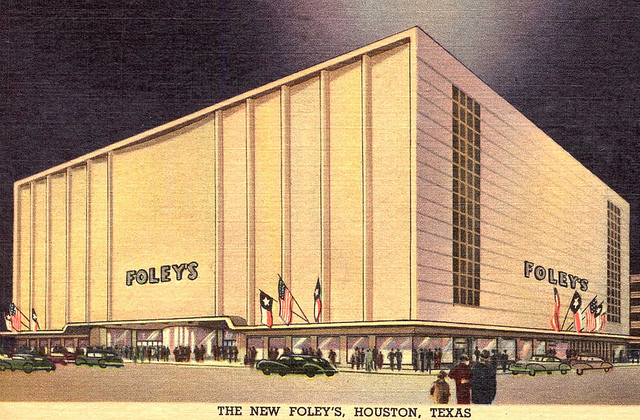
Foley's opened their new 10-story site at Main and Lamar in Houston in 1947.

Foley’s opened their new 10-story site at Main and Lamar in Houston in 1947.

Forget the fact that the roomy ten-story departments store at Main and Lamar in downtown Houston has been Macy’s for several years now, it will always be Foley’s to those of us who grew up with the Foley’s name as the hub of local retail sales on everything from clothing to appliances. Operating in Houston from the early 1900s forward, Foley’s relocated from a smaller nearby location to their locally famous flagship downtown site in 1947, about nine years prior to the opening of the city’s first suburban mall at Gulfgate off the Gulf Freeway in 1956.

This coming Saturday, 03/09/13, the downtown “Macy’s” store opens its doors for the last time. Sometime, thereafter, the ten-story building will be demolished to make room for something else in one of the only time-honored traditions of the Houston developers’ mentality. This time, there don’t seem to be as many tears over demolition. The building worked great as Foley’s and Macy’s, but who else now needs a ten-story building with no windows beyond the first floor?

The place was also built with central AC, but no heating system. Heat was supposed to be supplied by the body warmth of a constantly heavy flow of retail customers. The place drops to crypt-level comfort on the temperature side with no one in the place on cold days.

You really had to be here in Houston prior to the development of our freeway system and the new suburban shopping malls at Gulfgate, Sharpstown, Northline, The Galleria, Northwest, Willowbrook, Greenspoint, and Almeda to get what the new 1957 downtown Foley’s store meant to local shoppers. It was the center of everything else and, like everything that had anything to do with serious shopping, almost everything was located downtown. Even kids hopped on busses to go shopping downtown back in those days.

Here’s a link to another article from today about the downtown store closing that should be able to also connect you to a two-part KUHF-FM spotlight clip on the old place’s history and upcoming last days.

http://app1.kuhf.org/articles/1362587475-Touring-Macy’s-Foley’s-in-Downtown-Houston-One-Last-Time.html

My favorite Foley’s shopping experience story started in the summer of 1952 and stretched into the fall of the same year. As an incoming freshman at St. Thomas High School, I had ordered a red and white athletic jacket because I simply could wait to show my new school colors. Foley’s promised me that it would arrive in time for the first cool weather.

It didn’t.

By mid- October, I was still waiting, with all that was left of my little summer job money tied up at Foley’s, and nothing to show for it. I’d stop by Foley’s everyday after school to see if it had arrived, only to hear again the dreaded “not here yet” three words from the clerk at “will call.”

One day, I finally just exploded in a burst of immature excitement over the importance of my order and buying power to the Foley’s marketing plan.

“I’ve had enough,” I told the clerk at Foley’s. “If you can’t get my jacket here by the end of the week, I’m going to cancel my order and do everything I can from there to put Foley’s out of business by not buying anything else from this store for as long as I shall live.”

“Do what you have to do, young man,” said the smiling Foley’s lady.

I didn’t have to do anything. The next day the jacket came in. I guess I showed them.

Right?

Anyway, Saturday’s our last chance to personally check out another disappearing Houston landmark.

Statesmen, No; Fodder of the Funny Men, Yes!

March 6, 2013
Open Comedy Season on US Presidents may have started with LBJ, but it kicked into high gear with Richard Nixon.

Open Comedy Season on US Presidents may have started with LBJ, but it kicked into high gear with Richard Nixon.

Today’s late night “comedic” television hosts depend upon scandal, impropriety, criminality, stupidity, and licentiousness in the presidency for their daily joke grind. Sadly enough, the net result of this hunger for jokes about our perceived leader deficiencies have turned the late night shows into the only places where millions of Americans will make their choices for president in the next election.

Maybe, that’s OK. The more we move deeper into becoming a culture of people who depend upon Twitter over reading as our medium for communicating facts and ideas, well, maybe that’s all we deserve. Let’s everybody just base our votes upon what we got out of the material we heard on Letterman, Leno, and Kimmel. Maybe we’re just starting to get exactly what we deserve: Some clown, Democrat or Republican, male or female, white majority or ethnic minority, conservative or liberal, whomever/whatever – that all share one thing. – They each exit office with their own pockets full, a lifetime system of support and protection looking after them, a new library for all the books and records about them that no one is ever going to really study and read, and with a red sail into the sunset of happily ever after sealed by a reservation card that is left at the White House door on their way out for some relative by blood or marriage to take a leg up run at the same office in the near future.

We’ve had scandals and jokes about the presidency forever, but never anything so engulfing as the job done on pols today by the principal exposure media of television and the Internet. It’s just too bad that it doesn’t seem to be shining anyone toward dealing with the fact that all politicians seem to prefer to avoid serious action on taxation and spending, education and opportunity for all, immigration and border control, balancing the budget versus increasing the national debt, and entitlement versus equal opportunity.

We can build incredible bureaucracies with enough people there to write 13,000 word reports on each difficult subject the government does cover, but that doesn’t mean anyone, including the President or the Congress that approves these actions, is going to actually read what’s in the reports that portend to explain everything about what’s contained in a new law or piece of legislated social action. That job is going to still fall to the same phone bureaucrats whom you can’t reach in human form when you have to call to find out why you cannot, on Medicare, for example, sometimes continue to see a doctor who once saved your life for important treatment of a new problem.

Maybe it’s best that we can laugh prior to sleep. Otherwise, we might have to drown in our own tears.

Have a great Wednesday, everybody. I’ll feel more optimistic tomorrow – just as soon as I can get my “wall of denial” about really serious stuff back to its normal sky-scraping level.


It Happens Every Spring

March 4, 2013
Ray Milland stars as King Kelly in 1949's "It Happens Every Spring." Only Tony Perkins in "Fear Strikes Out" looked worse as a ballplayer than Milland.

Ray Milland stars as King Kelly in 1949’s “It Happens Every Spring.” Only Tony Perkins in “Fear Strikes Out” looked worse as a ballplayer than Milland.

One of my all-time favorite baseball movies is a little black and white comedy from 1949 called “It Happens Every Spring.” Ray Milland stars as a chemistry professor, Vernon K. Simpson, whose baseball fan addiction to the club from St. Louis (the Cardinals, but never named as such) that he can hardly teach when their games are broadcast over the radio at the same time he is scheduled to lecture.

One day, when Professor Simpson is working on the application of some important groundbreaking usage formulae in his laboratory, a baseball from the college team’s practice field crashes though the lab window and destroys everything he has been working for months to prove. Grave disappointment quickly turns to wide-eyed wonder when the professor finds that he has now accidentally perfected a substance that makes any material it touches repellent to wood.

When Simpson rolls the errantly soaked baseball down the lab sink surface in frustration, he is astonished to see that the ball either rolls around or jumps over anything made of wood. When he then tacks the ball to a string and suspends it from an overhanging surface, he tries swinging at it with a long wooden handle. The ball jumps over the stick every time.

The professor tries pitching to a couple of his students who are also members of the college baseball team. The kids kill every dry ball that Simpson throws to them. They also badly miss every doctored baseball that has received even a small touch of the mysterious new substance.

It doesn’t take long for Simpson to perceive the possibility of a career change, but he understands that he has to act right away, while there is still time to help the pitching-desperate St. Louis club. He also recognizes that he cannot share his intentions with anyone, not even his fiancée, Deborah Greenleaf (Jean Peters), the daughter of Dean Alfred Greenleaf (Ray Collins), and that he must take a quick leave of absence and pursue the change with a new identity.

Simpson gets a quickie sabbatical and grabs the next train to nearby St. Louis. He may be leaving Mizzou in Columbia,  but that point also is not made clear.

Once in St. Louis, Simpson barges into the office of St. Louis manager Jimmy Dolan (Ted de Corsia), offering to help the team win the pennant. He is immediately perceived as a nut case, clinching the diagnosis when Dolan asks him in sarcasm, “How many games can you win for us?” Simpson answers with a question of his own: “How many games do you need for me to win?”

Club owner Edgar Stone (Ed Begley) walks into the meeting in time to catch most of the same crazy drift, but is pushed over the edge when Simpson tells him, “Mr. Stone, if you allow me to walk out of here without giving me a chance, I’m taking the pennant with me. I’m sure the people in Chicago will be glad to give me a look.”

That did it.

“Dolan,” shouts the St. Louis owner to his manager, “take this upstart down to the field right now and let him pitch to the top of the batting order. We are going to teach him a lesson he’s never going to forget.”

Simpson, of course, mows them all down with a ball that jumps over and around all of their mighty level swings. He gets signed as “Mike Kelly” and rapidly becomes known as “King Kelly” for his total ability to look awful, but still beat any and all comers.

Manager Dolan still thinks of “Kelly” as a whacko, assigning catcher Monk Lanigan (Paul Douglas) as a roommate who will also keep an eye on the nut job phenom.

Trouble is, Kelly keeps his magic liquid concealed in hair tonic bottles. Prior to games, he squirts a small amount into a small sponge which fits easily into the pitcher’s glove, oozing out through an enormous obvious hole in the glove’s pocket that no opposing team or umpire ever asks to see.

Kelly tells roomie Lanigan that the bottles contain hair tonic when the latter discovers these bottles have no labels and is unsure about what they are. Trouble really is, Kelly cannot make more of the unformulated substance. He has enough to get through the season, but after that, he’s done. And that’s OK too – until late in the season when Lanigan runs out of his own hair tonic and quietly borrows some from Kelly – and also lends a whole bottle to manager Dolan.

Both of the borrowers go through some funny solo scenes trying to comb their hair with wooden combs and watching the repellent features of the magic substance work some wild hair wonder in each case. But, hey! Wouldn’t you just know it? All this happens on the morning of the season’s last game. Kelly set to pitch. If Kelly wins, St. Louis takes the pennant. If Kelly loses, St. Louis goes home empty-handed.

Kelly barely has enough juice left to reach the ninth inning. St. Louis has the lead by a run, but their foes have the bases loaded with two outs – and Kelly is dry-handed.

The batter lines a shot up the middle. Kelly knocks it down with his bare right pitching hand. In great pain, he scrambles to pick up the ball and then makes the throw to first. Game over. St. Louis wins the pennant.

But Kelly breaks his hand and can never pitch again. By this time, his fiancée and her Dean father all know about the adventure, but they are proud of “Vernon” for striking out on this curious road to success. They take him back to their college town where the whole community awaits his return with a brass band welcome.

Vernon gets the girl. They are married. He goes back to being just a fan on his way to academic success. And they live happily ever after.

No scandal, criminal, or civil charges arise from the professor’s journey. There is no media cry for an investigation into how many other players are doing exactly what Vernon Simpson did. And there are no notices from Cooperstown or the BBWAA that the player known as Mike “King” Kelly would be placed on the list of individuals who are ineligible for the Hall of Fame.

“IT HAPPENS EVERY SPRING” is the cheapest good time buy out there.

http://www.imdb.com/find?q=it+happens+every+spring&s=all

What a Difference Three Years Make

March 3, 2013
Carlos Lee: Gone With The Wind from 2010.

Carlos Lee: Gone With The Wind from 2010.

When it comes to their Opening Day 2013 starting lineup for the Houston Astros, the handful of possible repeat starters this year from 2012 are few. They include only Joel Castro, C; Jose Altuve, 2B; Marwin Gonzalez, SS;  and  J.D. Martinez, LF, as the only four holdover possibilities, with Castro and Altuve being the only strong (barring injury) starting repeat probabilities for 2013.

Go back two years to 2011 and Brett Wallace would need to start at first base to salvage the only possible returning starter from that season as a possible repeat in 2013.

Now go back to the Astros’ starting lineup for Opening Day 2010 and the possibility of repeat performers in 2013 slips all the way to the ghostly and gusty gone-with-the-wind level at .000. The 2010 starting Astros are now all either lost or gone forever from Houston – in all probability. Here is a brief “where they are now” look at the …

… 2010 Opening Day starting lineup for the 2010 Houston Astros:

1) Michael Bourn, CF: Dealt away to the Atlanta Braves in 2011, Bourn s now in spring training with his new club, the Cleveland Indians.

2) Kazuo Matsui, 2B: Matsui’s poor early performance in 2010 earned him a May release which quickly translated into his retirement from baseball, at least, on the American side of the really big pond.

3) Hunter Pence, RF: Traded to the Philadelphia Phillies in 2011, Pence was again moved to the San Francisco Giants in 2012, giving him the opportunity to win a World Series ring with the 2012 World Champions, for whom he still plays.

4) Carlos Lee, LF: Dealt away to the Miami Marlins late in 2012, the veteran Lee remains in 2013 ST camp with the Marlins, hoping to catch on at a price that is more appealing to the Miami rebuilding plans.

5) Geoff Blum, 1B: Free agent Blum saw limited action with the 2011-12 Arizona Diamondbacks and then retired. He is now back in Houston in 2013 to work as the back up analyst for 2013 Astros game telecasts.

6) Pedro Feliz, 3B: After a poor 2010 start with the Astros, veteran Feliz was dealt to the St. Louis Cardinals where he finished out what probably was his last season in the big leagues. Feliz continues in 2013 as an independent league ballplayer.

7) J.D. Towles, C: Towles performed poorly in 2010-11 and spent 2012 in the minors. He is set to again play minor league ball in 2013, but away from the Astros farm system.

8) Tommy Manzella, SS: Manzella had bat problems in 2010 and spent 2011-12 back in the minors.He will also play minor league ball outside the Astros system in 2013.

9) Roy Oswalt, P: The former Astros great is overwhelmed with arm injury and run support problems with the Astros in 2010. He is traded to the Philadelphia Phillies before season’s end, but his problems continue in Philly after a 7-1 2010 new club start makes it first appear that he is OK. Following a mediocre, arm-plagued season with the Phillies, Oswalt is released, only to sign with the Texas Rangers for limited action and mediocre results in 2012. Oswalt is in ST with Texas again in 2012, just hoping to salvage his fast-fading options as a big league pitcher.

The 2013 Astros may be fighting an uphill talent battle, but, at least, they will be doing it with young players who have some considerable upsides as career MLB prospects. The same certainly cannot be said for the starting nine from that 2010 Opening Day. Other than Bourn and Pence, and their windows were peaking in 2010 at a time they needed others around them to help them win, there was no future for the club that was taking the field to start that season.

Hindsight is wonderful. Foresight is hopeful. Reality is – play the games and let’s see what happens, always trying to change things as we learn more about the things we need to change. Our real hope is vested in our ability to learn from our mistakes and make the adjustments we need to make for putting constructive change in motion.

Have a nice Sunday, everybody! If what you’re doing today feels good, but doesn’t threaten the health of anyone or your own status with the law, don’t change a thing. Keep it up.

What’s in a Name?

March 2, 2013

aa question marks

What’s in a name? We all know and react to what it is. It’s the power of imagery, that’s what.

Sometimes it’s simply the actions of certain individuals that brands their names forever with a certain character regard in the ears of all others that is strong enough to drown out anything else about them that may have also been true. Judas Iscariot and Benedict Arnold are the clearest examples that occur to me. Their names are each the personification of “traitor.” Along the same line, Houdini is the name we liberally assign to all kinds of legal and social “escape artists,” and even to squiggly, squirming running backs who avoid getting tackled in seemingly inescapable situations on the playing field of American football.

Hollywood has been re-imaging actors and actresses forever with names that seem to better characterize the flow of their leading men and lady roles. Archibald Leach became Cary Grant; Frederick Austerlitz became Fred Astaire; and Virginia McMath became Ginger Rogers. And those changes worked out pretty well. Can you imagine Archibald Leach “getting the girl” at the end of his movies? How about recalling the great dance numbers of Austerlitz and McMath?”

Sometimes there really is a sort of bent logic in the changing of identities for performers. Names are a thing that either to or against the prejudices of their audiences. According to singer Tony Bennett, whose still going strong in his late 80’s, Bob Hope changed his name for him prior to a television appearance with the iconic American comedian (who himself was originally a Brit named Leslie Townes) back in the late 40’s or early 50’s because he felt that the mass audience might have more trouble with his birth name of Anthony Dominick Benedetto. The story doesn’t reveal if Hope thought the “trouble” might have been with memory or ethnic prejudice, but we know there was a time in which the anglicized name was preferred in Hollywood to names of Italian, Jewish, German, or other Eastern European cultures. Just check out this one site of Hollywood name changers and judge for yourself:

http://www.fiftiesweb.com/dead/real-names-1.htm

Thanks to the wonderful baseball biographer of Connie Mack that is Norman Macht, I only recently learned that one unidentified, but well-known general news writer of the early 20th century sometimes also covered sports, but under a tongue-in-cheek pen name. What a name he chose too. He wrote sports as “Jim Nasium.”

Baseball names breathe deeply from the nicknames we assign to players from the deepest points of the baseball community culture.  George Herman Ruth had to be re-born as “Babe Ruth.” He was everything that was new and exciting about the new power game. Tyrus Cobb, on the other hand, only needed to shorten his first name to “Ty“, sharpen his spikes to a razor clear “V”, and to start running those bases like the wild man that his grin and glare  always said he was.

My favorite baseball identity names, in no particular order, are these: Tomato Face Cullop, Satchel Paige, Yogi Berra, No-Neck Williams, Pee Wee Reese, Goose Gossage, Double Duty Radcliffe, Home Run Baker, Dizzy Dean, Rube Waddell, Ducky Medwick, Catfish Hunter, and Cool Papa Bell.

Let’s close on a really good one: Happy Weekend, everybody!


Cliffhanger Serials of the 1940s

March 1, 2013

They came to life twice in the early 20th century with “The Perils of Pauline” (1914, 1933). They zoomed from there into the stratosphere during the Great Depression with “Flash Gordon” (1936).  Then they took off with all the power of  comic books with “Batman” (1943, 1949) and “Superman” (1948) in the 1940s.

The immediate post-war years (1945-1949) were the halcyon days of the 12-15 week movie serials that drew the kids to movie theatres across America every Saturday to see how the storyline’s heroes escaped their latest almost certainly fatal brush with death in the previous chapter. They continued into the 1950’s, of course, but were soon enough put to bed for all time by the role of television coming into the picture and offering virtually the same fare at home for free.

George Reeves as Superman on TV, for example, had a staying power that KIrk Alyn as the movie Superman from 1949 could not have and hold. Alyn was done in 12 chapters. Reeves could keep it up as long as the kids wanted him – and, unlike Alyn, as we said earlier, he was free.

Everyone has their own serial favorites from the old days. Here are my three favorites from the 1940’s:

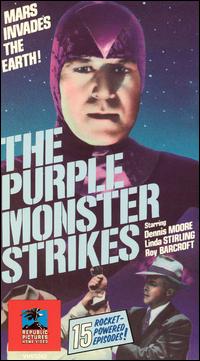
Circa 1945

Circa 1945

(1) “The Purple Monster Strikes” (1945, 15 chapters): Arch movie serial “bad guy” Roy Barcroft played the title role as solo visitor to Earth from Mars as the advance guard explorer of a planned invasion. For some reason, Mars had perfected a one-man rocket plane that could fly to Earth, but they lacked the technology to start it up again for a flight home to Mars. It’s a little hard to start a flying machine that explodes within ten seconds of its only occupant’s quick landing departure from the flight capsule. As the “purple monster,” Barcroft had come to earth to get that return flight know-how, fly back to Mars, and then lead the planned invasion back to Earth.

Described by the serial’s narrator as a “strange, weird visitor” from another planet, Barcroft wears a late 1940’s version of a purple spandex-like suit and something that looks like a purple shower cap as his everyday attire. We see his attire in shades of grey, of course, due the black and white film they used for these adventures.

The Purple Monster also has the ability to stand near a dead human body and explode a little smoky capsule that allows him to enter the deceased in ephemeral form and disguise himself as Dr. Cyrus Leighton, a prominent American scientist. The Martian also carries with him a little black box called the “distance eliminator” that allows him to both speak and understand any language. In the last chapter, the monster almost gets away. He crawls inside the “going home” rocket with all of the plans inscribed on paper in detail. He pushes the rocket’s lever from its “stop” to to the “take off” position. Before he can exit the Earth’s atmosphere, however, he is blasted to smithereens by an atomic rocket missile that has been set up by the US Army to defeat his getaway and save the world.

All’s well that ends well. And Roy Barcroft goes on to play the sheriff in the movies version of “Oklahoma”  in 1956. Those of us who grew up watching Barcroft in serials and Grade B westerns are as proud of him as we were of former Houston Buffs who later made it to the big leagues. A kids, we knew him as the Purple Monster, a bad guy, but one of our actors nonetheless.

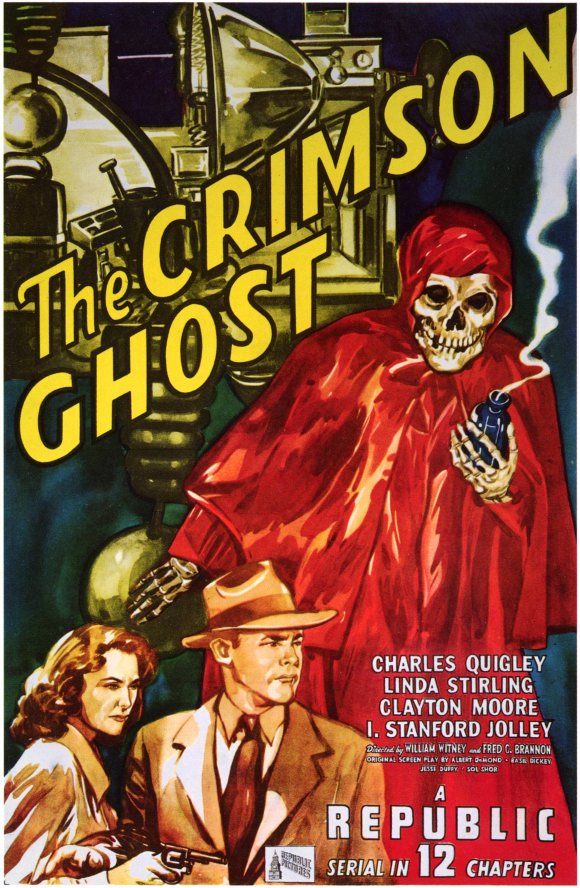
Circa 1946

Circa 1946

(2) “The Crimson Ghost” (1946, 12 Chapters): A college science professor leads a double life as “The Crimson Ghost” and he spends all his time trying to steal a colleague’s plans for building a Cyclotrode device that will have the power to short-circuit all-electric power on the planet. Whoever controls it will possess the power to take over the entire world. Megalomania was a common affliction among the movie serial villains. Must have been a writer’s disease, one that contemporary writers of the TV series “Revolution” may have copied from The Crimson Ghost.

What makes this movie so ironically attractive, however, is the presence of Clayton Moore as the Crimson Ghost’s top henchman, Louis Ashe. Moore is much better remembered today as the actor who played The Lone Ranger on the TV series of the same name.

One continuity problem with a Crimson Ghost scene that violated the laws of physics, even as I understood them at age 8: Hero Duncan Richards is about to drive off a cliff at 80 mph, but he is unconscious in the driver’s seat as the chapter concludes with the car going off into the abyss. The next week, the same scene plays out differently. This time, at the last minute, the hero wakes up in time to jump out of the car. From there, he runs on the highway to a slowing halt without either falling down or losing his hat as he also stops in time to watch the car going off the cliff without him.

What??? – Even at 8, I’m saying, “no way!” Even we kids can’t do that! He doesn’t even need a bandaid!

Like the Purple Monster before him, the Crimson Ghost is finally detected and stopped. This time the villain survives to go the penitentiary.

Circa 1949

Circa 1949

(3) “King of The Rocket Men” (1949, 12 Chapters): This one starred the only guy beyond the great Tris Speaker I ever heard of whose full first name was “Tristram.” Tristram Coffin played the Rocket Man who took on the challenges of the evil Dr. Vulcan for (what? you guessed it!) world domination. The Rocket Man wins to preserve the heroic record of good guys and the American Way against bad guys and evil at a perfect whatever figure for wins it is for America against zippo for the alien baddies.

Our science challenge with the Rocket Man had to do with the flame that burst out of his backpack rocket that enabled his flight. We could not figure out he was able to sit down anywhere after even a short flight. In fact, we would even ask ourselves: “Could the Rocket Man even fly from our neighborhood to the Avalon Theater and still be able to sit down once he bought his movie ticket?” We decided that he must have worn asbestos underwear that they just didn’t talk about back in the day.

Those were the days, my friend.

The Wizards of Odds

February 28, 2013
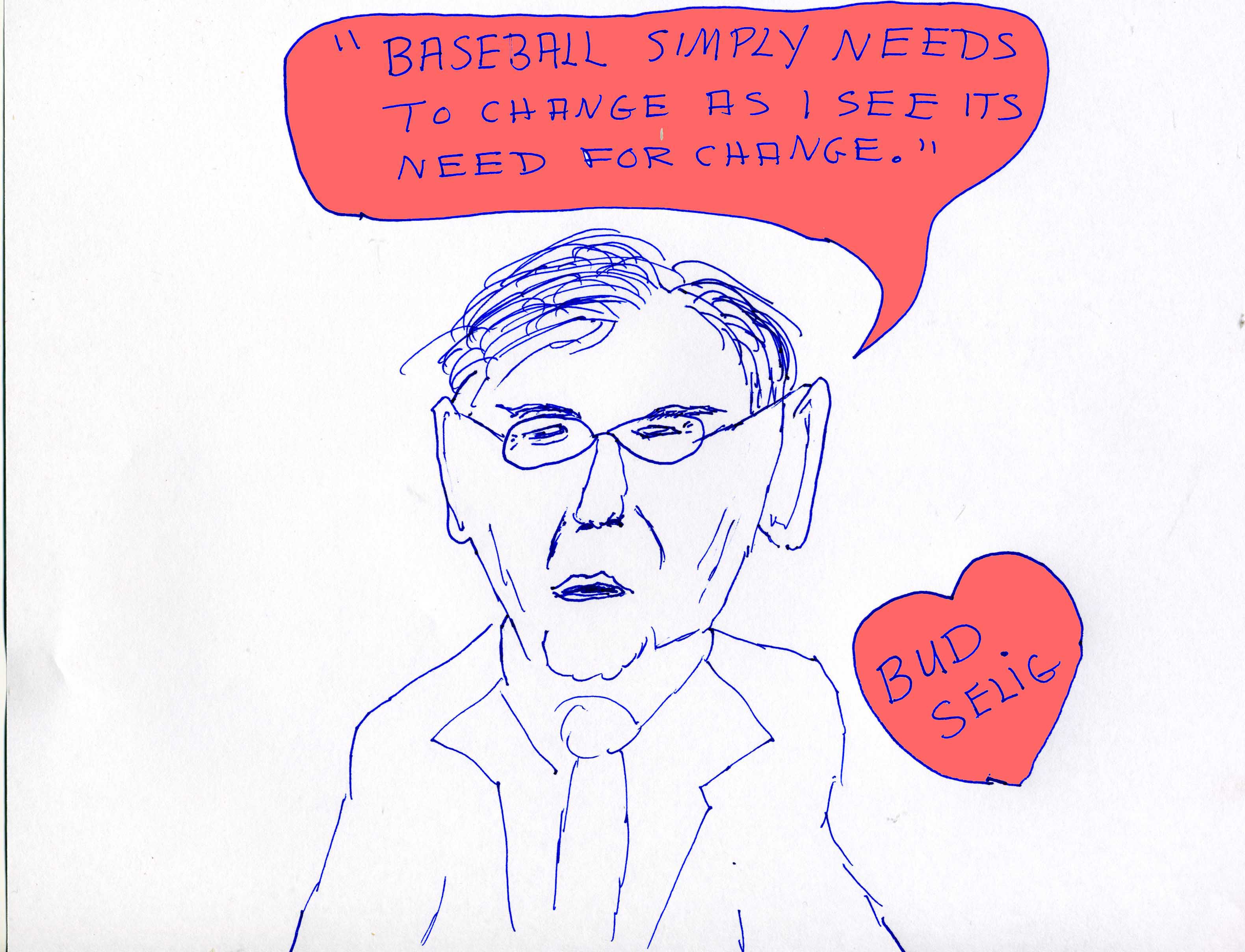
"I'm not really such a bad man. I'm just a terrible Commissioner." - Bud Selig.

“I’m not really such a bad man. I’m just a terrible Commissioner.” – Bud Selig.


I could research this for hours

Conferring batting powers

Consulting with my brain


And my head I’d be scratchin’

While my thoughts were busy hatchin’

On the SABR baseball train.


I’d unravel any riddle

For any individ’le

From Mexico or Spain


With these thoughts I’d be thinkin’

I could be another Lincoln

If I only had a brain


Oh, I would tell you why

K’s are three and walks are four

I could think of things I never thunk before

And then I’d sit and think some more


I will not be just a Selig

My head with lowered ceiling

My heart all full of pain


I will dance and be merry

Life will be a ding-a-derry

On the SABR baseball train


(Shift gears here on the melody after these three lines of shouted dialogue.)


So – where are we going, this summer and next?

To Oz? – To Oz?

No! We’re off to Philadelphia! Then to Houston!


WE’RE OFF TO SEE THE WIZARDS,

THE WONDERFUL WIZARDS OF ODDS!


OF BATTED BALLS AND GREAT PITCH CALLS

THE GREATEST THAT BASEBALL COULD DO BECAUSE,


OUR SABR OWNS – THE WIZARDS,

THE WONDERFUL WIZARDS OF ODDS!

As the NL Time Goes By

February 27, 2013
Hope is Where the Heart is.

Hope is Where the Heart is.

Humphrey Houstonfan and Hope Furtomorrow had been together for a long time, since 1962 to be exact. Their lifelong dream had always been for two things: watching their Houston Astros club win a few World Series titles and then simply living happily ever after as members of the National League family of organized major league baseball clubs.

All that changed in 2011 when the Houston Astros were sold to Mr. Jim Crane, who was also forced by the fascist regime that runs baseball from the Commissioner’s Office to accept reassignment of the club to the American League West as a condition of the deal’s approval.

Humphrey sagged. Hope sank. And the always loyal Houston couple spent the next year in painful deliberation of their next fan course of action: Would they simply go along with the move to the AL, pretending that any league that used a DH was playing real baseball? Would they painfully divorce themselves from the Astros and shift their allegiance to a longtime Houston NL favorite like the Cardinals? Or would they simply re-focus their fan attentions upon amateur baseball, and preferably upon some league that still either avoided the DH – or else – didn’t charge much for watching?

Rice and UH came to mind. Giving up baseball altogether never did.

Humphrey and Hope finally decided to shift their support in 2013 to the Houston Babies of the growing Texas Alliance for Vintage Base Ball. It was good clean 19th century base ball fun. Played from the soul. Played for free. And played out in bucolic grandeur from a deep love of the game on the Elysian-like fields of naturally green places like the George Ranch, south of Sugar Land.

The couple also agreed that they would drive to the big Houston airport and say goodbye to the Astros in the wee small pre-dawn hours of their first road trip of the 2013 season. Because it was so special as a goodbye, Humphrey had been able to get clearance from authorities for he and Hope to be right there at the departing gate with the Astros when the moment of goodbye finally came.

And here’s what actually happened that historic morning. It was like a script for some movie I once saw, but can now hardly remember by title. Perhaps the name will come to me, as time goes by:

As the list of all passengers set for the Astros flight is checked off with each person in line, Humphrey suddenly flashes a single extra computer-printed ticket and speaks to the attendant at the check-in lane:

Humphrey: “Add the name of Miss Hope Furtomorrow to your list.”

Hope: “Why my name, Humphrey?”

Humphrey: “Because you’re getting on that plane. These kids are green. They can’t win without Hope. They need you.”

Hope: “I don’t understand. What about you?”

Humphrey: “Forget me. I’m not Hope. You are. I may still be Love, but I’m too old and tired for this job. It belongs to you.”

Humphrey’s intention suddenly dawns on Hope. The pain in her face is tearful.

Hope: “No, Humphrey, No! What has happened to you? Last night, you said …”

Humphrey: “…Last night we said a great many things. You said I was to do the thinking for both of us. Well, I’ve done a lot of it since then and it all adds up to one thing. – You’re getting on that plane with the Astros where you belong.

Hope: (now protesting) “Humphrey, I..”

Astros Manager Bo Porter notices the couple’s struggle. He walks up close enough to be a concerned third-party listener.

Humphrey: “Hope, do you have any idea what we’d be up against here in Houston if the Astros have to go to the American League with no bats, no arms, and also no hope?  Guess who gets the blame for that last one. It will be you and me. And nine chances out of ten Bud Selig would ban us from every park in organized baseball if you don’t go with the team. – Isn’t that true, Bo?”

Bo Porter: “I’m afraid Commissioner Selig would insist.”

Hope: “You’re saying this only to make me go.”

Humphrey: “I’m saying it because it’s true. Inside of us we both know you belong with the Astros. You’re part of their work, the thing that keeps them going. If that plane leaves the ground and you’re not with them, you’ll regret it. …”

Hope: “…No!”

Humphrey: “…Maybe not today, maybe not tomorrow, but soon, and for the rest of your life.”

Hope: “But what about us?”

Humphrey: “We’ll always have the Spirit of 2005. We didn’t have, we’d lost it until you started going with me to vintage games. We got it back in the pasture land fields at George Ranch.”

Hope: “And I said I would never leave you.”

Humphrey: “And you never will. But I’ve got a job to do too. Where I’m going, you can’t follow. What I’ve got to do, you can’t be any part of. Hope, I’m no good at being noble, but it doesn’t take much to see that the problems of two little people don’t amount to a hill of beans in this crazy world. Maybe someday you’ll understand that my job as general manager of the Houston Babies isn’t all that easy. Finding players that can both catch a baseball with their bare hands and also understand the one-bounce out rule from 1860 aren’t that easy to come by.”

Hope’s expression wells with tears as Humphrey tenderly embraces her chin with the fingertips of both hands and looks her straight in the eyes.

Humphrey: “Wherever you are, I will always have hope. – Here’s looking at you, kid!”