Archive for 2013

Opening Day Reminiscences

March 29, 2013
Bye, Bye, Choo-Choo, Goodbye!

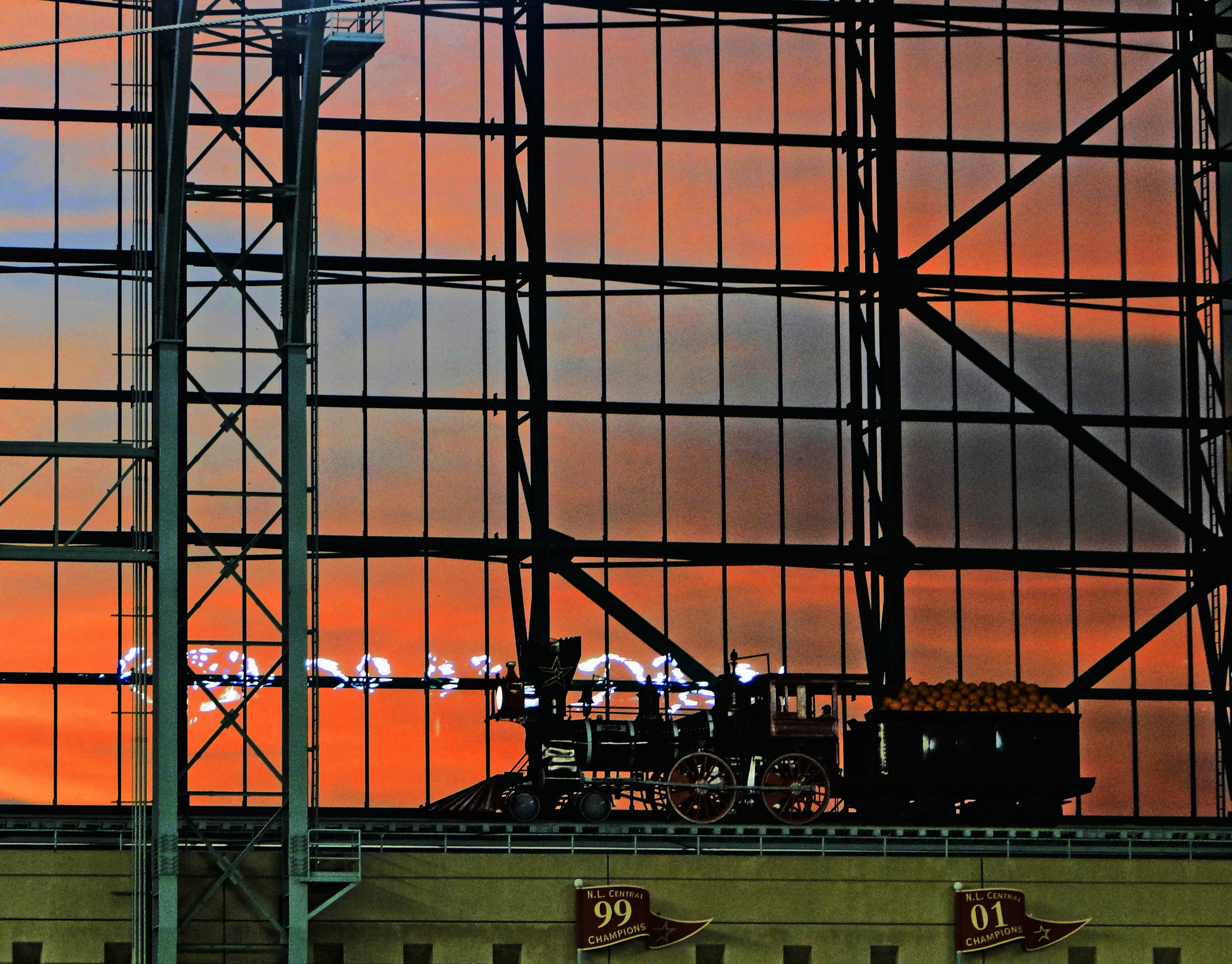
UPON FURTHER EVIEW, 3/30/13, 12 NOON UPDATE: SABR’S Bob Dorrill just called to clarify that Sam Quintero’s earlier report to me of the MMP train’s removal was in error. It’s still in the park, as per usual. That will teach me to go back to the ancient lesson of getting confirmation before making much adieu about nothing. I will take minor solace in the fact that I did note originally that my report lacked confirmation. My apologies to the Astros and readers for running with a story that needing further corroboration before it went to print. My apologies with this promise: Unless I go brain-dead, it will not happen again.

It won’t be an ordinary Opening Day for the 2013 baseball season in Houston. The local club is going into the American League; the Astros don’t have much chance of winning; many old fans swear they are now gone for good from MMP; the Club has the lowest payroll in MLB; hardly any of us could name the Astros starting lineup; and even fewer among us could list the entire 25-man roster; and, as for the coaching staff, forget it. I think Dennis Martinez is both the bullpen coach and the  general source of all stories about baseball in the South American boondocks.

The Pecan Park Eagle was also in receipt of an unconfirmed report from friend and fellow SABR member Sam Quintero that the little train that always ran on the tracks down the center to left field lines at MMP was now gone. That report turned out to be untrue.
NEXT!

Keep on Rolling, Gentle Mountain!

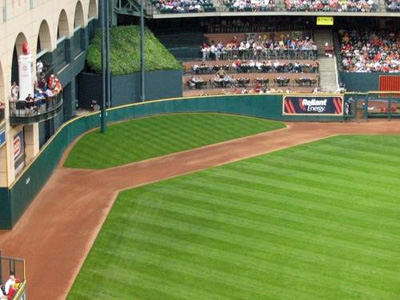
Let’s hope that neither the MMP train or Tal’s Hill shall ever disappear from the ballpark landscape. Bring that center field distance mark in from 436 feet to 400 feet and we may then watch a much larger percentage of the fly balls leaving the ball park. Do we really need MMP to turn into a a real “Juice Box?”

Opening Day always reminds me too of all the little changes that have occurred since the days of Houston baseball in the late 1940s and early 1950s. Back then, these kinds of things were everyday deals:

(1) Players tossed their gloves on the outfield grass when they came in to bat. I have no memories of a player ever stumbling over a glove, or a glove causing a deflection of a batted ball. Then, one season in the late 1950s or early 1960s, they just stopped leaving their gloves on the outfield surface.

(2) Infield practice was an everyday pre-game drill. Now it apparently only happens in spring training.

(3) Organ music tracked balls that ran up and then fell back down the screen behind home plate. High notes were for the high spots; low notes were for the low spots.

(4) Fungo bats were clearly in use by coaches heading up pre-game outfield fly ball shagging.

(5) Skinny legged pitchers were often used as pinch runners in the late innings.

(6) Brown spots on the field were created on the short outfield rim by tobacco-chawing infielders like Nellie Fox.

(7) Opening Day was a time for thinking that all good outcomes are possible. And it still needs to be that way, in spite of all the building evidence that keeps suggesting that the truth in this matter lies elsewhere. In that ancient spirit of hope in spite of the facts, I’m going to post my most positive and optimistic prediction here for the Astros’ first season in the American League, with a nod to some later-in-the-season help from people like young Mr. Singleton:

There's no canceling the hope that is always born 'neath the summer skies of Houston. It's been happening too long to be stopped now.

There’s no canceling the hope that is always born ‘neath the summer skies of Houston. It’s been happening too long to be stopped now.

My Astros 2013 Predicted Record: W 63 – L 99, Pct: .389.
Remembering Frontier Fiesta

March 28, 2013
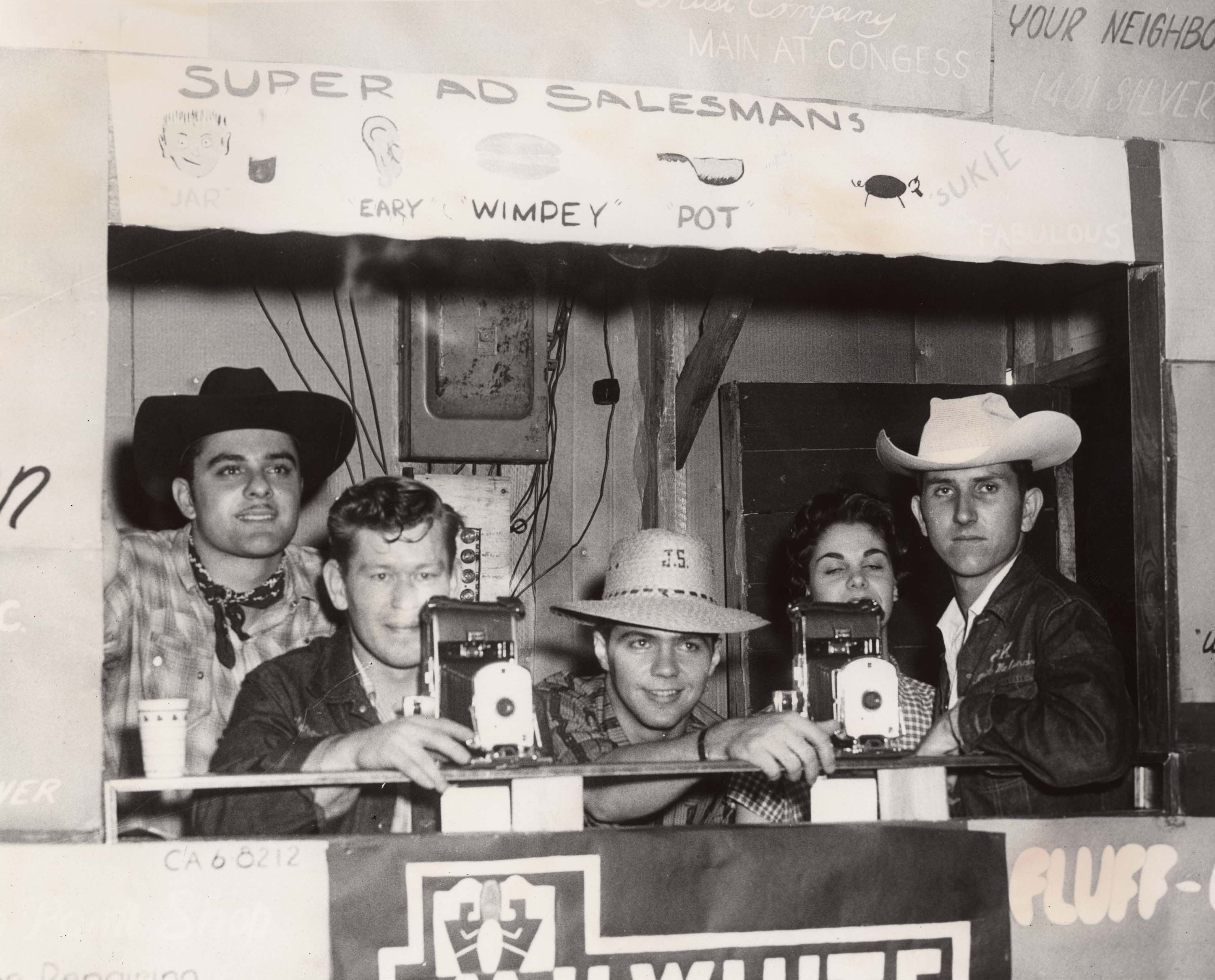
Our Phi Kappa Theta fraternity built and ran the annual "Foto Saloon", a place to have your souvenir picture of that Frontier Fiesta visit captured forever with help from brothers like Pat O'Brien, Bob Murphy, Bernard Ciulla, and Bill McCurdy. (The girl with her eyes shut was a visitor that night.)

Our Phi Kappa Theta fraternity built and ran the annual “Foto Saloon”, a place to have your souvenir picture of that Frontier Fiesta visit captured forever with help from brothers like Pat O’Brien, Bob Murphy, Bernard Ciulla, and Bill McCurdy. (The girl with her eyes shut was a visitor that night.)

Humphrey Bogart came to see us one time. It was close to sixty years ago now, but it really happened.

So did lesser stars like Rory Calhoun, Clint Walker, James Garner, etc, etc., but they came too. Singer Kenny Rogers even got his start with us. So, who were we, anyway? Well, back in the post-World War II years, from 1946 to 1959, we were the University of Houston’s annual version of “The Greatest College Show on Earth”, a spring semester hard work, but lots of fun conversion of the north side of the UH campus into a little western town called “Fiesta City – Population 1,001.”

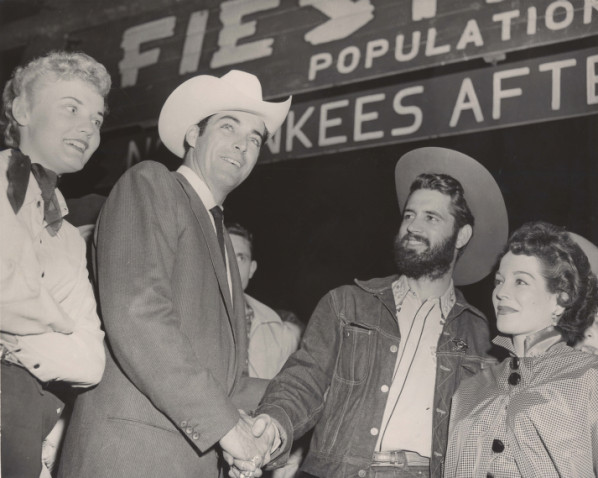
Rory Calhoun is welcomed to Fiesta City.

Rory Calhoun is welcomed to Fiesta City.

For that thirteen year period, every spring semester at UH was spent in rebuilding this small western town and putting on the musical shows that filled the walls of about ten separate, fully operating production houses for an entire seven-day run in about the third week in April of each year. Places like the Bella Union, the Silver Moon, the OK Corral, and the Bayou Queen stand out in memory, but there were others – so many others – and that’s to say nothing about the ancillary food and rink businesses and street entertainer shows that went on concurrently. It was also at a place called “Yosemite Sam’s” that the locally famous Valian’s Pizza Pie first introduced the City of Houston to that now taken-for-granted delicacy staple of the American fast food industry.

The difference was – Valian’s pizza was no dough clogging choker dish. It was pizza like no other since. Or ever. And, sadly, it is now apparently lost forever.

... and her comes Clint Walker.

… and her comes Clint Walker.

Kenny Rogers pretty much made his Houston debut performing at the Frontier Fiesta in the late 1950s. And just about every television western star and hot female movie starlet showed up every spring to be photographed at “Fiesta” each spring.

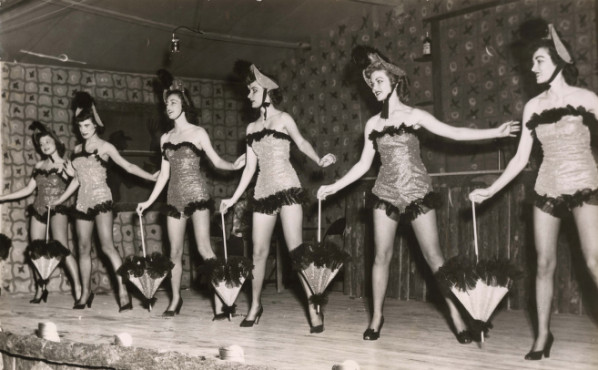
The shows were pretty good too.

The shows were pretty good too.

1957 may have been the zenith year for Frontier Fiesta. Life Magazine, a big media deal in the 1950s, came to Houston and did a story on the 400,000 people (I think it was) that came to see the shows that year. It may have been 1956, the same year that Bogart came to visit so late in his life. He died in 1957. I cannot remember and I have no time for exact time and attendance research this morning.

The problem ultimately was the academic toll that Fiesta took upon the student grade point average each spring. In spite of the fact that it taught more about business and time planning than any course offered, not one among us was getting tested on the basis of how well we handled Fiesta, but on how well we handled our academic courses in spite of Fiesta.

Fiesta is now back at UH in a more manageable form. And here’s an article you may enjoy reading about it.

http://app1.kuhf.org/articles/1363005187-UH-Moment-Frontier-Fiesta.html

UH Grad Student Has Artistic Astrodome Answer

March 27, 2013
"SAVE THE ASTRODOME!"

“SAVE THE ASTRODOME!”

About a year ago, architectural artist Patrick Lopez suggested on these same Pecan Park Eagle pages that the Astrodome could be preserved as a fitting structural artifact by our preservation of its girded superstructure in overlay upon something like a botanical garden in that same historical space where so much great local history has unfolded.

https://thepecanparkeagle.wordpress.com/2012/04/04/what-are-we-going-to-do-with-the-astrodome/

Now it seems that a UH graduate school architectural student  named Ryan Slattery has been pursuing his master’s thesis with a plan along those same lines.

http://newsfixnow.com/2013/03/26/what-to-do-with-the-astrodome-reddit-has-answers/

Slattery still needs to come up with a cost strategy for effecting this conversion, but it does look great from a conceptual standpoint – and one that’s a whole lot better than a plain additional parking space patch in the middle of an already extant sea of cement.

Let’s keep our prayers pointed and/our fingers crossed that the rising wave of support for a more artistically inclined and historically dedicated Houston public voice shall finally rise up to win this day for the most important local structure we have ever sat around and paid to watch go to hell.

My 3 Favorite One-Game Wonders

March 25, 2013

Of all the players who made it to the big leagues for only one single game appearance, these three guys are my favorites. Given the romance we enjoy in baseball lore and literature for the bizarre and unusual, how could they not be?

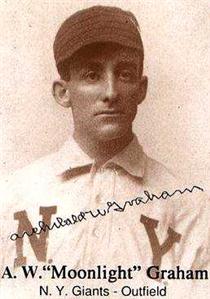
Moonlight Graham

Moonlight Graham

(1) Moonlight Graham, June 29, 1905: Leading, 11-1, in a National League game at Brooklyn against the Superbas in Washington Park, New York Giants manager John McGraw pulls right fielder George Browne and replaces him starting the bottom of the eighth with first (and only) time rookie Moonlight Graham.

Graham is on deck as the next hitter in the top of the 9th when Giants batter Claude Elliott lifts a fly ball for the third out, denying Graham his only chance in the game to hit. Three infield out later in the bottom of the 9th and Brooklyn is done. Graham finishes the game without coming to bat or having anything to do with the six outs that take places on defense while he is in the game.

Graham’s minor league career continues through 1908, but he never again appears in another major league game. He subsequently moves to Chisholm, Minnesota and spends the rest of his life practicing medicine as a small town doctor.

Doc Graham dies in Chisholm in 1965.

In 1975, baseball novelist W.P. Kinsella incorporates the unusual one-game record of Archibald “Moonlight” Graham into his novel, Shoeless Joe, and that character, of course, is then immortalized in the movie Field of Dreams by actor Burt Lancaster.

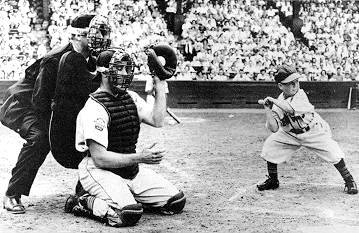
Eddie Gaedel

Eddie Gaedel

 (2) Eddie Gaedel, August 19, 1951: Eddie Gaedel was the supreme promotion of showman Bill Veeck in the waning days of the old St. Louis Browns. Brought into the picture b the Browns owner to play one game only, the little midget (vertically challenged) ballplayer came into a game at Sportsman’s Park in St. Louis as a pinch hitter in the bottom of the 1st inning for lead-off batting center fielder Frank Saucier, drawing a walk on four pitches and then exiting the game for pinch runner Jim Delsing.

Here’s the parody I wrote about Gaedel years ago to the melody from “Rudolph the Red Nosed Reindeer”:

The Ballad of Eddie Gaedel
(sung to the tune of “Rudolph, The Red-Nosed Reindeer”)
by Bill McCurdy, 1999.

Bill Veeck, the Brownie owner,
Wore some very shiny clothes!
And if you saw his sport shirt,
You would even say, “It glows!”

All of the other owners,
Used to laugh and call him names!
They wouldn’t let poor Bill Veeck,
Join in any owner games!

(chorus)
Then one humid summer day,
Bill Veeck had to – fidget!
Got an idea that stirred his soul,
He decided to sign a – midget!

His name was Eddie Gae-del,
He was only three feet tall!
He never played much baseball,
He was always just too small!

(chorus)
Then one day in Sportsman’s Park,
Eddie went to bat!
Took four balls and walked to first,
Then retired – just-like-that!

Oh, how the purists hated,
Adding little Eddie’s name,
To the big book of records,
“Gaedel” bore a blush of shame!

Now when you look up records,
Look up Eddie’s O.B.P.!
It reads a cool One Thousand,
Safe for all eternity.

John Paciorek

John Paciorek

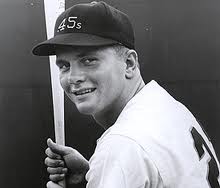
 (3) John Paciorek, September 29, 1963: It was arguably the greatest one-game career in the history of major league baseball. Playing out the last game of the season at Colt Stadium in Houston, the Astros blast away at the New York Mets by a score of 13-4.

Right fielder John Paciorek celebrates his only appearance in a regular season big league game by reaching base in all five times he comes to bat. His three singles and two walks result in both a 1.000 career batting average and a 1.000 on base percentage, with four runs scored and three runs batted in.

Back problems and surgery prevent Paciorek from playing in another big league game, but he continues his minor league career through 1969 and ten spends the rest of his working life as an amateur coach.

John Paciorek’s brother Tom had a six-season MLB career during the 1970s and 1980s; an another brother, Jim, plated 48 games with the 1987 Milwaukee Brewers.


The Painful Pursuit of Accuracy

March 24, 2013
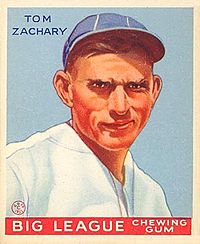
Tom Zachary, BL/TLMLB, 1918-1936

Tom Zachary, BL/TL
MLB, 1918-1936

Why is it so important that our baseball records are recorded as accurately as possible? To me, that answer is simple: If we cannot continually strive to get them recorded as right as rain as possible, we may as well not keep them at all. If they are to tell us anything of what has gone before us, they need to be as correct as possible about the facts that really matter about individual hitting, pitching, and fielding. We don’t need to know at any given moment that a state of 100% accuracy in detail has been finally attained. We simply need to always remain committed to the pursuit of that condition.

What brings records accuracy to mind this morning is another delightful insight into the subject from the great work of Norman L. Macht on the history of the game through the half century career (1901-1950) of Philadelphia Athletics manager Connie Mack in that one position alone.  You see, early in his managerial career, Mack established a pattern of awarding tryout career starts to countless young guys who managed to catch his eye or grab his ear for one of these “try me and sign me, if you play me and like me” quick-look opportunities.

The problem often was the fact that the young talent often feared the loss of amateur status that came with making even a one-batter game appearance under his real name. So, he, or Connie Mack, or both would come up with a false name that would protect the young player’s amateur eligibility in the event that the professional tryout plan didn’t pan out.

Such was the case with famous lefty pitcher Tom Zachary, whose 19-season MLB career (1918-1936) was highlighted by him becoming the 1927 season pitcher for the Washington Senators who gave up Babe Ruth’s 60th home run. The more intriguing truth was the fact  that Zachary started his career as one of Mack’s re-named pitching minions.

In 1918, “Jonathan Thompson Walton (Tom) Zachary” was a young man cooling his heels in Philly as a World War I “conscientious objector” awaiting assignment to Red Cross duty in Europe when his baseball pitching skill came to the attention of Connie Mack. Zachary was offered a tryout pitching opportunity with the A’s, but he was one of those kids that wanted to protect his amateur college eligibility for after the war, just in case.

No problem.

Either Zachary or Mack, it isn’t clear which, publicly changed his name from “Tom Zachary” to “Zach Walton” and he proceeded to pitch and win two games for the A’s in 1918 before shipping out overseas.

In 1919, Tom Zachary returned and signed with the Washington Senators under his real name. I’m not sure how many years it took for the two 1918 wins to slide under his credit too, but I would imagine they were a more recent correction to the record. Perhaps, Norman Macht can shed some light on how the correction took place in the case of Zachary and also comment on the wild guess wonder about other false name players who either remain on the books as failed short-term players – or whose early false name records remain disconnected in the record books from the famous real name players they later became.

Ain’t baseball history wonderful?

Dierker Quits Astros!

March 23, 2013
Larry Dierker

Larry Dierker

We’ll miss you, Larry, but some of us won’t say goodbye. After all, our Houston SABR group isn’t named the Larry Dierker Chapter for any idle reason. When we picked your name to carry our banner of Houston MLB history a few years ago, we did so because we wanted for our own identity the one name that has characterized the full length and breadth of things over the long course of Houston big league history. And that person was you, by length of service and depth of contribution at so many essential levels as a player, communicator, and manager.

Your resignation from the Astros yesterday also flies with no impunity upon the reputations of all the other former Astro stars who remain on the club’s payroll as public relations specialists that you have now chosen to leave the club rather than stay on the payroll as a greeter or personal appearance icon. Those roles are legitimate service and the kind of work that many former players can handle just fine. It’s just not the kind of substantive work that your soul cries out to do at this point in your life. You’ve either got more books to write or new creative job dragons to slay.

Now you will just have to do what all of us non-icons do when faced with the same challenge: Find some place to work in which there appears to be a true opening to the blue sky of possibility, however modest it may first appear to be – or ultimately turn out to be. You, at least, will always have the Dierker Charisma rolling out the road-to-downtown path for what you really want to do.

And you will be OK because – you already are. And because you are loved. And revered by the fans of Houston baseball.

David Barron’s column in this morning’s March 23rd Houston Chronicle is well worth the read. We are going though a change in Houston MLB ownership that is much larger than the single departure of Larry Dierker. You may want to give it a fresh read, if you haven’t yet seen it:

http://blog.chron.com/ultimateastros/2013/03/23/after-nearly-50-years-with-astros-larry-dierker-severs-ties-with-rebuilding-team/

Good luck, Larry! We’ll see you around.


Take Your Super Bowl and Shove It, Mr. Goodell!

March 22, 2013

Seven Days Ain’t Bad. For better, worse, or same difference, I’m back. After seven days on the 15-game DL, I’ve been given permission to return to my Pecan Park Eagle blog about Houston, baseball, and the general culture of the muses. I’m 70% of the way through an antibiotic script that’s been juicing my defenses against what turned out to be a crude and rude bacterial invasion, but that war is being won, even as I continue to take all the medications, all the way out, no matter how much better I feel this early. Lesson learned from the past:  Never quit punching on a bacteria until you know for sure that the thing is completely cold cocked and dead out on the canvas, gone.

Besides, I couldn’t let this modest response to the self-aggrandizing Commissioner Roger Godell of the National Football League fly unfired upon from my arsenal of concern about how we take care of history in Houston in the 21st century. Some are of the impression that we Houstonians can still be bought out for the right price on anything, if the right sized orange carrot is dropped in front of our Houston rabbit nose. 

If they are right, shame on us. We’ll be getting what we richly deserve – the short end of the stick.

Would you rather it serve as an architectural icon and Home of All Houston History - or just a space to park 1500 more rodeo car visitors?

Would you rather it serve as an architectural icon and Home of All Houston History – or just a space to park 2500 more rodeo and football car visitors at Reliant Stadium?

The rodeo-football people have already done their homework. They’ve done a new study on what it will cost to tear down the Astrodome and turn it into space for 2500 more parking spaces. They’ve even managed to get the Eunuch Chieftain of the NFL, Commissioner Roger Goodell, to state that tearing down the Astrodome for an additional 2,500 car parking spaces will help the City of Houston get the bid to host the 2017 Super Bowl. – Makes you wonder why those spaces weren’t that critical for the last SB we hosted in the first decade of this century.

Let’s put the proposition slightly differently: What is more important to Houston, preserving the architectural prototype for all covered athletic stadiums from the late 20th century forward – or providing additional parking space for 2,500 more Bruno Mars fans at the next rodeo performance?

I find the remarks by Commissioner Goodell to be both self-serving and short-sighted, and also most likely to have been words encouraged into expression by owner Bob McNair of the Houston Texans and the homey board chiefs of the Houston Rodeo group. For whatever reason, those people have never wanted to make the future of the Astrodome a plan hat could also benefit their interests beyond increasing the area for cars or carnival food stands. I can’t prove that either had anything to do with the Goodell statement, but I would be most unsurprised to learn that they were behind this little tempest in a teapot.

As an architectural achievement, the Astrodome rests on a level of significance that is historically equivalent to that one of the Eiffel Tower in Paris, The Empire State and Chrysler Buildings in Manhattan, the Washington Monument in the District of Columbia, the Coliseum in Rome, and the Statue of Liberty in the New York Harbor. Unfortunately for the Astrodome, it first saw the light of day in Houston, where the forces for fair preservation often lose to the expedient needs of today’s fast buck business culture.

Our fault? We should have had a Plan B for the Dome years ago. We didn’t have one. When the Astros left after 1999, it was just abandoned, left to decay under inadequate care that would still cost millions of taxpayer dollars over time. We would see a bump of public interest in doing something to save the Astrodome every now and then, but each plan would fall quickly to doom for want of vision, support, or money when it came time to line up against the real-time costs of putting the old place into shape for new use.

Look! As much as I hate to admit it, I’m beginning to finally see my city of Houston as one of those places that just isn’t big enough to take care of historical landmarks. What else is there to conclude?

If we cannot take care of the Astrodome, let’s, at least, take responsibility for putting the old girl out of her misery on our own dime. We don’t also need to be remembered as the town that took down the Astrodome under an ultimatum from the NFL in order to get 2,500 extra parking spaces at Reliant and a 2017 Super Bowl award. Throw in an extra thirty pieces of silver, if we elect to go this route.

Once upon a time, we could have converted the Astrodome into the coolest historical museum and entertainment center in the world. Too bad. We just didn’t have the people, the timing, and the plan that would work to get the job done. All we are doing now is running into a wall on the Astrodome’s life span that has been waiting for us forever, given the way history is devalued in Houston.

Goodbye, Astrodome! Wish we had been the kind of people who knew how to preserve the major construction project in the history of Houston. As it turns out, we just didn’t have it in us as a community – and your disappearance shall be our eternal loss – and not some stupid trade result from a deal we made with the NFL over a Super Bowl.

Pecan Park Eagle on DL

March 15, 2013

Astro Tie    The Pecan Park Eagle is temporarily on the Disabled List, recovering from a mysterious chest congestion or allergy. We shall return as soon as we can again view our world with eyes that don’t bleed inside a head that doesn’t throb on top of a chest that doesn’t wheeze like a straw sucking up the last few wet tastes of a chocolate malt. Fortunately, my stretchy old sense of humor has somehow managed to stay off the casualty list.

Regards, Bill McCurdy

The Thundering Hooves of Memory

March 13, 2013
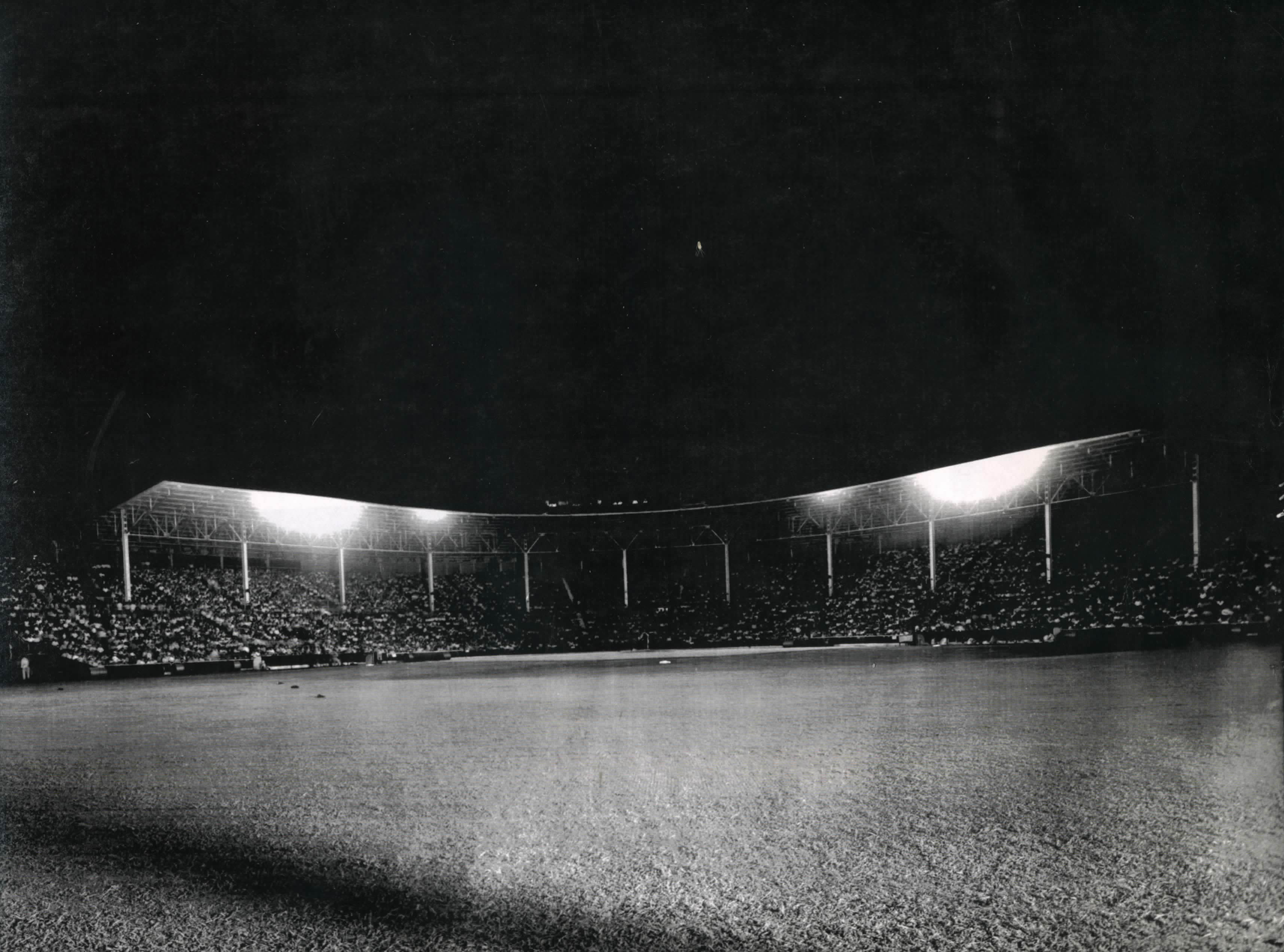
Once Upon a Time:Buff Stadium in Houston.

Once Upon a Time:
Buff Stadium in Houston.


The Thundering Hooves of Memory

by Bill McCurdy


The thundering hooves of memory,

Stir our souls to rise and roar,

In hot pursuit of destiny,

On passion’s fiery shore.


And so it was with baseball,

In sandlot games galore,

Inspired by human buffaloes,

Into the ball – bats tore.


We played from light to fading sight,

Our twilight whisper game,

And then we slept to rise again,

And play ’til we fell lame.


And if the day shall come for us,

When echoes call the herd,

We’ll race with wild abandon,

To the place it once occurred.


“Pick up your gloves and follow me!”

Is the order of our day.

“It’s time to play the game for keeps!”

Our hearts can’t wait ’til May.

Top 10 Similarities and Differences Between the College of Cardinals and the St. Louis Cardinals

March 11, 2013

Cardnals College

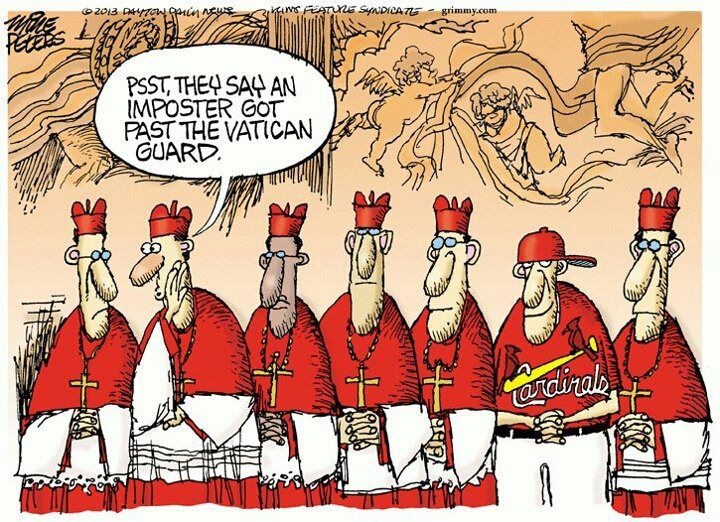
Top 10 Similarities and Differences Between the College of Cardinals and the St. Louis Cardinals

(10) The St. Louis Cardinals wear red and white uniforms.

(9) The College of Cardinals wear red and white uniforms, but with no covered stirrup socks or spiked shoes.

(8) In honor of the recently retired Pope Benedict, a College of Cardinals Committee on Appropriate Poetic Parody is now working on an adaptation of “Casey at the Bat” in recognition of his handling of rogue priest issues, the downturn in religious vocations, and the role of women within the Church.

(7) The College of Cardinals is considering the adaptation of a St. Louis Cardinals uniform design for their new summer cassocks. If approved, the new College breast-plate logo will feature two new Popes each season, facing each other from standing positions on both ends of a horizontally inclined obelisk.

(6) One Vatican observer noted that the College of Cardinals may have a very clear profile of what they are seeking in the next Pope. “They are looking for Jesus Christ with an M.B.A.,” he remarked. Meanwhile, the St. Louis Cardinals have some clear ideas on leadership too. The more their managers look, think, and act like Tony LaRussa, the better.

(5) The St. Louis Cardinals are falling a little behind in their use of modern media technology. The College of Cardinals still prefers smoke signals to Twitter, texting,  or e-mail.

(4) Growing up, I once knew a religious and athletic Italian fellow named Johnny Sicola. Johnny couldn’t make it with the St. Louis Cardinals because he didn’t quite have major league ability. So, he became a priest, but he couldn’t make it to the top because the College of Cardinals decided that no one would pay serious attention to a church leader who wanted to be known by his given name as “Pope Sicola.” *

(3) College of Cardinals members pray for heavenly help to pass through the Pearly Gates; the St. Louis Cardinals play for heavenly managers (and a few from that other place) to get through the Gateway Arch and win a World Series whenever it’s possible.

(2) College of Cardinals members wait until they die before they go play with the angels.

(1) The College of Cardinals have never been perfect; the St. Louis Cardinals once had Stan Musial.

* 3/12/13: What are the odds? Yesterday morning, I included the “Pope Sicola” tale   in this piece after carrying it in my heart for well over a half century, and guess what? Last night, Jay Leno used the same story in his monolog! He changed the lead in part of the joke, of course, but the punch line was straight out of this Pecan Park Eagle column.

They even had a prop Pepsi bottle made up that said “Pope Scola” on the label, even though Jay very clearly pronounced the name with an “i” as “Sicola” in his TV bit. Don’t worry, Jay. I’m not going to sue you.