Archive for 2013

“New Dome Experience” Plan Sounds Great

June 20, 2013
Harris County Sports and Convention Corporation

Harris County Sports and Convention Corporation

If you have not yet seen the news, check out the front page headline in today’s June 20, 2013 Houston Chronicle for the story by Kiah Collier entitled “A conventional idea for Dome”. The Harris County Sports and Convention Center Corporation is recommending a $194 million dollar proposal that would convert the old Astrodome into a world class major exhibit and activity space that would simply fit right in with how it was intended in the first place. They could even play football there again and also become  a major help to the needs of events like Houston’s annual OTC convention.

Three aspects of the plan are emphasized:

(1) They would remove the 60,000 seats now in place and fill in the one-story underground space to create a street-level exhibit and meeting space. The exterior would be landscaped in attractive greenery.

(2) Potential uses would include swim meets, graduations, community events, football and soccer games, and as a central space for use by the growing Offshore Technology Conference. A 350,000 square foot meeting space leaves the door open for an infinite number of convention uses by groups from all over the country, including the major political parties.

(3) The “transformation” is expected to take 30 months for completion. If the plan gets on the ballot in November 2013 with a funding plan showing the public/private plan for making payment on the project, and this plan is approved, then work could actually be put in place to start by August 2014 and be finished and put into use by the 2017 Super Bowl that Houston will be hosting.

The Astrodome in 2013 ~ with no help ~

The Astrodome in 2013 (Bill McCurdy)
~ with no help ~

The Astrodome in 2017 ~ with planned renovation ~

The Astrodome in 2017 (Harris Co. Sports, et al)
~ with planned renovation ~

They say that this plan is about $80 million dollars cheaper than a similar proposal the same group made last year because of the agreement to bypass restoring the underground level in favor of filling it in.

Let’s see what happens next. At least, we seem to have moved an inch from doing nothing and paying for it to finding an actual cost on a serious good plan for action.

Buff Biographies: Sam DiBlasi

June 19, 2013
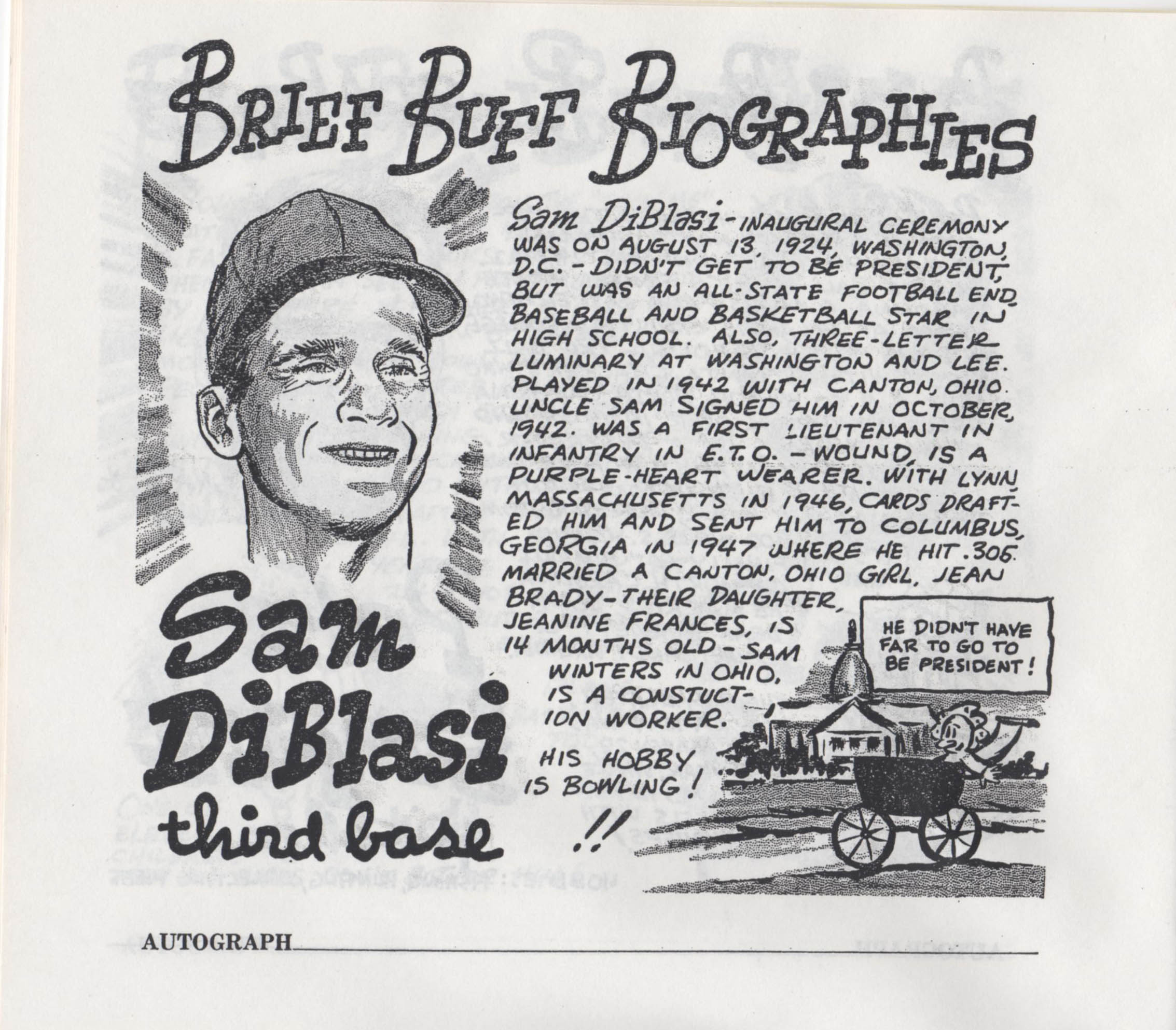
Excerpt from "Your 1948 Houston Buffs, Dixie Champions: Brief Biographies By Morris Frank and Adie Marks (1948).

Excerpt from “Your 1948 Houston Buffs, Dixie Champions: Brief Biographies By Morris Frank and Adie Marks (1948).

Sam DiBlasi had one of the better years among those who played for the 3rd place 1948 Houston Buffs. In 132 games as a third baseman, Sam batted .290 with 22 doubles, 10 triples, and 2 homers. His good offensive production was just topside of his career minor league totals over six seasons (1942, 1946-50) of 83 doubles, 39 triples, and 9 homers. 1948 was the athletic Mr. DiBlasi’s only season as a Buff.

Born August 13, 1922 in Washington, DC, the 6’0″, 190 lb. DiBlasi (BR/TR) was a three-sport star and all state end in football before becoming a three sport letterman at Washington and Lee University and embarking upon his pro baseball career in Canton, Ohio in 1942, where he also met his future wife.

World War II took care of the next thee seasons (1943-45) as DiBlasi went off to battle in Europe as a 1st Lieutenant and also earning a Purple Heart for his battle wounds. Sam resumed his baseball career in 1945 after taking up residence in Canton, Ohio as a construction worker.

After 1948, Sam DiBlasi moved from the St. Louis Cardinals to the Brooklyn Dodgers’ farm system and splitting time with the latter’s clubs at AA Fort Worth and AAA Montreal in 1949.

Something happened after 1949, but I lack the immediate resources without further research to know what caused the change and fairly abrupt end to Sam’s baseball career. In spite of the fact that DiBlasi’s batting averages at Fort Worth and Montreal ranged from .260 to .277, he dropped down to Class A Greenville of the Sally League in 1950 as a pitcher. He had pitched five innings for Montreal in 1949 and posted a 1-0 record. He worked in four games for 1950 Greenville and compiled a 3-0 record with a 1.67 ERA.

Then nothing. At age 27, Sam DiBlasi was gone from baseball.

Sounds a lot like an injury-forced retirement after 1950. As I have time, I will try to learn more about what happened. If you know anything about what led to Sam DiBlasi’s early departure from the game, please post it here at The Pecan Park Eagle as a comment on this column. Thank you.

According to a post-column report from Darrell Pittman, Sam DiBlasi passed away at age 81 on August 18, 2003 in Canton Ohio. Here’s additional news of Sam’s post-playing career involvement in baseball:

“Baseball player. He was a pitcher and third baseman with the Brooklynn Dodgers and the Canton Terriers Class AA League. He was a member of the Stark County Baseball Hall of Fame and was past president of Eastern Ohio Basketball and Football Officials Association. He served as an official and television liason for the mid-American conference; was a life member of the Ohio Association of Football Officials. He served as commissioner for the Class A Baseball League from 1967-1977 and was Commissioner for the Federal League for 29 years. Sam was a World War II Army veteran having served in Normandy, Utah Beach, D-Day + 1. Survivors include his wife Donna L (Kitzmiller) DiBlasi; three sons and a daughter.” – http://www.findagrave.com

The Frank/Marks cartoon identified Sam’s wife as Jean; this findagrave reports her name as Donna. Sam either had two wives, or one wife who used two names, or someone simply made an ancient reporting mistake on her name in the first place.

Thanks, Darrell!

Buff Biographies: Russell Rac

June 18, 2013


Buff Logo 12

Russell Rac The Early Years

Russell Rac
The Early Years

Russell Rac (5’11”, 188 lbs.) (BR/TR) was a slugging, speedy, good-natured outfielder for the Houston Buffs intermittently from his very first handful of hitless professional times at bat at age 18 in 1948 to his eleventh and last season as a full-time, .312-hitting 28-year-old Buff in 1958. Rac came by his affinity for Houston quite honestly. He was born in Galveston on June 15, 1930 and grew up a Buffs fan as also honed his playing skills at the Island City’s Ball High School.

Rac played for the Houston Buffs for parts or all of seven seasons out of his eleven years total (1948, 1951-52, 1954-56, and 1958). He batted .289 with 161 HR over the course of his minor league career. Russell never made it to the big leagues with the always talent-heavy St. Louis Cardinals, but that was more due to their abundance than any deficiency in Russell Rac. In today’s market, Russell was the kind of guy who could have played several years in the big leagues.

Two Rac home run feats come to mind: In early April 1951, Russell Rac homered against the New York Yankees in a 15-9 spring training loss by Houston to the Bronx Bombers at Buff Stadium in the waning days of spring training. At age 21, Rac was not the youngest player to homer in that game. An 18-year old kid named Mickey Mantle also hit one out for the Yankees before the day was done. – The other home run story came to me directly from Russell Rac. He once showed me a newspaper account to back up his story, but I couldn’t read the whole thing. It was all in Spanish, but I do understand the word “quatro” as “four”. I saw it in the headlines of the article that Russell pointed out to me.

Russell Rac The Later Years

Russell Rac
The Later Years

The story? One year in South American ball, Russell Rac belted four home runs in a single game!

Russell Rac was one of those compact guys that could really pile some distance into a baseball when he caught it with those quick wrists on the sweet spot. After baseball, Russell Rac remained active in those periodic reunions of the Houston Buffs and he was there with a bells-on spirit for the 1995 Last Roundup  of the Buffs.

Some people never give up on the joy of living life as a celebration. In my experience with him, Russell Rac was one of those people. He also never abandoned his joy for the game of baseball. And like most good old time baseball people, he always seemed to have time for another good baseball story.

Sadly, we lost Russell Rac a couple of years ago. He died on October 11, 2011 at the age of 81.

Keep smiling, Russell. – That’s how most of us will always remember you.


Buff Biographies: Charlie Sproull

June 17, 2013
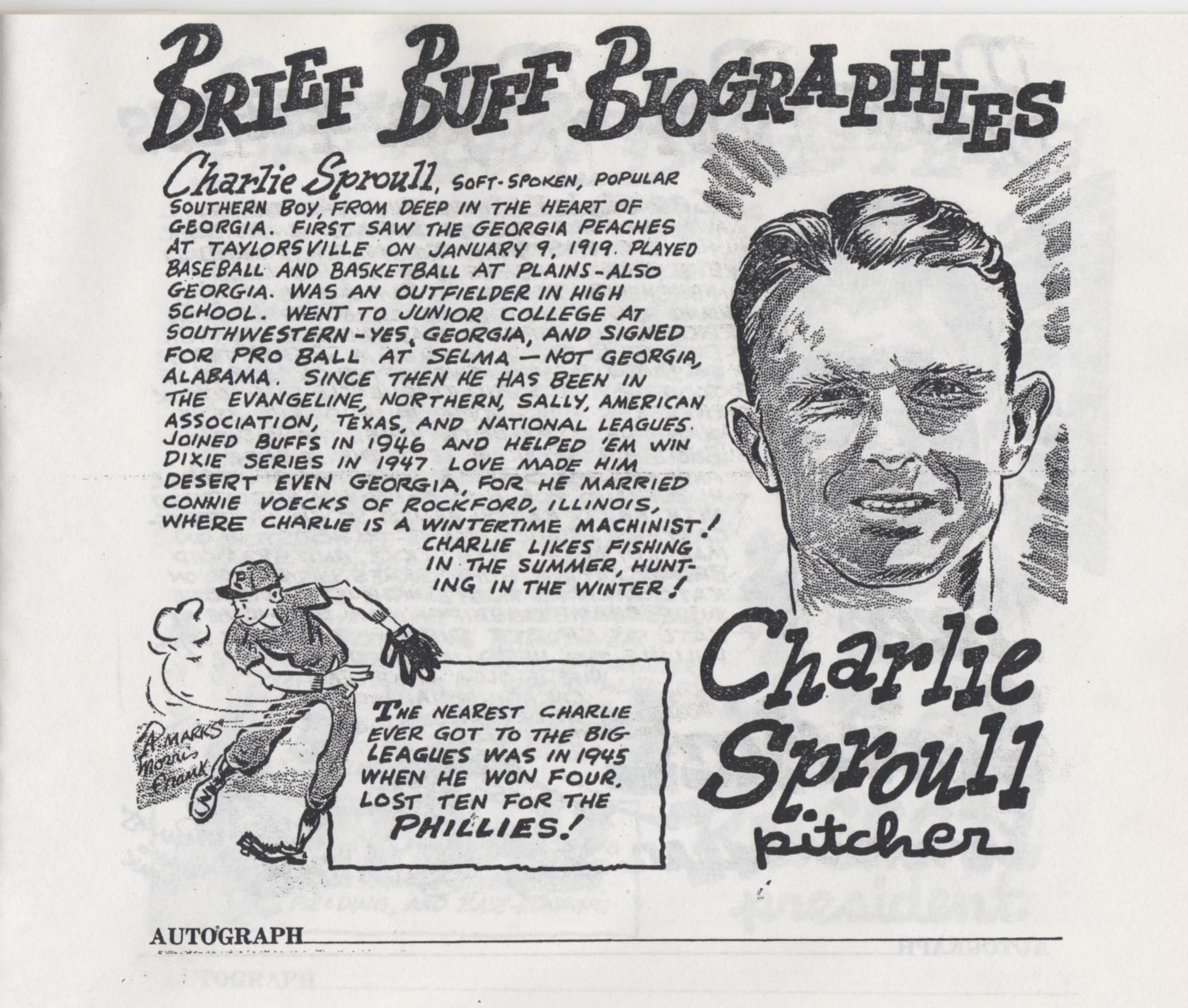
Excerpt from "Your 1948 Houston Buffs, Dixie Champions: Brief Biographies By Morris Frank and Adie Marks (1948).

Excerpt from “Your 1948 Houston Buffs, Dixie Champions: Brief Biographies By Morris Frank and Adie Marks (1948).

Charlie Sproull

Charlie Sproull

As Frank and Mark point out in their cartoon, former Buffs pitcher Charlie Sproull (6’3″, 185 lbs.) (BR/TR) was born January 9, 1919 in Taylorsville, Georgia. Save for a deal that sent him to Dallas at the very end, his 1946-48 time with the Buffs were a wrap on his 10-year minor league pitching career (1938-44, 1946-48) and a record of 87-96, and a 3.73 ERA, He was out of baseball as an active player at age 29.

Charlie’s big league career took place in 1945 when he won 4 and lost 10 with a 5.94 ERA for the Philadelphia Phillies. In spite of his Georgia Peach tree and culture roots, Sproull married a girl from Rockford, Illinois and made his home there until his death on January 13, 1980 at the age of 61. In his off-seasons, as Frank and Mark also show, Charlie worked as a machinist who liked fishing in the  spring and summer and hunting in the fall and winter.

Charlie Sproull was hardly close to ever having been one of the revered names in Houston Buffs history. He won 1 game for the ’46 club, 5 games for the ’47 team, and a mere 2 games for the ’48 Buffs, but he was made of the stuff that made minor league baseball popular. He was a member of that legion of dreamers who, whether they realized it or not, had to put everything else in life aside while they each chased the chance to one day fly across the summer sky of America’s consciousness as one of the game’s shooting stars.

Charlie Sproull put his baseball dream to bed before he turned 30. Hopefully, he spent the remaining 32 years of his life from there in a loving marriage with the fullest satisfaction of knowing that he had given baseball all he had.

God Rest Your Soul. Charlie Sproull!

Happy Father’s Day 2013!

June 16, 2013
Neal & Dad, 1988.

Neal & Dad, 1988.

The Days Flew By – Before We Knew,

Two Weeks – Six Months – A Year or Two.

From Toothbrush – To School Choice – And Artful Glue,

We Sought Out A Way – That Worked Best For You.


But While We All Scurried – Each Fall – As A Rule,

Halloween – Thanksgiving – And Soon Came The Yule,

To Roll In Upon Us – At A Pace Kindly Cruel,

That Roared Us Through Springtime – To Summer’s Cool Pool.


The Clock Kept on Ticking – In Its Quiet Quick Way,

It Sped Us Overnight – To Graduation Day,

And Your Life Moved Forward – On Your Own – As They Say,

On A Course You’re Still Carving – As The Lessons Portray.


Mom And I Still Remember – The Gift of Your Birth,

And We Both Want To Say – For What It Is Worth,

That Had We Both Known – ‘Bout The Spin of Life’s Earth,

We’d Have Slowed Things Down Fast – And Got Lost In The Mirth,

… While We Could.


Thank You, Neal, For Being The Sweet Spot Reason That It’s Both A Happy Mother’s Day For Mom And A Happy Father’s Day For Me!

Love. ~ Forever. ~ Dad.

Happy Father’s Day, Everybody!

Happy Father's Day 2013! From Norma, Neal, Bill, Gateway the Longhorn, & Handler Taste of Texas Restaurant Houston, Texas

Happy Father’s Day 2013!
From Norma, Neal, Bill, Gateway the Longhorn, & Handler
Taste of Texas Restaurant
Houston, Texas

Buff Biographies: Jerry Witte

June 15, 2013

Buff Logo 12

Jerry Witte, First Base Houston Buffs, 1950-52

Jerry Witte, First Base
Houston Buffs, 1950-52

The 1950  wonderful morning that I read in the Houston Post that first baseman Jerry Witte was joining the Houston Buffs on assignment from the Cardinal AAA club in Rochester, I was doing just about the same thing that I’m doing this June Saturday morning in 2013, drinking my wake-up cup of hot tea and reading the sports page reports and columns of the wonderful old Houston Post and writer Clark Nealon.

Those were the days, my friend, but that’s a much longer story for a different day. The point here is that I suddenly found my self stunned into happiness over the thought of Jerry Witte joining my Buffs. He had been something akin to Darth Vader in my childhood mind since he came to town with the 1949 Dallas Eagles and made Houston one of the places he cranked out those 50 home runs in a single season. Now it seemed that old Darth had decided to come on over to fight for the Light side against the forces of evil darkness.

We didn’t have Star Wars as a base metaphor in 1950, of course, but it retroactively fits Jerry Witte coming to Houston back then better than any other frame of reference available to our experience as Buff fans of that era. I am right about Jerry joining the light side in 1950 Houston. The Buffs were about as “light” on talent that year as they could be. Even the 30  home runs that Witte brought to the Buffs lineup from June 11, 1950 forward did not matter that much as the club went on to a 61-93 record and a last place finish.

The next season, Jerry Witte’s 38 homers paced the Texas League as the Buffs rose to first place and also captured the playoff league pennant before losing the 1951 Dixie Series in six games to the Birmingham Barons. Jerry played one more season for another bad Buffs team in 1952 before retiring from baseball at age 37.

Jerry Witte and his wonderful wife, Mary Witte, settled in the Houston East End following the end of his baseball career and proceeded to raise a family of seven bright and beautiful girls. Jerry operated his own successful landscaping business until some time in the 1980s, but he never forgot his earliest roots as a contributing member of the working class.

Many had a bigger wallet. None had a bigger heart.

Late in life, Jerry  and I teamed to write his autobiography, “A Kid From St. Louis”. The book was published in 2003, a year following Jerry’s death in 2002 at the age of 86. It is an engaging story of the man and his times. Born in Wellston County, west of St. Louis, on June 30, 1915 as the 6th born of 10 surviving children,  Jerry grew up as the child of  a hardworking German-Polish family who also just happened to have been blessed with a special talent for crushing baseballs into flight across the summer skies of St.  Louis, Missouri.

Signed originally by the St. Louis Browns in 1937, Jerry Witte had a 13-season minor league career (1937-42, 1946-52) in which he batted .276 with 308 HR. After three years of Army service in World War II, Jerry had brief cracks with the Browns in 1946 and 1947, but didn’t stick.  His best minor league years were 1939 at Lafayette when he batted .354 with 14 homers and won the Evangeline League MVP award and 1946 at AAA Toledo when he batted .312 with 46 home runs, plus also crushing 3 HR in the All Star Game that season. His 50 and 38 homer seasons with 1949 Dallas and 1951 Houston were pretty good too.

Jerry’s downfalls were the high inside pitches he could neither resist or hit and the fact that he placed way too much pressure on himself to perform instantly during his 46-47 call ups with the Browns. Late in life. he was quite accepting and philosophical about the way things turned out.

“My life worked out the way the Good Lord wanted it to work out,” Jerry once told me. “The Lord gave me baseball and landscaping as my ways in life. He delivered me to a happy lifetime of marriage to the only woman I ever loved. And He blessed us both with seven wonderful daughters and our whole family with happy times and the support of truly good friends and a faith in Jesus Christ that makes sense about why we are all here, anyway. – Money can’t buy those things. So, how could more time in the big leagues have made any real difference? It wouldn’t have mattered one iota. No sir! I’m happy with the whole thing and the way it played out as it did. – Who knows? God may have been saving me from myself.  Had I made it big in the big leagues, I might have been one of those guys who got so full of himself that I screwed it all up!”

I don’t think so, Mr. Witte. As one of your dear friends in later life, there was no way you would have ever screwed up everything that was so right as rain about the loving state of mind, heart, and soul that was your marriage, your family life, your friendships, and you as a man. You just weren’t destined to be one of those dumb turkeys who made all the stupid self-serving choices.

Everyone should be so “lucky” as you and your good friend, Mr. Larry Miggins. If we all could, what a wonderful world this would be, indeed.

Note: For any who may be interested, hard cover copies of Jerry Witte’s autobiography, “A Kid From St. Louis”, are still available. Do not send cash. If you would like one, please make out a check for $26.70 and send it to “Bill McCurdy” to cover the book, sales tax, shipping, and handling and send your order with clear mailing address instructions to:

Bill McCurdy, Publisher

Pecan Park Eagle Press

PO BOX 940871

Houston, TX 77094-7871

Jerry Witte is deceased, but I will be happy to sign the book for you as his co-author, if you would like or just send it as is. If you do want me to sign as a gift to someone or just want a dedication message, simply let me know your wishes and I will be happy to oblige.

For further information or order follow-up, I can be reached at 713.823.4864.

My apologies, but I am not set up to handle credit card orders.

Thank you for your interest.

Buff Biographies: Cloyd Boyer

June 14, 2013
Excerpt from "Your 1948 Houston Buffs, Dixie Champions: Brief Biographies By Morris Frank and Adie Marks (1948).

Excerpt from “Your 1948 Houston Buffs, Dixie Champions: Brief Biographies By Morris Frank and Adie Marks (1948).

One of eleven Boyer children and the oldest of three brothers who grew up to reach the baseball major leagues, Cloyd Boyer started off his pitching career with a hummer of a fastball and a scary quick delivery.

Born in Alba, Missouri on September 1, 1927, the 6’1″, 188 lb. right hander played most of the 1948 Houston Buff season as the still 20-year-old ace of the pitching staff, powering his way to a 16-10, 3.14 ERA record. In a 14-season minor league career (1945-49, 1951, 1953-54, 1956-61) Cloyd registered a career mark of 117-97, 3.50 that included, of course, his two years with the Buffs (1948, 1953).

In four seasons with the St. Louis Cardinals (1947-52) and one with the Kansas City Athletics (1955), Cloyd Boyer finished his big league business with an MLB record of 20-23 and 4.73.

Remember what we said about every player having his level of competitive ascension largely determined by  the drag of his personal gravity? Cloyd Boyer is simply another example at a higher level than most. At the MLB level, Boyer’s abilities faded a couple of notches in accomplishment from what they were at the higher minor league levels – and for whatever reason. Boyer’s 1948 “stuff” at Houston looked like the stuff of a future major leaguer of exceptional ability, but it never happened. Whether it was pure ability or some combination of psychological or injury factors that activated Boyer’s resistance  to excellence in his higher level performance we cannot now know or recover beyond irresistible speculation.

But speculation is irresistible, indeed.

Younger brothers Ken and Clete Boyer made it big as successful third base men, even meeting each other as third base men for the Cardinals and Yankees in the 1964 World Series. Hmmm. Cloyd Boyer played most of his amateur life as a shortstop. Speculation stop: Maybe Cloyd Boyer should have kept that strong right arm and used it to keep playing shortstop at the professional level. We’ll never know.

According to Baseball Reference.Com, Cloyd Boyer is still alive at 85 – and headed toward 86, come September.

http://www.baseball-reference.com/players/b/boyercl01.shtml

Buff Biographies: Remy LeBlanc

June 13, 2013
Excerpt from "Your 1948 Houston Buffs, Dixie Champions: Brief Biographies By Morris Frank and Adie Marks (1948).

Excerpt from “Your 1948 Houston Buffs, Dixie Champions: Brief Biographies By Morris Frank and Adie Marks (1948)

Remy LeBlanc was a Cajun outfielder who hailed from the heart of Cajun country. Born in New Iberia, Louisiana on March 7, 1925, “The Flying Frenchman” ended up playing out a minor league baseball career that may have helped his speed in the game, but had nothing to do with using wings that could fly him to the more rarefied air of the big leagues. Like thousands of others who played with him, before, him, and after him, Remy LeBlanc of the 1948 Houston Buffs was still looking for his highest level of joy and productivity in the game.

In baseball, the limits on “up” are determined by a player’s personal gravity.

Ascension wouldn’t last for Remy LeBlanc in Houston. LeBlanc hit .235 with only 2 homers in 43 games as an extra outfielder for the AA level 1948 Buffs. The parent club St. Louis Cardinals then sold Remy’s contract to the C level club they owned in his hometown of New Iberia. Home cooked boiled crawfish and gumbo apparently were just what good old Dr. Foucheaux ordered. Remy remained at home for the next three seasons. LeBlanc hit 14 HR and .261 starting with New Iberia in 1949; 24 HR with a .291 BA in 1950; and 42 HR with a .298 tab in 1951. The following year, he moved up to Class B ball at Wichita Falls on a sale to the Boston Braves organization. In that 1952 season, he crashed 30 HR with a .291 BA.

In 1953, LeBlanc found his ceiling and gravity again when the Braves sold him to San Diego of Open Class (AAA) San Diego Padres. A .143 BA with only a single homer in 30 games earned Remy a trip to Paris (Paris, Texas). LeBlanc played for the Class B Paris/Greenville/Bryan club for the rest of 1953, batting .295 with 5 homers in 49 games.

Remy LeBlanc went home to play for New Iberia in 1954. It was his last season as a professional ballplayer, but it was also his best. He hit 42 homers and batted .319 in 140 games. At age 29, Remy Leblanc hung ’em up. It was time to play life more laid back and let the zydeco drift through his Cajun soul. 1954 was a season to celebrate for the rest of his life.

In 10 minor league seasons (1942, 1946-54), outfielder Remy Leblanc (6’2″, 175 lbs.) (BR/TR) batted .287 with 180 HR. He died in January of 1986 at the age of 60.

Buff Biographies: Johnny Grodzicki

June 12, 2013
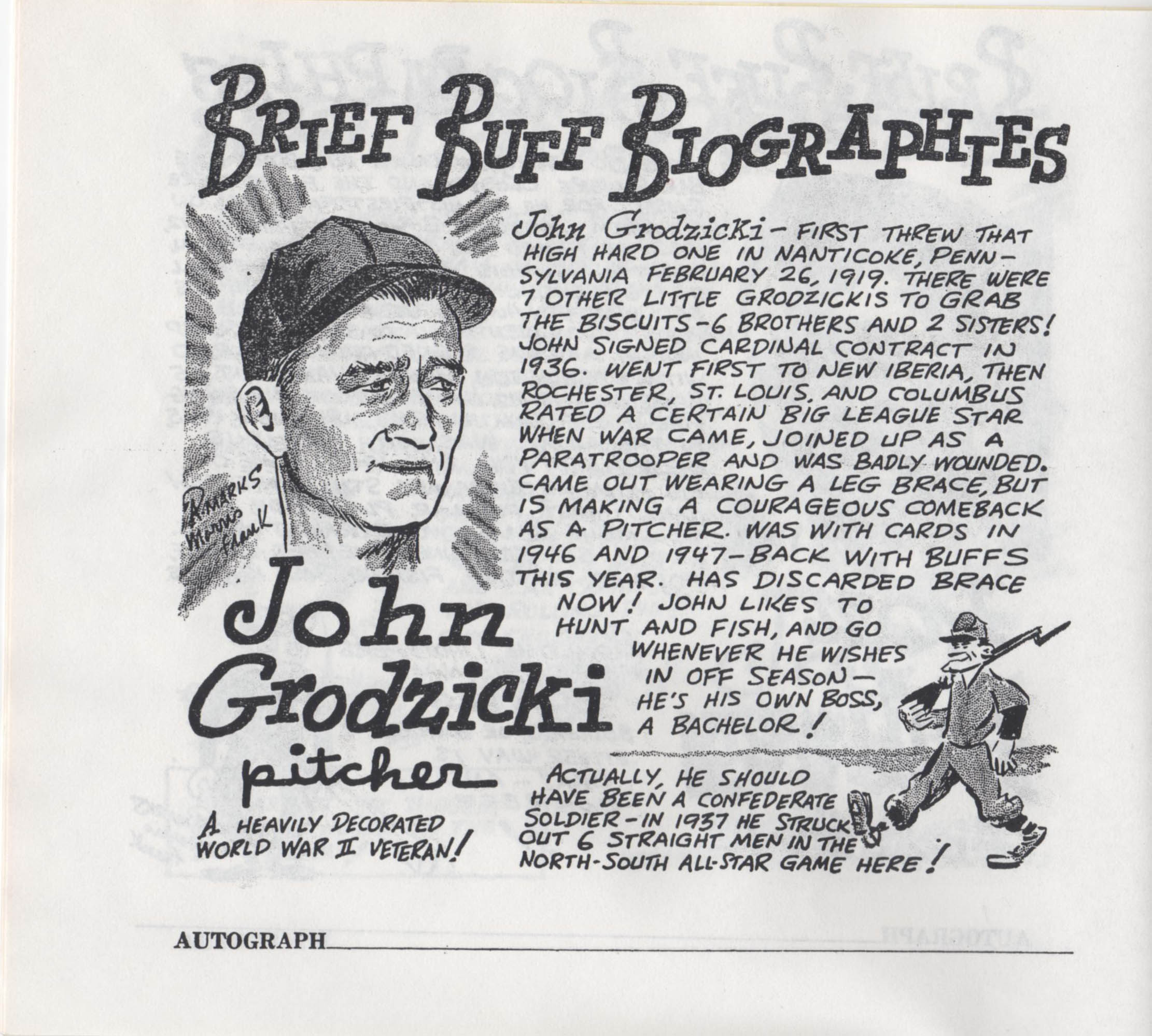
Excerpt from "Your 1948 Houston Buffs, Dixie Champions: Brief Biographies By Morris Frank and Adie Marks (1948).

Excerpt from “Your 1948 Houston Buffs, Dixie Champions: Brief Biographies By Morris Frank and Adie Marks (1948).

Johnny Grodzicki is one of those “might have been” stories that overflow the narrative file on individual careers. He also was a pitcher, and he could have been one the legion who lost their baseball futures after a sudden blip or twang in the arm following an average game or warm up pitch, but that sad mystery  was not his story.

Johnny Grodzicki was a Wold War II casualty.

Six years (1936-41) into his all Cardinal farm club minor league career, Johnny Grodzicki went into the Army for four years of service (1942-45) as a member of the 17th Airborne Division.  In combat in Germany on March 29, 1945, Grodzicki sustained shrapnel wounds to both legs. He was awarded a Purple Heart. He also required surgery and extensive rehabilitation to resume his baseball career after the war’s end.

Due to age and injury, Grodzicki no longer had it as an MLB prospect when he came back to Houston as a 1948 Buff, but he was still good enough to register a 6-5 mark and a 2.05 ERA that year in the Texas League.

Grodzicki’s entire playing career was spent with the Cardinal organization. He was a Buff for whole or partial spots of five seasons (1936-38, 1948-49). His best Buffs season was 1937 when he went 18-11 with a 2.88 ERA. Over his eleven minor league seasons (1936-41, 1948-52), and spanning from age 19 to age 35, Johnny Grodzicki compiled a total minor league record of 108-63, 3.65. In 24 games over three seasons as a Cardinal (1941, 1946-47), Grodzicki was 2-2 with a 4.43 ERA.

After his playing days were done, Johnny spent the rest of his working life as a coach and scout for both the Cardinals and others. He passed away on May 2, 1998 as t the age of 81.

The Buffs in Panama

June 10, 2013
Run, Larry, Run!

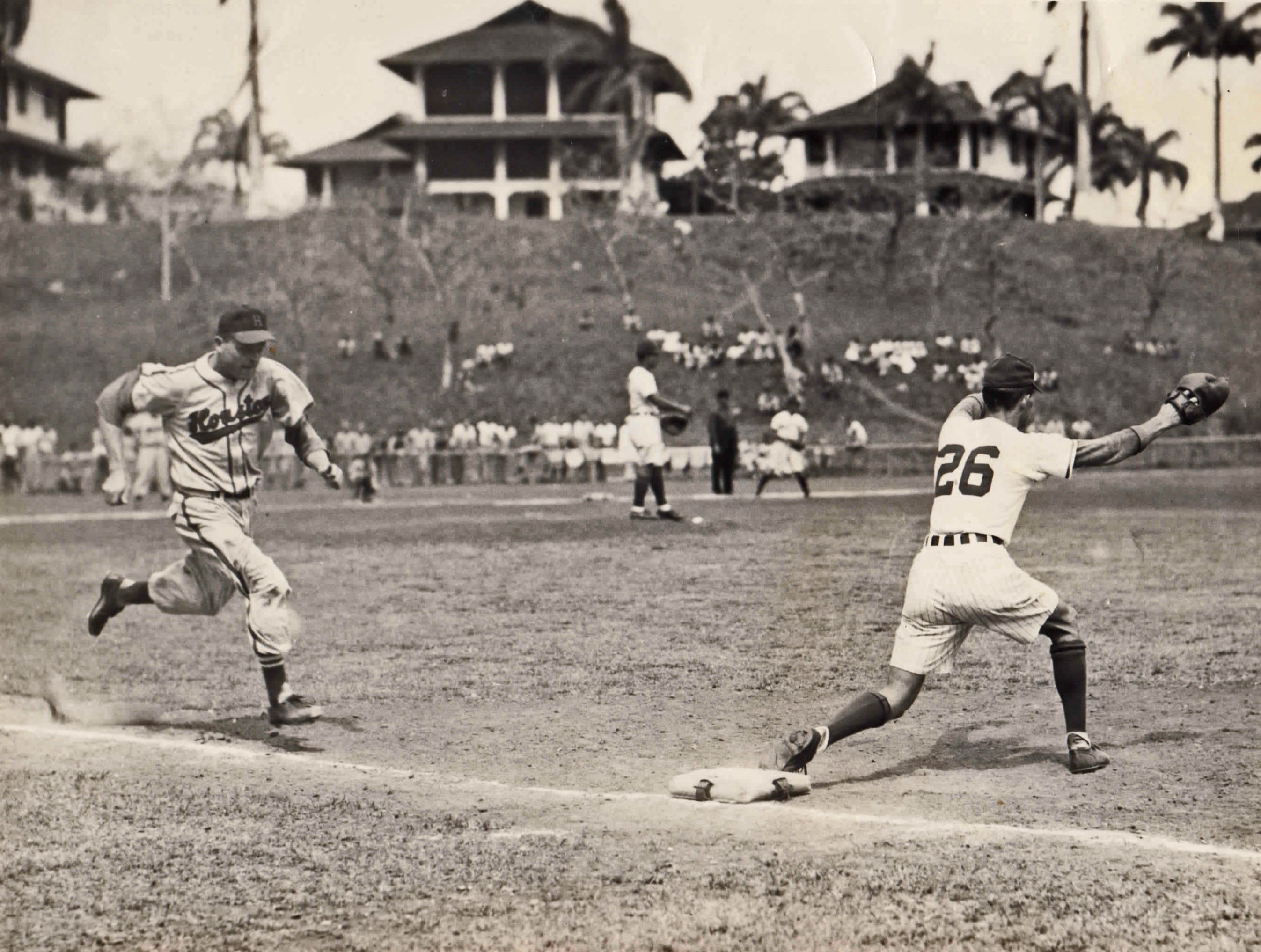
Run, Unidentified Buff Player, Run!

In the spring of 1951, the Houston Buffs trained in Panama, playing several games against the Albrook U.S. Air Force Base Flyers. Here we see a now unidentified member of the 1951 Buffs legging out a ground ball in a game in which the Flyers wore their cool short pants leg uniforms. It looks too much like Larry Miggins to not be him, but for one thing: Larry says he wasn’t assigned to the Buffs in 1951 until after spring training and that delay by the Cardinals caused him to miss the trip to Panama. By the way, the Flyers also had a conventional baseball outfit they wore, but living near the Equator made the brief version popular.

The Buffs wore shorts for less than a month, late in the previous bad season of 1950, but their motives were driven as much by President Allen Russell’s desire to pump the gate with the female fans as it was for player comfort.

Short pants didn’t work in Houston. Nothing can compensate for losing baseball in the long run.

Speaking of heat, we are supposed to get triple digit temps here in Houston by the end of the week. Have fun staying cool, everybody. Whatever it takes to get you there is now in play as the challenge of the day.