Archive for 2013

Buff Biographies: Harry McCurdy

June 30, 2013

Buff Logo 7

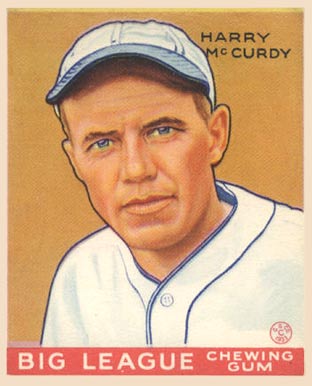
Harry McCurdy 1933Goudey Card It feels as though I’ve known the late Harry McCurdy my whole life. The fact is,  I never even once met him in person, and, in spite of the fact that we regularly got phone calls from people searching for Harry McCurdy at our house while I was growing up in Houston, I was never led to believe that we were related to him as blood family kin.

As an old, but then young Buffs and baseball fan after World War  II, I could only wish that Harry McCurdy was somehow my dad’s much older brother. Born on September 15, 1899, in Stevens Point, Wisconsin, Harry McCurdy (5’11”, 187 lbs.) was born eleven years sooner and half an America earlier than my dad, Bill “Wee Willie” McCurdy, Jr. (5’6″, 140 lbs.). Dad came into this world on December 23, 1910 in Beeville, Texas.

Harry McCurdy grew up to be a big league catcher who batted left and threw right. Wee Willie McCurdy grew up as an outfielder for St. Edwards University Prep School in Austin and various Beeville town ball teams of the 1930s. Opposite Harry, Wee Willie batted right and threw left.

For the rest of their Houston lives, my dad’s role in Harry’s life was educed to simply telling people who called our house looking for Harry McCurdy that “No, this is not THE residence of the Harry McCurdy who serves as Principal of Hogg Junior High School in the Heights. We are the McCurdys, all right, just not that McCurdy. You’ve got the wrong number. – Maybe, you should call Information and ask them.”

As a kid, I often wondered why Dad didn’t just call Information himself and get Harry’s number for the next wrong McCurdy caller, but I guess he didn’t see it as his job to do.

Harry McCurdy was with the Houston Independent School District as an administrator for quite a few years prior to his death in Houston on July 21, 1972 at the age of 72. And I imagine too that he was probably glad to miss some of those complaining parent calls that were aimed at catching him at home away from the shield of staff. After all, how many people call a middle school principal just to chew the fat about baseball?

Harry McCurdy was a smart guy. After graduating from the University of Illinois at Urbana-Champaign in 1922, Harry began a wonderful baseball career that started and ended with seven seasons in the minors (1922, 1924-25, 1929, 1934-36). He spent three seasons with the Houston Buffs (1924-25, 1934), a stint that included his greatest full year of 1925, when he batted .361 with 16 homers in 124 games as a Buffs catcher. His career minor league totals capped at a .314 BA with 29 homers for 489 games over 7 years.

The major league record for Harry McCurdy in 543 games over ten seasons was even more impressive. Harry batted .282 with 9 HR for the St. Louis Cardinals (1922-23), the Chicago White Sox (1926-28), the Philadelphia Phillies (1930-33), and the Cincinnati Reds (1934).

I no longer get calls for Harry McCurdy at my house – and Wee Willie’s no longer here to take them, either, but both of these men remain in my consciousness – and larger than life.

God rest your souls, McCurdy boys!

Sandlot Science

June 29, 2013

Sandlot Science

(1) Play the game barefoot. Take off your shoes after the last day of school going into summer and leave them off, except for those times that you go to church. You will play the game shoeless as a guy named Joe once did and you will develop callouses that are as tough as buffalo hooves by summer’s end. You may get a few broken glass gashes and tin can cuts along the way, but you will be OK.

(2) Protect yourself from mosquitoes. When the mosquito spray truck comes by your field some evenings, rip off your shirt, if you are even wearing one, and run behind it in the chemical fog. Rub that DDT into your chest for even greater protection from the pesky flying skeeters.

(3) Go shirtless in the summer sun. If you’re a girl, just take off as much as you can. The sun’s rays may burn off a few flaky layers of skin, at first, but they will then tan you to some deeper skin tone than you naturally were. The deep tan will fill you with vitamins and protect you from getting sick like those people who avoid our great star’s healing light.

(4) Use your DH to step off the base path distances scientifically. Find someone who clears exactly two feet with each step he takes. Make him serve as your DH. (DH stands for “Designated Hiker”. At game time, go to the area of your sandlot that usually serves as home plate and place a stick in the ground where you think home plate ought to be. (Let’s say it’s usually found near the SE corner of your sandlot.) Then have your DH stand at the stick with a compass and walk 45 steps north and then put another stick at that point as 1st base. Then have the DH turn due west and mark off 2nd base in the same way before heading due south to do 3rd base. Then its walking due east for 45 steps. If the DH has done it right, he should be exactly at the home plate stick at the end of his fourth straight-line walk.

(5) Map out the pitching rubber distance from home plate. Now ask the DH to face due NW from the home plate stick and walk 30 steps in that direction before stopping to add the length of a six-inch pencil or cigar to the NW distance and putting another stick there for the pitching rubber location.

(6) Install the bases and pitching rubber.  Find 5 big rocks or 5 tee shirts and replace the sticks in the ground with these objects as home plate, the three bases, and pitching rubber.

(7) Line out fair territory. As kids, you must only expect this step to work once and very temporarily. Run out strings from home plate to the end of the lot down both the 1st and 3rd base lines. Then carefully sprinkle flour you’ve borrowed from several mothers’ kitchens down both lines of string, all the way to where the street or sidewalk resumes on either side. Only take this step if you are willing to accept from the start that there will be repercussions that could result in the suspension of everyday play.

(8) Electric tape made the sandlot possible. The balls and players of sandlot baseball went on forever. Without adults in our way, we played for as long as daylight and moms allowed. We (and the scuffing concrete streets) literally knocked the cover off the ball, but that was OK. If a ball lost its skin, we just wrapped it in electric tape and the game played on until the day’s last light for continuation tomorrow – on its trek to forever.

(9) Never throw away a cracked bat.  We didn’t. We couldn’t afford to throw them away, but it wasn’t necessary either. We just nailed them together and wrapped the fix-point with electric tape too.

(10) The science of the sandlot boiled down to a simple reality. Good things you love never have to end when you never give up on them. And our earlier Post World War II generation never gave up on sandlot baseball. We just grew up in a world that eventually stole away our sandlot time until some of us got old enough to fight our way back into that frame of mind.

sandlot 02

The Greater Cardinal Sin

June 28, 2013
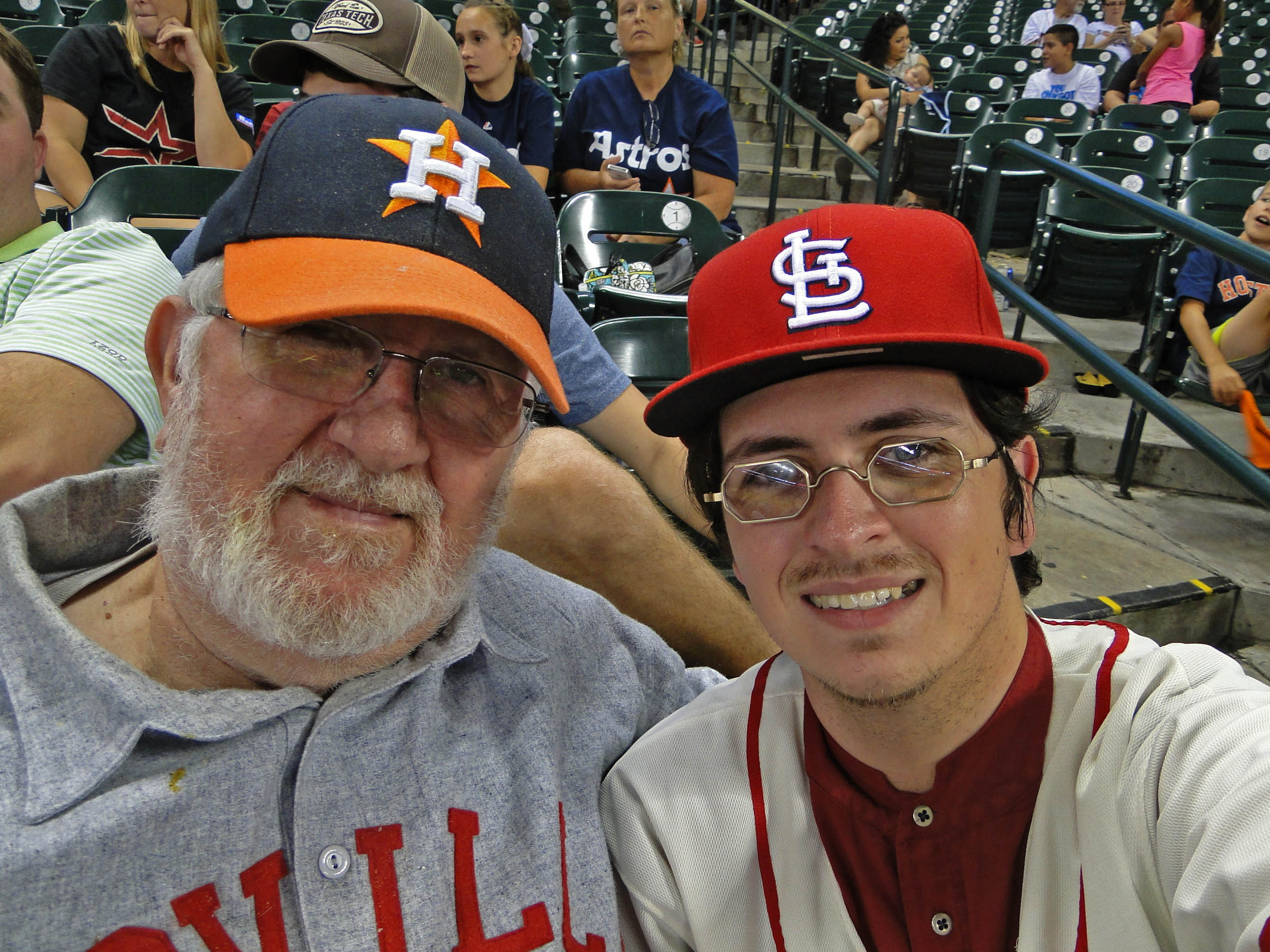
Neal and I saw the Cads whack the Astros, 13-5, on Tuesday night. We should have gone Wednesday and we could have seen the Astros rally to defeat the Cards by 4-3.

My son Neal and I saw the Cardinals whack the Astros, 13-5, on Tuesday night. We should have gone Wednesday and we could have seen the Astros rally to defeat the Cardinals by 4-3.

Which is the greater cardinal sin? Is it remaining loyal to the Houston Astros even though they have now been forced to play baseball in the American League and to abide by the “DH” rule that governs there? Or is the greater cardinal sin to be found upon the souls of those who  abandon the Astros as a result of their involuntary league switch as they also shift their allegiances to other National League teams?

Neal was happy with the 13-5 Tuesday Cardinal drubbing.

Neal was happy with the 13-5 Tuesday Cardinal drubbing.

Yours truly falls into the “Astros Loyalist” category. My son Neal is an adamant defector and now a rabid supporter of the team he always liked secondarily to the Astros as a kid, the St. Louis Cardinals.

“Dad,” Neal says to me, “you’re the one that always taught me that it’s the NL that plays real baseball, not the AL with their stupid DH rule. Now I will no longer go to Astros games at Minute Maid Park, unless its to go with you to watch them get their rears kicked by the Cardinals!

“What happened to you, Dad?” Neal goes on. “How can you abide watching the Astros playing by rules that aren’t even real baseball in the first place? I just don’t get it.”

I’m not sure if I have a good explanation – or even a strong need to explain myself to Neal or anyone else on this point, although I do think Neal gets what I’m now about to say in repetition to each of you here:

I am first of all a Houstonian. Once the Crane purchase came down with the AL move requirement put in place as Commissioner’s Bud Selig’s condition for approval of the deal, I saw my choices as (1) walk away from baseball altogether; (2) do what Neal did, transfer my loyalties to the Cardinals, the MLB team of my youth, along with the now defunct Browns; or (3) deal with the AL move and stay true to my hometown team.

Well, for better or worse, it didn’t take me long to see my only choice. I wasn’t going to give up major league baseball and, unlike my son, I wasn’t capable of simply transferring my loyalty to the Cardinals. I had to stay with my hometown Astros and deal with both the imposed influence of Bud Selig and the coming of DH baseball to Minute Maid Park.

Half way through the 2013 first AL season for Houston, I’ve only seen two games in person and none on television. Our house is among the 60% that doesn’t get Comcast, the only carrier of Astros TV games.

Both of my MMP games have played out over the past eight days: On Thursday, June 20th, I went with a friend to a day game and got to see the Astros down the Brewers, 7-4, on an exciting 10th inning walk-off homer by Carlos Pena. Then Neal and I went to see the Tuesday, June 25th, 13-5 drubbing that the Cardinals put on the Astros earlier this week.

Here’s what I notice: (1) I don’t miss the Astros on TV, but that has to with the fact that they are a losing baseball team, not because they are playing in the AL; (2) the DH doesn’t bother me at all. In fact, I had no sad feelings at all over the fact that we were not going to see the pitchers bat; (3) I suffered no feelings of loss that the DH rule was protecting Astros manager Bo Porter from some big strategy decision with the double switch; and (4) I was more intrigued now with how Porter was deciding when to make a big pitching change without the NL’s built-in pinch-hitter-for-the-pitcher spots in place to make the tough decisions easier for him.

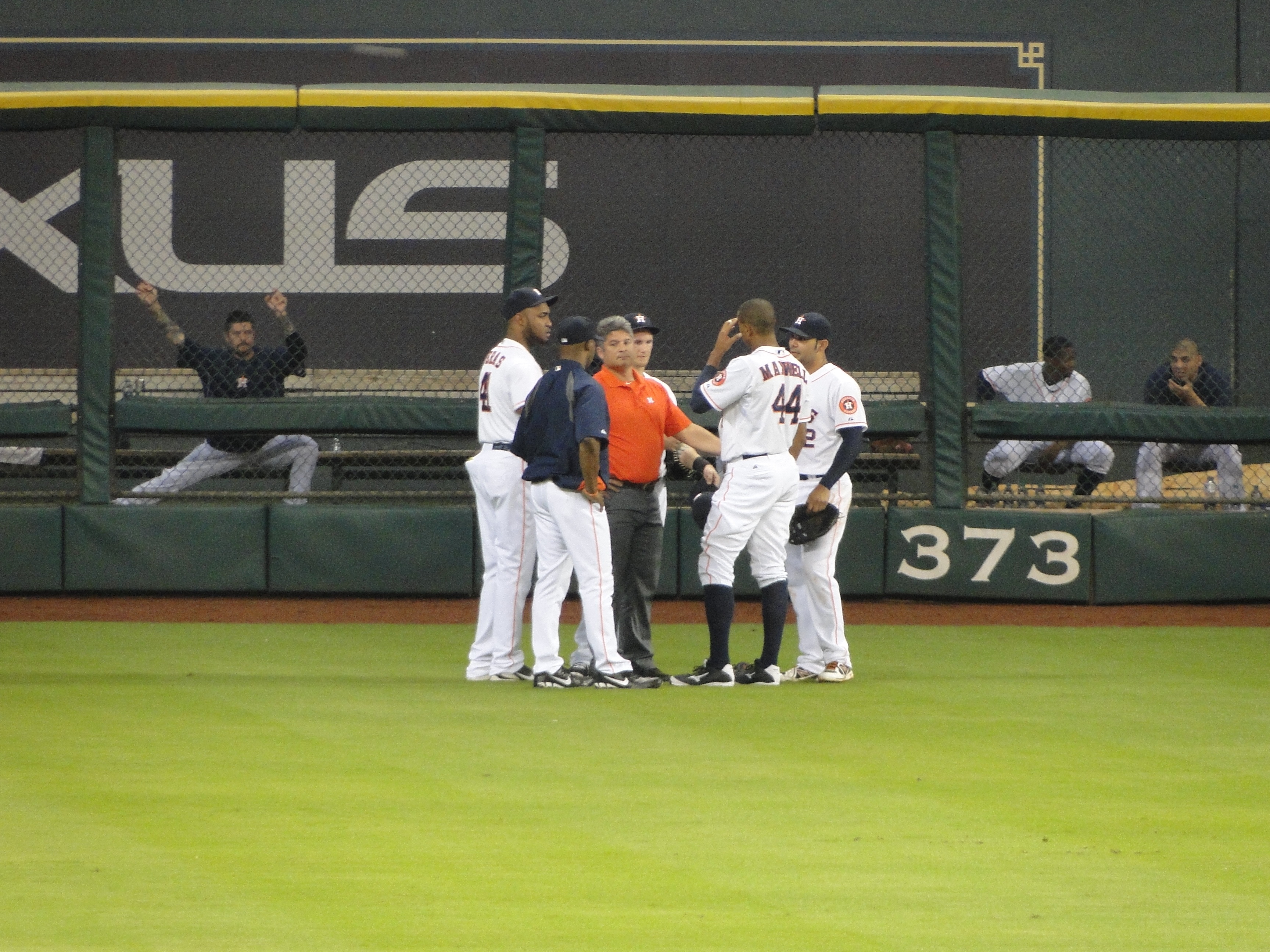
Astros right fielder Justin Maxwell suffered a mild concussion on his failed attempt on a diving miss of a bases loaded triple Tuesday night.

Astros right fielder Justin Maxwell suffered a mild concussion on his failed attempt on a diving miss of a bases loaded triple Tuesday night.

For me, my acceptance of the AL/DH presence in my hometown Astros’ lives comes down to this: I’m 75 years old now and I’ve never seen my Houston Astros win a World Series. Maybe we’ll have better luck in the AL within two to three years. I like manager Bo Porter and I like what GM Jeff Luhnow is doing with the farm system. Now we just need to see owner Jim Crane and President Reid Ryan sign and keep the players we need on the roster long-term to have a winning shot.

I also look forward to regular season games with the Yankees and Red Sox far more than I do regular annual contests with the Brewers and Marlins.

As for cardinal sins here, there really isn’t one in my book. I respect everyone’s right to decide for themselves what they choose to do with the Astros in the AL reality.

Give up MLB baseball. Transfer your loyalties to another NL club. Or work it out and keep watching the Astros.

The choice is yours.

A Pecan Park History Note

June 27, 2013
Pecan Park ... It's a state of mind thing.

Pecan Park … It’s a state of mind thing.

As many of you already know, my passion for the history of the Pecan Park neighborhood in southeast Houston is fueled by the fact that I grew up there from 1945 through 1958, from age 7 to age 20.  As such, I am also a junkie for any news or historical references that show up about my old stomping grounds in the newspaper files of those earlier times.

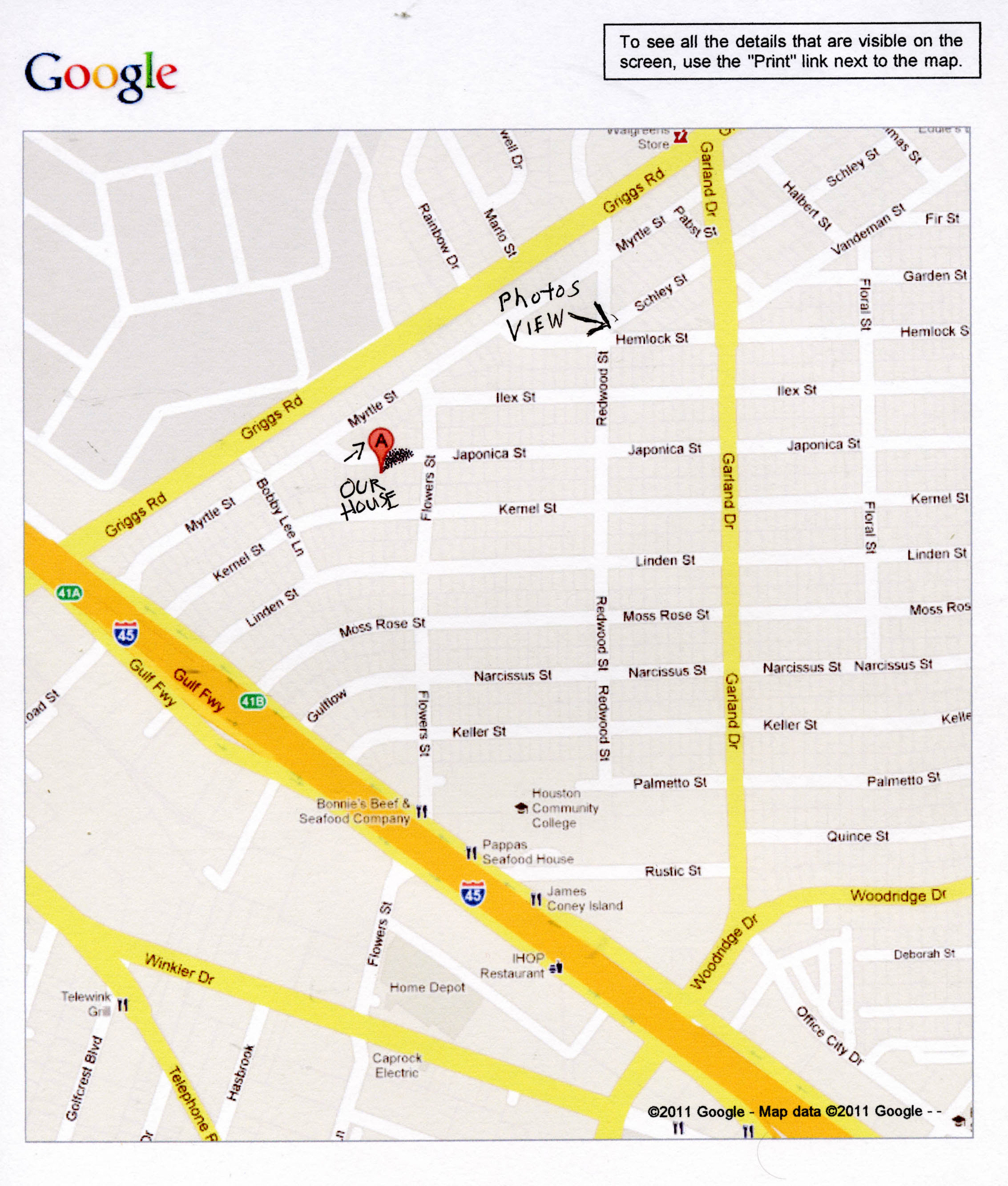
This map provides a little help showing the location of Pecan  Park relative to the I-45 South Gulf Freeway.

This map provides a little help showing the location of Pecan Park relative to the I-45 South Gulf Freeway.

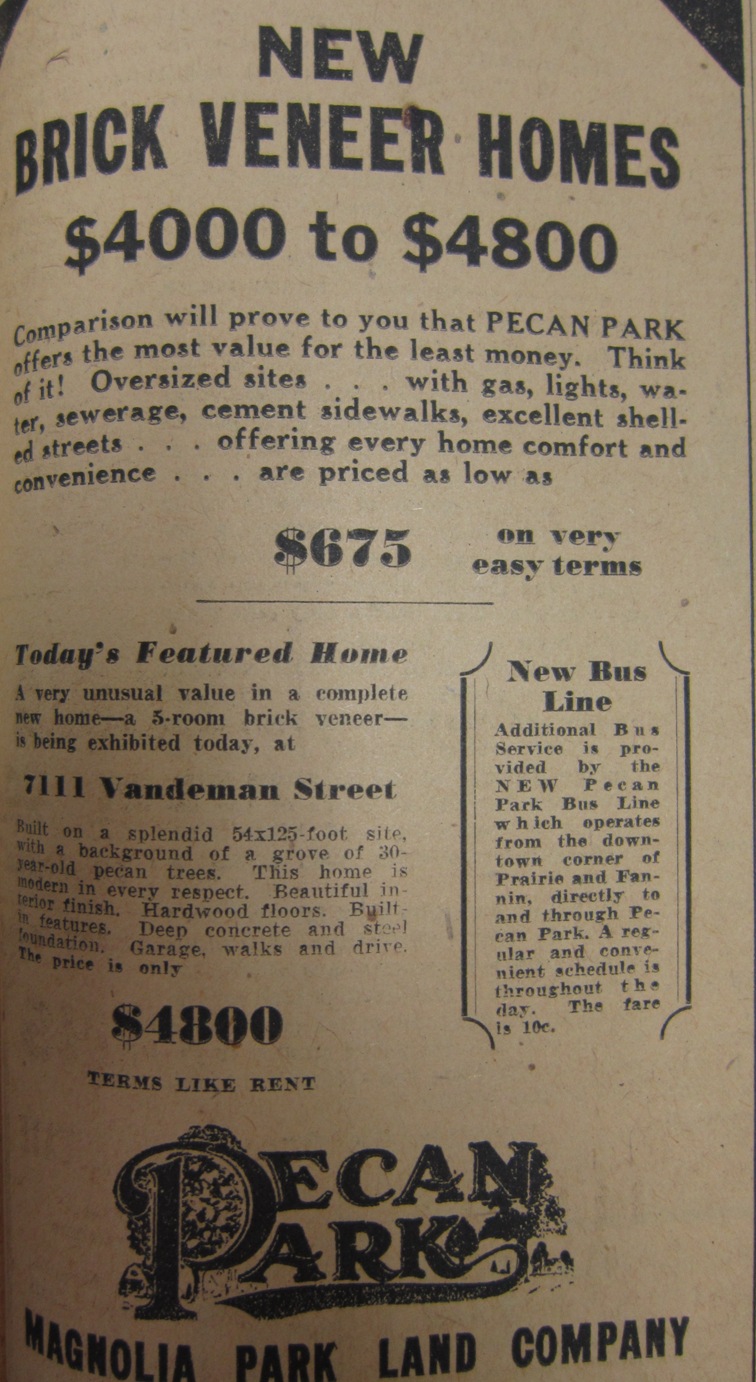
Four days ago, I was rewarded with a gift from friend and SABR colleague buddy Mike Vance. Mike sent me a copy of the following real estate advertisement  from the July 6, 1930 edition of the Houston Post:

hp 6 jul 1930 pecan park sm

Of course, I immediately had to check and see what the property at 7111 Vandeman Street looks like today through the Google Maps street view program. I learned that the property is now the base for a small apartment house project, but the house to its right looks as though it could have been a neighbor to the five-room place advertised in the post.

The housing prices are consistent with what my dad always told me about our own place. He and Mom bought our home at 6646 Japonica in 1945 on a $5,000 mortgage purchase over thirty years. They kept the house as a rental property once they finally moved in 1958, but finally sold it in the early 1970’s. The last time I checked Harris County proper valuations about three yeas ago, our old house was now valued at something in the low $90,000 dollar territory.

Money’s crazy. Inflation is even crazier.

Our Japonica Street place was pretty much standard for Pecan Park homes as far as size and space offerings are concerned. We didn’t have the brick veneer, but we did have real wood siding boards and none of this particle board crap that begins to fall apart in about ten years.

Five rooms included a living room, kitchen, dining room, and two bedrooms. We had one bath, a one-car garage with a manual door, an attic fan for coolness in the summer and a floor furnace for heating in the winter. My dad added a large bedroom after my sister was born in 1949, but we did not begin to have air-conditioning until my folks bought a window unit for the living room in 1957. Attic fans cooled by sucking air though opened screened windows and through the attic. These also brought with them all the various seasonal and full-time smells that hovered outside – and I do mean everything – from the putrid smells of the nearby Champion Paper Company in Pasadena to the rotting figs on the tree outside my bedroom window.

Those wonderful finely crushed gravel roads that the above ad mentions were pretty much gone, converted to cement, by the time we moved into Pecan Park, but Flowers Street was still that way for a while. We used to harvest Flowers Street gravel as land filler in the bowls we used as homes for our pet turtles.

The mostly Hispanic immigrant families that now live in Pecan Park have done a good job keeping the old neighborhood alive in recent years. The family  that now owns our old place, in fact, has greatly improved the property, adding a long sitting-room front porch and converting the garage to some kind of extra inside room.

Everything changes – for either better or worse – or simply because nothing ever stays the same over time – no matter how much we fondly remember what we often think of as “the good old days.” Pecan Park will always be with me in the present because it was always there for me in the past, but it has changed – and so have we all.

I will still collect everything I can find on its history for as long as Pecan Park items keep showing up.

Buff Biographies: Roy Huff

June 26, 2013
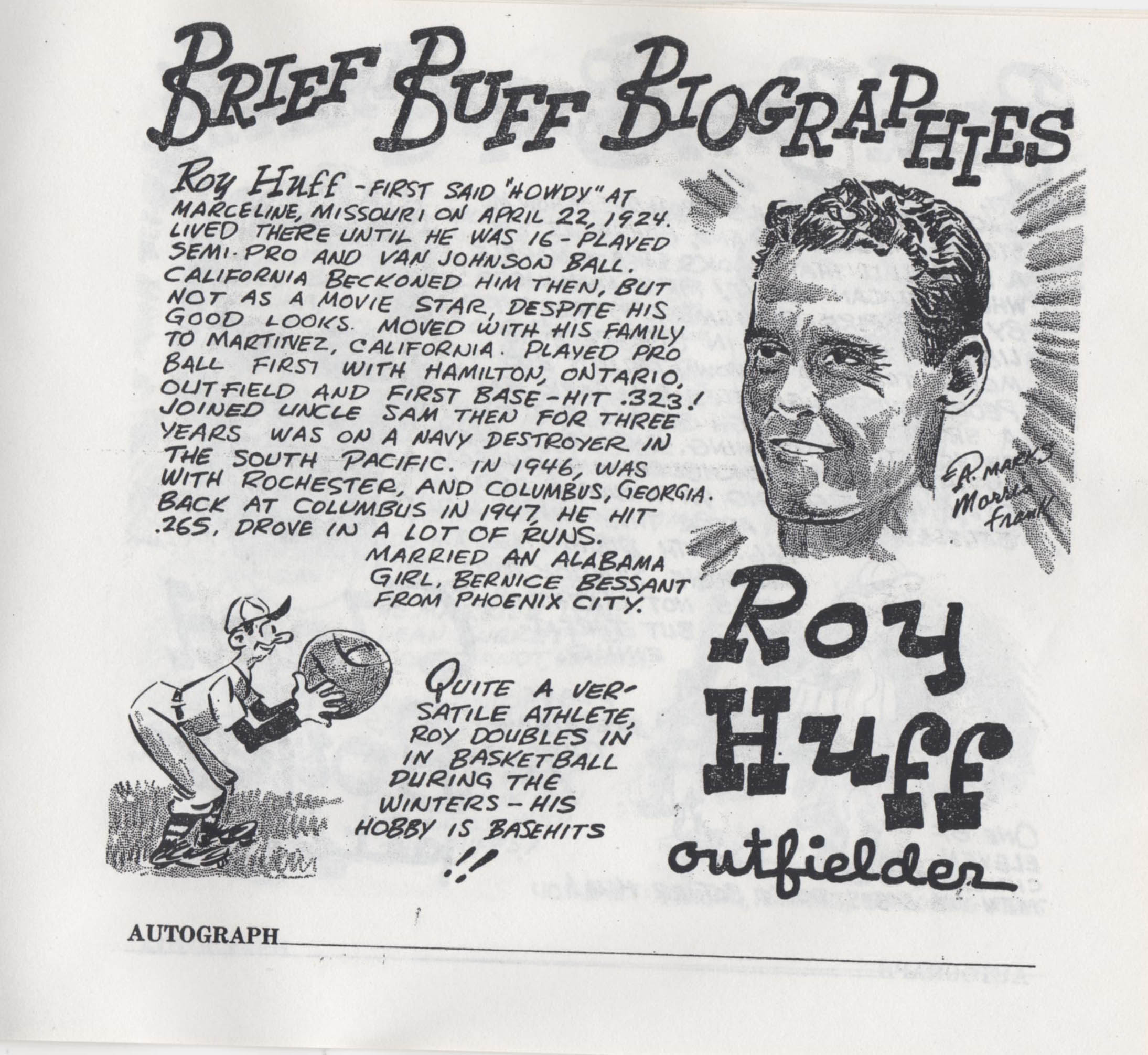
Excerpt from "Your 1948 Houston Buffs, Dixie Champions: Brief Biographies By Morris Frank and Adie Marks (1948).

Excerpt from “Your 1948 Houston Buffs, Dixie Champions: Brief Biographies By Morris Frank and Adie Marks (1948).

Outfielder/1st Baseman Roy Huff (6’1″, 180 lbs.) (BL/T?) was born on April 22, 1924 in Marceline, Missouri. He lived there until age 16, when the family moved to Martinez, California. The following year, 1941, Roy began a nine season minor league career (1941-42, 1946-52) in which he batted a reasonable .270 with 74 homers. In between, Huff served thee years in the Navy during WWII (1943-45).

In 1948, his only season as a Buff, Roy Huff batted .230 with 3 HR in 252 times at bat for Houston. His best season was 1942 when he batted .320 for Class D Hamilton with 8 HR. His next best season, or maybe his best overall, was 1950 when he hit .302 with 18 HR for Class A Omaha.

Baseball Reference has no recollection of his throwing arm side and neither do I. Sorry to admit it, but beyond a blurry recognition of his name, my personal memories of this ancient Buff named Huff are almost missing from the memory of my second season as a kid baseball fan.

Baseball Reference also lists Roy Huff as alive today at age 89. I tried to verify that conclusion with findagrave.com, but could pull up nothing to show that he may be deceased as of 2013. We shall keep an eye and ear and digital search close at hand for further data on Roy Huff of the 1948 Houston Buffs. For now, he looks simply like another short-term member of the minor league passing parade from long ago.

We still respect him for having given part of his early life to the game we all love. Without the Roy Huffs of this world, there would be no more famous baseball history stories to write.

Thanks for the good, the bad, and the ugly, Roy Huff. None of us would have much to look back upon as baseball were it not for the passionate pursuits of reserve clause era guys like you.

Buff Biographies: Jack Angle

June 25, 2013
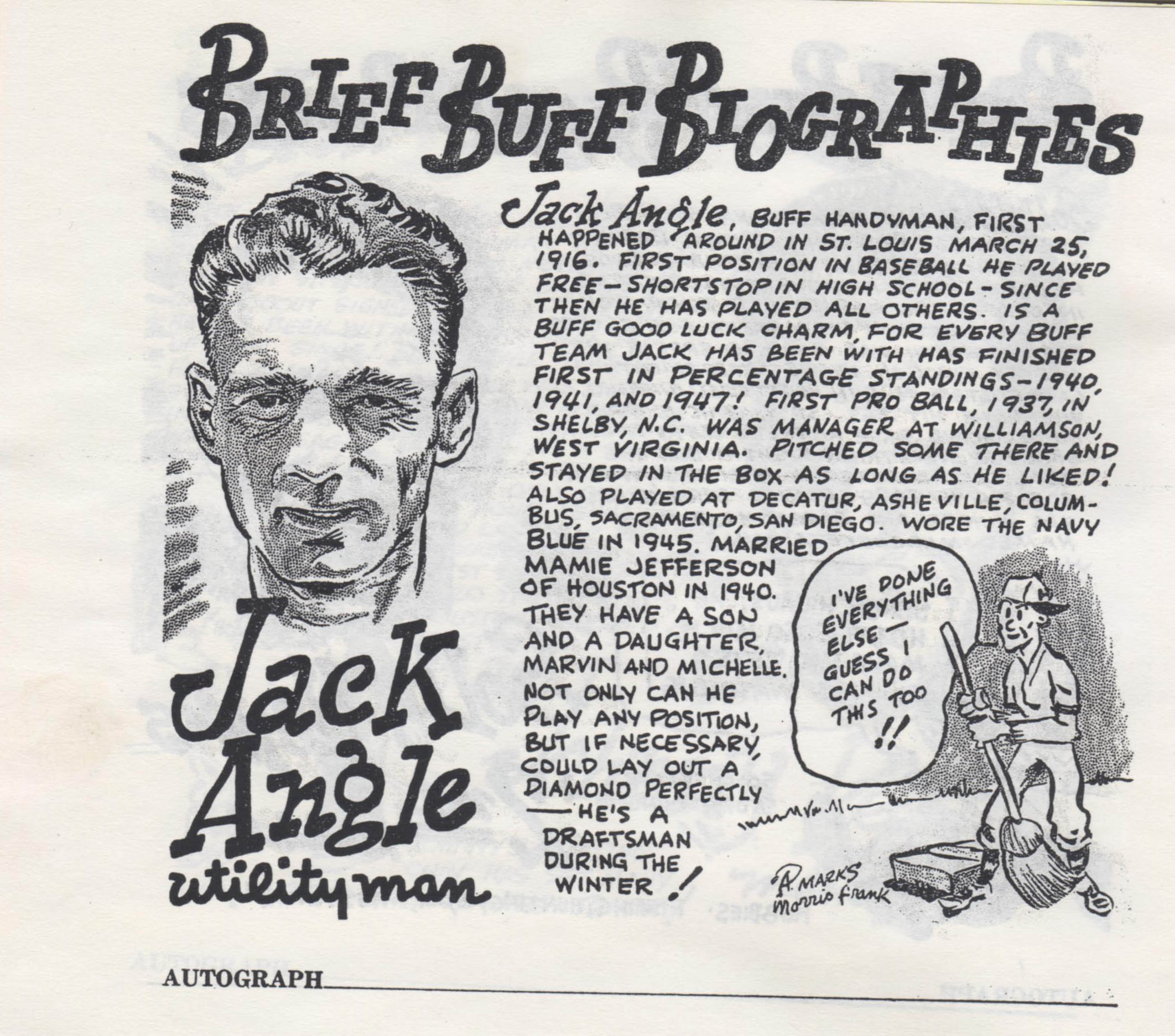
Excerpt from "Your 1948 Houston Buffs, Dixie Champions: Brief Biographies By Morris Frank and Adie Marks (1948).

Excerpt from “Your 1948 Houston Buffs, Dixie Champions: Brief Biographies By Morris Frank and Adie Marks (1948).

Jack-of-all-trades utility man Jack Angle (BR/TR) (5’11”, 167 lbs.) was born on March 25, 1916 in St. Louis, Missouri. He passed away at age 79 on October 21, 1996 in Claremore, Oklahoma and was buried there in the Woodlawn Cemetery.

As a Houston Buff for four seasons (1940, 1941, 1947 and 1948), Angle’s teams each finished first with the best winning percentage in the league over the first thee years of his local tenure. His 1948 tout with the Buffs also proved be the last of his 12 seasons (1936-44, 1946-48) as a minor leaguer in the Cardinals system. Jack batted .270 with 40 HR over the course of his career. His .251 mark with the 1947 Dixie Series champion Buffs was his best local mark, but it wasn’t his bat that made him valuable to Houston. The guy could, and did, play all eight field positions with some degree of competence, confidence, and reliability. That versatility was a tremendous asset to any minor league club back in the days of limited rosters of 19 players.

Jack married a Houston girl that he met in 1940 and also developed an off-season occupational skill as a draftsman that helped him support the children that he and Marie Angle raised together. Those utility guys are always thinking. They are the wizened ones that understand one of life’s most basic truths: The more things I do well, the more my chances of keeping my job or finding new work go up to the max.

Thank you for making Houston one of your career stops, “Jumping Jack” Angle. It’s always easier to jump when you’ve got something in your pocket or in your mind that helps you bounce and rebound.

Right, Jack?


Man of Steel Review: Spoiler Alert

June 24, 2013
While he was growing up on Planet Earth, his adoptive human father tried to keep his special powers secret. "Once the world finds out about you, it's going to change the way everyone sees everything!"

While he was growing up on Planet Earth, his adoptive human father tried to keep his special powers secret. “Once the world finds out about you, it’s going to change the way everyone sees everything!”

SPOILER ALERT!!! If you haven’t seen the new Superman movie, Man of Steel, you may want to pass on reading any further. I cannot think of a way to describe the “prequel” qualities of this film without relating certain information you may not wish to know in advance. On the other hand, if you are a longtime loyal Superman fan, read away. – After all, we always know how this “strange visitor from another planet” fares against “the forces of evil” in the end, don’t we?

Not afraid? – Good! – Let’s get with it!

Man of Steel is not one of those Superman flicks that finds the immigrant Kryptonian grown up and working as a reporter for The Daily Planet within the first ten minutes of rolling film. Man of Steel essentially is the prequel story of how this special being even gets his job at that famous fictional newspaper.

The death of Planet Krypton is treated with more causative information than we’ve ever previously received. Krypton is imminently near the end due to its governmental disregard for personal freedom, its dedicated commitment to genetic breeding of new Kryptonians on a “skills needed”, external-to-the womb agricultural breeding process, and its misuse of energy from the planet’s core that is moving everything to a point of imploding destruction of all life.

The writers’ warnings for Planet Earth are clear and obvious.

Jor-El (Russell Crowe) is the chief Kryptonian scientist who has come to see the beginning of the end. He secretly has bred his own infant son by natural childbirth with his wife, Faora-Ul (Antje Traue) with all the genetic skills. He has also built a rocket ship to take the infant to another planet where survival and protection by another compatible species would allow their child to later interbreed and pass on the best of Krypton to another world in need of less imminent salvation.

The future “Superman” is thus framed here as both the saved one – and the savior of others who need his help. Cal-El/Clark Kent (Dylan Strawberry as a teenager; Henry Cavill as an adult)

General Zod (Michael Shannon) wants to kill the failed governmental leaders for their failure and take over control of all breeding secrets so that he can “save” Krypton by military rule. A bloody encounter with Jor-El in the halls of government results in General Zod learning of the former’s plan to launch into space, but he is too late to stop it. After he and his followers are sentenced to something like a 1000-year freeze in space, the future Superman is launched in the nick of Krypton’s end time. He reaches Earth OK, where, as you undoubtedly know, he is raised by midwestern farmers Jonathan and Martha Kent (Kevin Costner and Diane Lane).

The central theme of Superman’s childhood is the message from his earthly father: “Be careful not to show your powers to others before it is time because the world changes forever once everyone can know your power. Aside from a few near misses on total exposure, Clark Kent as a young man is able to refrain from even trying to save his father in a public situation during a tornado.

After his father dies, Kent stumble around though some manual labor jobs, but he uses his special powers enough to draw attention from reporter Lois Lane (Amy Adams) and editor Perry White (Laurence Fishburne) of The Daily Planet.

Enter the action theme of the movie.

The heat from the explosion of Krypton was enough to thaw out General Zod and his small army of followers. They somehow were able to salvage a space ship with enough intelligence and munitions to follow Superman to Earth in the hope of recovering his genetics program that would allow them to kill all the Earthlings and take over the planet as their new Krypton.

The General Zod threat is Superman’s coming out call – blue tights, red cape, flying, fighting, and all.

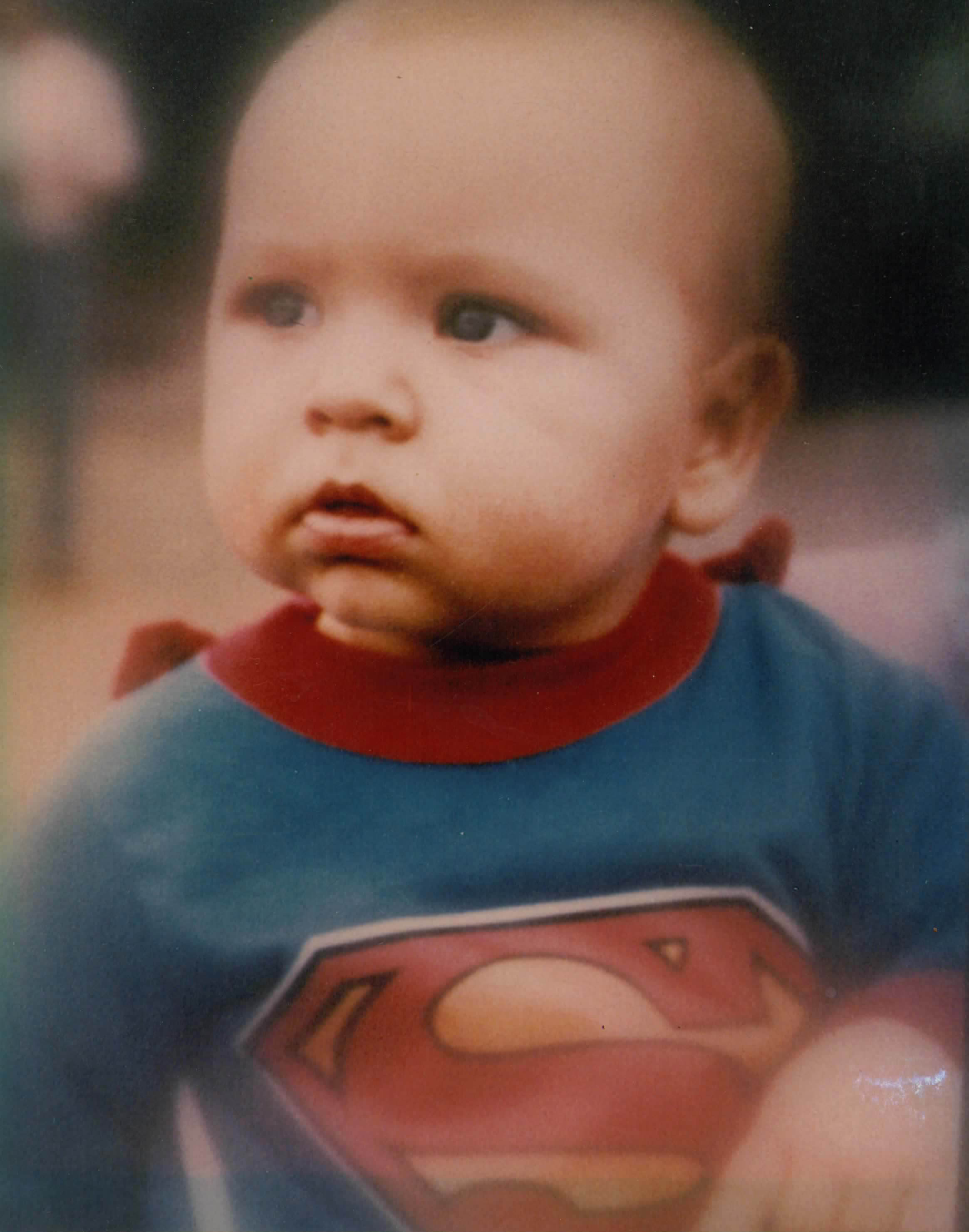
The action now moves into 3-D delight gear, rivaling anything ever put out there by Star Wars or Star Trek. Superman finally kills General Zod and all his minions. He explains that the large “S” on his chest is nothing more than a Kryptonian symbol for “good luck”.  That’s when Lois Lane explains to him that “down here on Earth it looks more like an ‘S’ – and ‘S’ in your case, has to stand for ‘Superman’.”

Only in the last scene, nearly two and a half hours into the film, does Superman show up in a suit, tie, hat, and glasses at the Daily Planet.  He is introduced by Editor Perry White as “our new cub reporter, Clark Kent.”

Clark Kent and Lois Lane exchange secretive smiles. This time, Lois knows. She knows that Clark Kent is really Superman. She knows that he plans to help improve the Earth’s gene pool. And she knows that he is interested in her. She also knows that he’s more powerful than a locomotive, but she shows no real concern for the fact that he’s also reputed to be faster than a speeding bullet.

If you’re a Superman fan, it’s a deeper twist on an old theme with plenty of action fireworks. If you’re looking for something from Dostoyevsky or Chekhov, don’t bother.

Buff Biographies: Johnny Bucha

June 23, 2013

Image

The above cartoon is an excerpt from “Your 1948 Houston Buffs, Dixie Champions: Brief Biographies By Morris Frank and Adie Marks (1948).

Catcher Johnny Bucha was one of those former Houston Buffs who did get his major league cup of coffee extended through the entire breakfast club hour. Born in Allentown, Pennsylvania on January 25, 1925, Bucha played 2 games with the 1948 St. Louis Cardinals, 22 games with the 1950 Cards, and 60 games with the 1953 Detroit Tigers, where he also picked up his only big league homer. His batting average for the entire big league foray was .205

Johnny Bucha Detroit Tigers 1953

Johnny Bucha
Detroit Tigers
1953

As a 16-season minor leaguer (1943-49, 1951-52, 1954-60) Johnny Bucha did quite well with the stick, hitting for a career batting average of .289 with 96 home runs. In his lone 1948 season with the Houston Buffs, Johnny Bucha played a back up catcher role, hitting .236 with one homer in only 32 games. Bucha’s best year was 1954 when he batted .331 with 16 homers for two AAA clubs at St. Paul and Buffalo. He had a higher .338 BA earlier for 1944 Allentown, but that was for a wartime Class B club.

As a kid, I remember thinking that Johnny Bucha (BR/TR) (5’11”, 190 LBS.) both looked and acted like a catcher. Maybe the fact that he hardly ever beat any land speed records running out ground balls or stealing bases contributed to the impression.

Johnny Bucha died on April 28, 1996 at Bethlehem, Pennsylvania. He was 71 when he passed.

Rest in Peace, Johnny B!

Buff Biographies: Pete Mazar

June 22, 2013
Excerpt from "Your 1948 Houston Buffs, Dixie Champions: Brief Biographies By Morris Frank and Adie Marks (1948).

Excerpt from “Your 1948 Houston Buffs, Dixie Champions: Brief Biographies By Morris Frank and Adie Marks (1948).

Lefty Pete Mazar Columbus Redbirds 1951

Lefty Pete Mazar
Columbus Redbirds
1951

“Lefty Pete” or “Little Pete” Mazar (BR/TL)) (5’9″, 152 lbs.) of the Houston Buffs came by his two nickname references in the most honest baseball ways. – Besides having some talent for pitching a baseball, he simply was both of those things: a little guy who threw left-handed. Hence, the obvious identifications. Baseball people like to express the straight line obvious whenever possible.

As noted in the 1948 cartoon sketch, Pete Mazar was born in Annandale, New Jersey on February 9, 1921.  Baseball Reference shows Pete Mazar as still living at age 92, but we knew that couldn’t be true from more recent contacts with his now deceased widow, Mrs. Eleanor Mazar. A search by independent researcher Darrell Pittman now confirms that baseball’s Pete Mazar passed away at age 62 on April 1, 1983 in High Bridge, New Jersey, a small town located only a few miles from his place of birth.

http://www.death-record.com/l/105431381/Peter-Mazar

Confirmation also has been obtained that Pete’s widow Eleanor subsequently passed away at age 83 while living near two of their four surviving daughters in LaPorte at Pasadena in the Houston area on January 20, 2006. The other two Mazar girls live away from the State of Texas.

http://www.findagrave.com/cgi-bin/fg.cgi?page=gr&GRid=53420404

As for baseball, we have to chalk up Pete Mazar as another of those talented farm hands from the reserve clause era that never got to throw a single major league pitch because of the piled-up talent glut and the shortage of big league opportunities for making it with only 16 MLB teams and each of them reducing a player’s choices to virtually zero on an every season basis. Being “good” was no guarantee of a major league career; and never playing in the big leagues did not mean that a player wasn’t any good. Pete Mazar was another of those good players who simply never got a big league shot.

Over the course of his 12-season minor league career (1941, 1944-54), Lefty Pete Mazar racked up a pitching record of 100-105 with an ERA of 4.o3. In 5 seasons with the Houston Buffs (1947-51), Pete registered his best season as a pitcher for the 1948 Buffs club, posting a record of 15-10 and an ERA of 2.53.

I remember Mazar as a battler, a guy who would grind it out as long as his manager allowed him to go, and one pitcher who almost seemed to enjoy getting into situations that he then had to escape. The joy in his body language upon an avoided bad inning was as apparent as his obvious dejection in times things did not end well.

Pete Mazar also owns the distinction of being Buff President Allen Russell’s first “baseball crooner” in a line of players that later included such memorable Buffs as outfielders Larry Miggins and Danny Gardella. Russell just loved having talented singing ball players who could do The National Anthem or other music on special occasions. He couldn’t miss with “Frank Sinatra Jersey Boy Mazar”, a guy who could take singing way beyond simply carrying a tune.

Mazar got to do The National Anthem more than once at Buff Stadium, but it’s too bad that Russell wasn’t quite ready to expand these player/crooner concerts to cover subjects like his aversion to rain outs and rain checks. Pete Mazar could have done a great job on “Singing in the Rain”, or even better: “Rain! Rain! Go Away! – Come Again Some Other Day!”

The last time I saw Pete Mazar pitch was in that preseason game the Buffs played against the New York Yankees in early April 1951. He soon after went 2-1 with the ’51 Buffs and earned a move up to AAA Columbus,  never again returning to Houston as a player, though making his home here for several years.

That 1951 Buffs-Yankees game was a signature day for Lefty Pete. The Buffs took an early lead over the Yankees, but Pete got himself into one of those trouble spots. It was not a good time for it. The Yankees had guys named Joe DiMaggio and Yogi Berra in the lineup, plus an 18-year old kid rookie right fielder named Mickey Mantle coming up to bat.

The merciful version is that Pete Mazar got blasted by the 1951 New York Yankees. The heart version is the whole story. – Pete Mazar fought them as hard as he could, for as long as he was allowed, giving it all that he had, – and he still left the game obviously dejected that he had not pitched out of a jam against one of the greatest baseball teams of the mid-20th century.

Thanks for the memories, Pete. And thanks for all the heart and talent that made you the man you were.

Buff Biographies: Herb Moore

June 21, 2013
Excerpt from "Your 1948 Houston Buffs, Dixie Champions: Brief Biographies By Morris Frank and Adie Marks (1948).

Excerpt from “Your 1948 Houston Buffs, Dixie Champions: Brief Biographies By Morris Frank and Adie Marks (1948).

Former Houston Buffs pitcher Herb Moore (BL/TL) (6’0″, 200 lbs.) was born on November 27, 1915 in the town of Crew in Prince George County, Virginia. He died on June 18, 2002 in Chester, Virginia at the age of 86. In the early in-between years of his long life, he worked out his passion for baseball as a steady journeyman minor  league pitcher, mostly in the St. Louis Cardinals farm system, for 12 seasons (1933-38, 1941, 1946-50).

Moore first performed for the Buffs in 1936, starting the season at age 20, using his fair assortment of goodies to post a record of 8-13 with a 4.38 ERA. He returned to the Buffs over a decade later and put up a 5-2, 5.60 ERA mark for the 1947 Texas League and Dixie Series champion Buffs. 1948 was Herb’s final season as a Buff and he managed only a 1-2 mark in 35 innings of work.

1948 was also Herb Moore’s last dance as a career Cardinal far hand. After his closing tango with the ’48 Buffs, Moore pitched two final seasons at thee D ball level and then hung ‘em up. He finished with an all minor league career record of 86-62 and a 3.34 ERA. His two best seasons were 1935 when he was 21-5 with a 2.97 ERA for Class B Asheville and 1946 when he went 15-3 with a 1.44 ERA for Class D Albany.

Moore’s .278 career batting average speaks for his better than average hitting ability, but his .529 BA in 1947 speaks volumes for Herb Moore’s ability to come through in critical game situations and as a pinch hitter. In 17 official at bats for the ’47 Buffs during the regular season, Moore banged out 11 hits, including two triples. He became manager Johnny Keane’s “go-to” guy as a pinch hitter in the ’47 Buffs successful playoff run.

Moore tried a little managing before he completely hung it all up in baseball and retired to his life as a Virginia country squire. He had good baseball stuff, especially with his curve, but he looms in memory as just another of those guys whose skills and ability were not enough in that limited opportunity era to earn him a shot in the big leagues.

Herb Moore just played the game at the level that was available to him because he was a baseball man and for him and thousands of others like Herb Moore, playing the game somewhere was seen as a far better choice than not playing at all.

Thank you, Herb Moore! – Thank you for doing your part to keep the baseball chain of passion alive and growing under the far more difficult circumstances of the reserve clause era.