Archive for 2013

Elmer: The Dizziest, Daffiest Dean of ‘Em All

September 21, 2013
The Dizzy Dean Family

The Dizzy Dean Family

As many of you know, Dizzy Dean had another brother beyond Daffy. And his name was Elmer Dean.

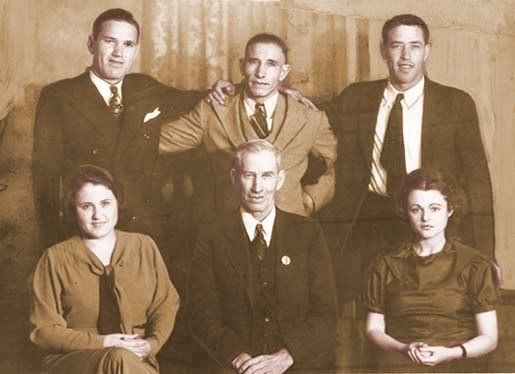
While searching some sources for a friend on this subject, I came across the picture above and the unconnected story below that pretty well capsules the story of Elmer Dean’s short-lived baseball career as well as any I’ve found. The picture is a Google image – and it comes unexplained as a photo without explanation of content or source. The only mysteries in the photo are the identities of the two featured ladies. Most probably, they are either Dean blood relatives, or else. the wives of Dizzy and Paul “Daffy” Dean. I don’t have time to research the issue further this morning, but will do so later. If you know the answer, please leave a comment below.

The males in the photo, top, left to right, are Dizzy, Elmer, and Paul Dean. The seated male in front is their father, sitting in between our two “guess who” girls.

What follows is the article I found online with the direct help of NewspaperArchive.com. It is reproduced here from a story that appeared on Page 4 of The Joplin (MO) News Herald of August 10, 1934:

**********************************************************************************************

Where’s Elmer?” Now Answered. Dizziest of Deans in St. Louis

St. Louis, Aug. 10 – (AP) Dizzy Dean and his brother, Paul, aces of the Cardinal pitching staff are not the only Deans who are likely to attract attention in Sportsman’s Park during the present home stand of the Cardinals.  home stand which ends August 20. In answer to the question “Where’s Elmer/” a third Dean brother of that name is about to go into action.

Elmer Dean is a pitcher. But he will not report to Manager Frisch in an effort to solve his pitching problem. Instead, he will report to Blake Harper, chief of the concession department at the ball park. For Elmer pitches peanuts to fans in the stands. He sells soda pop, hot dogs, pop corn and almost anything.

Elmer Dean is said to be dizzier than either Dizzy or Paul. He was lost for four years when Dizzy and Paul, driving a flivver, got across a railroad track ahead of a freight train and he didn’t. When the long freight train finally got out of the way, Dizzy and Paul were out of sight and Elmer was four years in catching up with them.

Elmer had a tryout with Houston as a pitcher in the spring of 1933, but as a ballplayer he led the experts to believe he’d make a great peanut vender. His pitching was all right except his follow through wound up with Elmer sprawled out on his face and the ball went over the plate – that is. once in a while. After providing hilarity for the Houston camp several days, he found his nich(e) as a peanut vender, and has been a personage in the Houston Ball park ever since.

He wears a cap on which his name is printed in large capital letters. But he doesn’t need any label. Like Dizzy, he speaks for himself and for the Dean family, extolling their pitching prowess and other virtues.

Elmer has one particular hobby – it isn’t going to movies or collecting old coins – he loves to ride elevators. So if you see a fellow who looks like Dizzy or Paul Dean constantly riding in one of the elevators of the Telephone building or the Railway Exchange, well, it’s Elmer Dean getting the thrill of his lifetime. Down in Houston, Elmer is said to have traveled more miles up and down elevators than Lindbergh has flown in a plane.

– The Joplin (MO) News Herald, August 10, 1934, Page 4  

************************************************************************************************
The Four Horsemen of The 1928 Houston Buffs

September 20, 2013
Pastureland for the Four Horsemen of the Houston Buffs.

Pastureland for the Four Horsemen of the Houston Buffs.

As in all other things, times have changed greatly in baseball since 1928.  Pitchers who once went all the way are now sharply divided into starters and a whole sub-species of pitchers who do the various specialty jobs as relievers by inning and game situation. Starters have done their job in 2013 when they have either gone five or six innings or thrown 100 pitches. As one result, the so-called “W”s that go to one man per game for a winning effort are now more easily spread throughout the staff, along with “H”s and “Sv”s that didn’t even exist back in 1928.

Throw in the fact on the major league level that any starter today who wins 20 games in a single season is going to earn a salary that will make it harder for a club that’s strapped for cash to sign others like him and you have a formula for teams winning championships with probably none or only one 20s-count official game winner.

With a record of 104-54, .658, the 1928 Houston Buffs still managed to only take the first place finish by one game over the second place Wichita Falls Spudders, who finished at 104-56, .650. The Buffs also then defeated the Spudders, 3 games to 1, in a pennant playoff series to advance to the Dixie Series against the Birmingham Barons, Champions of the Southern Association. The Buffs then took the Barons, 4 games to 2, to win the Dixie Series, the pinnacle of their opportunities.

Here’s a pitcher-by-pitcher capsule look at how the 1928 Houston Buffs of the Texas League won the pennant and also captured the Dixie Series with a pitching staff that included four 20-game winners. These men were, even though I’ve never read them described as such, The Four Horsemen of the 1928 Houston Buffs:

Jim Lindsey

Jim Lindsey

 1) Jim Lindsey, Age 29 (25-10, .714 W%, 3.49 ERA) (BR/TR) (6’1″, 175 LB.) Lindsey had a 9-season career in the big leagues (1922, 1924, 1929-34, 1937, posting a career MLB record of 21-20, .512 W%, 4.70 ERA.

Over the longer course of his 13-deason minor league career (1923-29, 1933-38), Lindsey posted a total mark of 143-114, .556 W% with a 4.01 ERA. Lindsey won 20 games one other time and it also occurred with Buffs the following season of 1929 when he went 21-10, .677 W%. with a 2.87 ERA.

Jim Lindsey passed away in 1963 at the age of 64.


Wild Bill Hallahan

Wild Bill Hallahan

 2) Wild Bill Hallahan, Age 25 (23-12, .657 W%, 2.25 ERA) (BR/TL) (5’10”, 170 LB.) Hallahan enjoyed an 11-season career in the big leagues (1925-26, 1929-38) and played an important pitching role for three Cardinal NL pennant winners in 1930, 1931, and 1934. The Cardinals also took the World Series in 1931 and 1934. Hallahan went 19-9 for the 1931 club and he finished his big league time with a record of 102-94, a .520 W%, and an ERA of 4.03.

Wild Bill had a 5-Season (1924-24, 1927-28, 1939) minor league career, posting a record there of 62-49 with a .559 W% and an ERA of 3.50. His 23 win season in his only year with Houston was his only time to ring the 20 game winner season bell on any level

Wild Bill Hallahan passed away in 1981 at the age of 78.


Ken Penner

Ken Penner

 Ken Penner, age 32 (20-8, .714 W%, 3.47 ERA)  (BL/TR) (5’11”, 170 lb.) Ken Penner is nothing short of minor league pitching roalty. He worked a 23-season career over 30 years (1913-25, 1927-38, 1942-43).  Penner had an amazing minor league career mark of 315-269 with a W% of .539 and an ERA OF 2.93. In the minors, Penner earned a minimum of 20 wins in 5 different years and he also won 17-19 games in 6 other seasons. In Penner’s other 1927 season as a Buff he had chalked up one of those 19-win marks. in  In spite of his overwhelming success at the minor league level, however, Ken only enjoyed two widely separated cups of coffee in the majors in 1916 and 1929, coming up with an MLB career mark of only 1-2 with a .333 W% and an ERA of 3.55.

Ken Penner died in 1959 at the age of 63.


Frank Barnes

Frank Barnes

 Frank Barnes, age 28 (20-9, .690 W%, 2.95 ERA) (BL/TL) (6’2″, 195 lb.) Frank Barnes also went n to a peekaboo MLB pitching career in 1929-30, posting a career mark withe the Tigers and Yankees of  0-2, .000 W%, 7.79 ERA.  Frank’s 20-win season in his only year with Houston also would be the sole time he came close that to that charmed level again, anywhere else.

Frank Barnes died in 1967 at the age of 67.


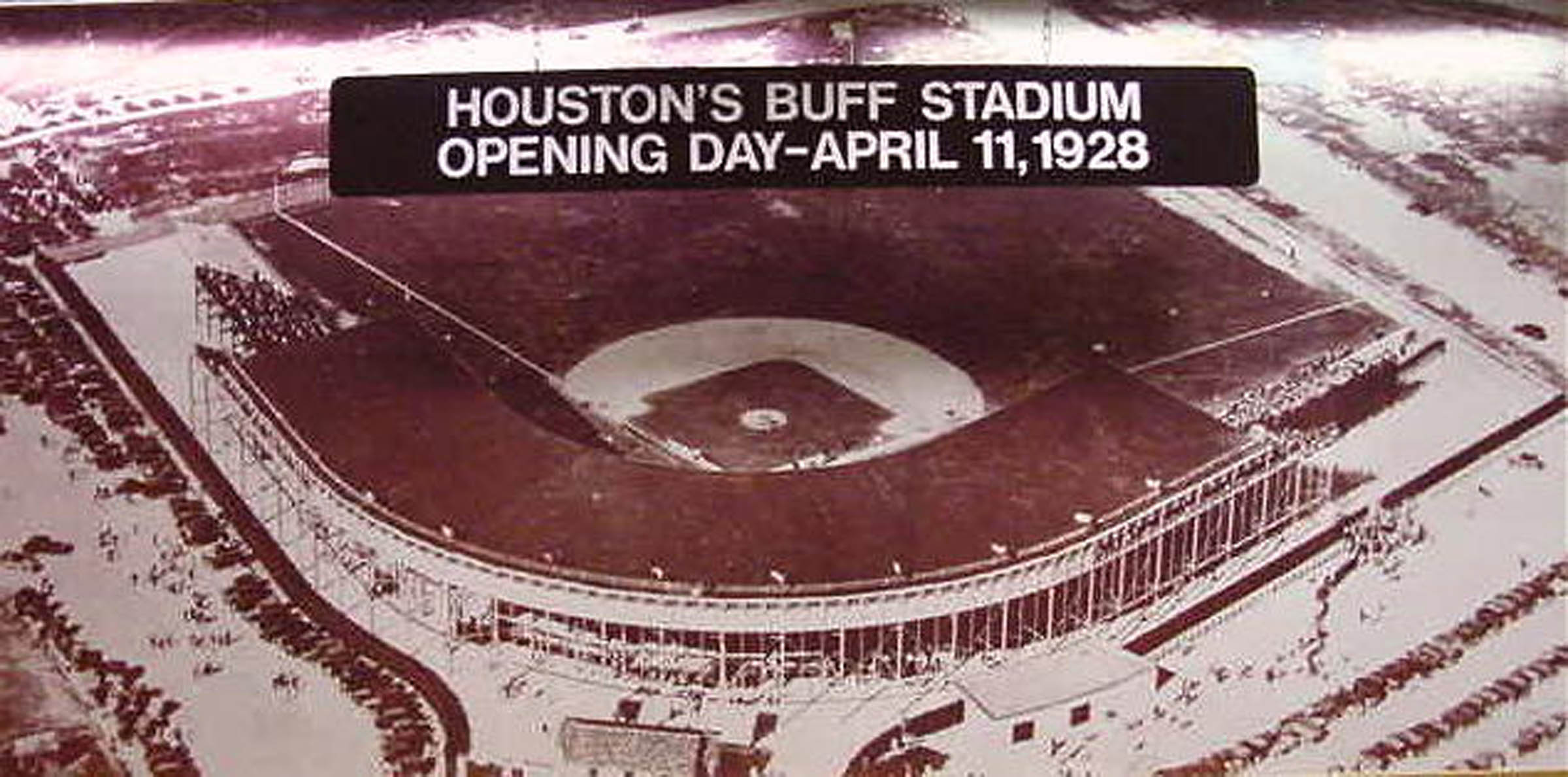
Things just came together for the ’28 Buffs. They had a brand new jewel of a ballpark and a hunger for winning that carried them to every chance for glory that lay in their realm. Together, the four horsemen of the 1928 Houston Buffs led the way to glory as 20-win pitchers, one and all.

1946: UH Cougars Play Their First Football Game

September 19, 2013
UH's new stadium is now under construction on the site where the Cougars played their first intercollegiate football game on 9/21/46.

UH’s new stadium is now under construction on the site where the Cougars played their first intercollegiate football game on 9/21/46. (THE STADIUM WILL NOW BE LAID OUT E-W, NOT N-S, as shown in this original drawing.)

Founded in 1927 and only raised to the status of a four-year university in 1934, the University of Houston did not begin play in football until September 21, 1946, when they opened against Southwestern Louisiana Institute at Jeppesen Stadium on Cullen Boulevard, which then belonged to the Houston Independent School District as their high school stadium.  That property was eventually acquired by the University later in the 20th century and renamed Robertson Stadium, a named it retained through the 2012 season. Robertson has now been demolished in preparation for the new stadium now under construction for UH football in 2014 on the same site.

Here’s how the Galveston Daily News reported that first UH game, with the help of Associated Press:

*********************************************************************************************************

SLI Spoils debut of Houston, 13-7

Houston, Tex., Sept. 21.,  AP  The Bulldogs of Southwestern Louisiana Institute scored twice in the last 17 minutes of play here tonight to spoil the University of Houston’s debut in intercollegiate football, 13-7.

SLI tied the game at 7-7 midway in the fourth period when Di Gizzani, a guard, recovered a Cougar fumble on the UH 22. Niel of SLI then passed to Ferris  on the Cougar 7. From there Budd powered over in four tries, the last time from the 1 yard line. Pettit kicked (the) goal and the score stood at 7-7.

With one minute and twenty-five seconds remaining in the game, Niel, proving himself very much a thorn in the Cougars’ side, intercepted a pass on the Bulldog 21 and ran it back to the 46. From there Niel passed to Diddier on the Cougar 43.

Another pass, Niel to Diddier, pulled the game out of the fire for SLI. Diddier took the heave on the Cougar 35 and raced down the sidelines for the winning marker. Seventeen seconds were left as the Bulldogs kicked off after the try for (extra) point and the Cougars were never able to put the ball into scrimmage.

– Galveston Daily News, Sunday, September 22, 1946. Page 12.

********************************************************************************************************

Post-Report Notes: The AP report left out the mention of any Cougar players in the first game, but from Wikipedia it should be noted that Charlie Manichia, the first Cougar quarterback, also scored the first UH touchdown earlier in the game for a 7-0 lead that faded away. The Cougars were only 4-6 in their first season under first Coach Jewell Wallace, but they did win their first game in history on their second try, taking out West Texas State Teachers College (Now known as West Texas A&M), 14-12.

Jewell Wallace would coach the Cougars in their first two seasons (1946-47) and then yield the reins to Clyde V. Lee (1948-54).

As for that conflicting report in the story that says the Bulldogs did not score until 17 minutes remained in the games, and also that they first scored “midway in the fourth period”, all I can presume is that someone typed “17” when they meant “7” minutes were left on the clock.

One New Stadium Note: The new UH stadium will not be laid out N-S as Robertson was. The new one will place the end zones in an E-W opposition to each other. The Cougar home stands will then occupy the “S” side, giving the home club fans the sun at their backs for day games and a breathtaking view of downtown on the “NW” near horizon from the campus.

Those of us with strong Cougar ties are happy about the powerful driving energy that now directs our university and we are looking forward to even brighter tomorrows.

Eat ‘Em Up, Cougars!

A Day in the Life of the Houston Eagles

September 18, 2013
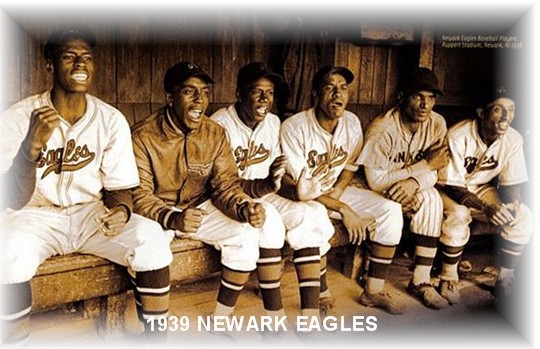
The Newark Eagles were once a force in Negro League baseball, but that all changed rapidly for all segregated black clubs once integration finally arrived.

The Newark Eagles were once a force in Negro League baseball, but that all changed rapidly for all segregated black clubs once integration finally arrived.

The Newark Eagles moved to Houston for the 1949-1950 seasons as the result of a dramatic loss of support for Negro League baseball back east following the integration of organized baseball. With Eagle stars like Monte Irvin signing with the New York Giants and pitcher Don Newcombe casting his lot with the Brooklyn Dodgers, old Newark fans were abandoning their home club in droves to watch their former heroes compete in integrated baseball.

For those two 1949-50 seasons, the transplanted Houston Eagles played out their home schedule as sub-let tenants at Buff Stadium in the hope of developing a fan base that could keep the club alive. When it didn’t happen, the Eagles moved again in 1951, this time heading 369 miles east to New Orleans, where they played out a few seasons during the death rattle days of Negro League baseball.

Here’s a Day in the (brief) Life of the Houston Eagles, as reported in a headline story on Page 14 of the August 30, 1950 edition of the Benton Harbor (Michigan) News Palladium:

**********************************************************************************************

Benton Harbor Cubs Face Houston Eagles Tonight

———————————————————————————————-

Contest to Start at 8:30

———————————————————————————————–

Strong Colored Nine, Loaded with Talent, At House of David

 ———————————————————————————————-

One of the “big” names in Negro baseball, the Houston Eagles, will come to town tonight at 8:30 to engage the Benton Harbor Cubs in an exhibition game at House of David Park.

The Eagles, who are reported to be an up-and-down club, seem to be in one of their uphill periods at present. After getting off to a slow start at the beginning of the season, Houston strengthened itself recently for the second half push in the Negro American league and is now a strong contender for loop honors. Ever since the acquisition of four new players, the Eagle gang has been a rough bunch to beat.

Much credit for helping to turn the Houston outfit from a so-so team into a red hot club fighting for first place in a tough league may be given to Willie Grace, formerly with the Cleveland Buckeyes, and Wiley Griggs. Grace, a hard-hitting outfielder, has added much balance to the Houston hitting attack, while Griggs, a fine third baseman, has tightened the inner defense. Two other new players are catcher Billy Bailey and Bill Scruggs, a pitcher.

Besides this quarter (quartet), a star-studded array of old “standbys” graces the Eagle lineup. The infield is reportedly fast and steady, with Johnny Washington at first, Eddie Brooks at second, (Wiley) Griggs at third, and “Curley” Williams at short. Williams is rated the leading shortstop in the league.

SPEEDY OUTFIELD 

A speedy outfield which boasts three good hitters is also a factor in Houston’s success. Bob Harvey, the team’s home run leader, holds down right field, with (Willie) Grace in center, and “Cotton” Williams in left. Jenosie Heard, a clever southpaw, heads a strong mound corps, and Leon Ruffin works behind the plate.

Harvey, Washington, Heard, and “Curley” Williams were all named as members of an All-Star team in the East-West battle recently in Chicago.

– Excerpt from an article on Page 14 of the August 30, 1950 edition of the Benton Harbor (Michigan) News Palladium.

**********************************************************************************************

A Page from Satchel Paige History

September 17, 2013
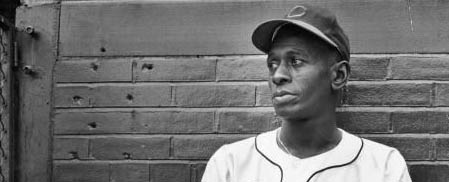
Satchel Paige, The Hero of Bismarck, North Dakota.

Satchel Paige, The Hero of Bismarck, North Dakota.

Contrary to the popular belief of some people, there was a lot written about Hall of Fame pitcher Satchel Paige in newspapers back in the early days of his Negro League career. It simply was erratic and inconsistent – and impossible to mount over time by any accurate statistical analysis of credible data.

But it was there in varied forms.

Through these excerpts from a rather lengthy report on many other factors, here’s how the Bismarck Tribune reported the success of Mr. Paige in their September 5, 1933 edition of the paper after Leroy led the local club he played for through a a critical Labor Day series weekend. It begins with four bold type layered headlines:

*********************************************************************

TWO VERDICTS AND WINS, TIE IN OTHER

————————————————————————————————————————-

Reached Dramatic Peak Sunday When Satchel Paige Out-pitched Willie Foster

————————————————————————————————————————

CRUSHED VISITORS MONDAY

———————————————————————————————————————–

Two Teams Will End Their Seasons Next Sunday With Contest At Jamestown

————————————————————————————————————————

Winning two games and earning a tie in the other contest of a three-game series with Jamestown over the Labor Day weekend, Bismarck’s potent baseball club decisively advanced its claim for the unofficial state championship.

About 7,000 fans saw the series which reached its dramatic peak in the tenth inning of Sunday’s game when Satchel Paige singled in a run from second base to win his own game with Willie Foster and came to a roaring end Monday when Bismarck routed both of Jamestown’s mound aces, Barney “Lefty” Brown and Willie Foster, to win an 11-5 verdict in a walkaway.

Bismarck will play its last home game Wednesday evening when it battles the strong Dickinson club at the city park beginning at 6 o’clock.

Finale at Jamestown

……. Besides outpitching Foster in a brilliant mound duel Sunday between the two greatest hurlers in colored baseball, Satchel Paige, Bismarck’s elongated right-hander, knocked in all three of Bismarck’s runs to nip Jamestown 3-2, Satchel’s last single coming dramatically in the 10th inning to score  Oberholzer from second and end hostilities for the day.

Paige Whiffed Fifteen

Besides restricting the visitors to six hits in ten innings, Paige whiffed 15 of the visitors. Foster, the colored race’s great southpaw, was nicked for seven safe hits and in flurries of wildness, intentional and unintentional, gave 10 free tickets to first base. ………

Figures Tell Story 

Bismarck probably be without the services of Satchel Paige this week, though it is possible he will return here for the winter and next season. Paige Tuesday was tentatively planning to accept an offer to pitch for the Easterners next Sunday against the Western All-Stars in a feature game between colored teams as a World’s Fair feature at Chicago. Willie Foster will pitch for the Western club.

More than a thousand fans turned out for the Saturday night game here, 4,000 for Sunday’s game and 1800 for the Monday contest. A special train from Jamestown Sunday brought nearly 500 here to swell the crowd into probably the largest turnout in North Dakota history.

– Bismarck Tribune, September 5, 1933, Page 6.

***********************************************************************
If we only had that working time machine today, Bismarck could have had the largest turnout in Baseball History back on the Labor Day weekend of 1933.

First Game at Rice Stadium: September 30, 1950

September 16, 2013
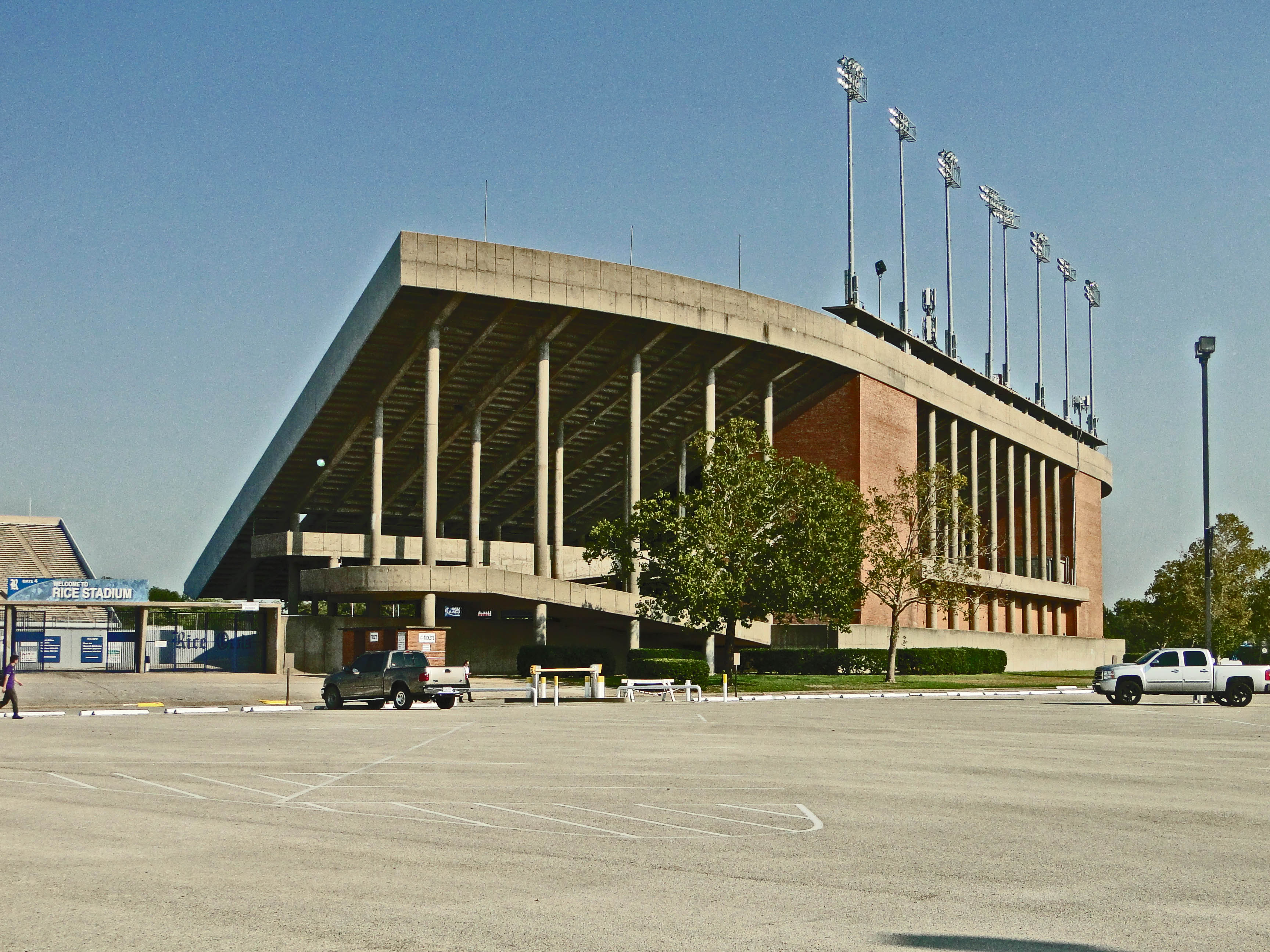
63 Year Old Rice Stadium in 2013. - GO OWLS!

63 Year Old Rice Stadium in 2013. – GO OWLS!

The following (AP) story appeared in the Sunday, October 1, 1950 edition of the Corpus Christi Caller-Times. Thank you Newspaper Archive (dot) Com for making this kind of wonderful information available to the digital world:

*********************************
Rice Triumphs, 27-7, on Glass’ Passing

HOUSTON, Sept. 30 (AP) – Quarterback Vernon Glass, who didn’t see much action last year, threw four touchdown passes tonight as Rice’s Owls walloped Santa Clara, 27-7, in an intersectional game that dedicated Houston’s new stadium.

A near capacity crowd of 68,000 saw the 21-year old senior from Corpus Christi, whose talents had been hidden for two years by the quarterbacking of Tobin Rote, come into his own.

Decimated by the loss of Rote and 20 other letterman from the team that won the Southwest Conference championship last year and drubbed North Carolina, 27 to 13, in the 1950 Cotton Bowl game. Rice looked like it again had the makings of a major football power.

Glass completed 12 out of 21 passes as Rice totaled 217 yards in its first aerial offensive of the new season.

A blocked kick and two fumbles set up three of the Owls’ touchdowns, but Glass, who previously had enjoyed only fleeting moments of glory, gave Santa Clara nothing but trouble all night.

Outweighed Santa Clara, 1950 Orange Bowl champions, warded off two Rice touchdown bids with sporadic exhibitions of defensive brilliance.

************************************
Historical Notes: Rice left end Bill Howton scored the first points in the new Rice Stadium in the first quarter when he caught a pass from Glass on the Santa Clara 35 and raced it home to the end zone for the first touchdown in the brand new history of  the venue. – In the third quarter, Abraham Dung of Santa Clara reeled in a pass on the Rice 22 and scored with it to post the first opposition TD and score in the new book on Rice Stadium.

Happy 63rd Birthday, Rice Stadium!

1968: About That Houston 100-Points Game

September 15, 2013
The 100-6 UH football victory over Tulsa in the Astrodome on 11/13/1968 is one for the ages.

The 100-6 UH football victory over Tulsa in the Astrodome on 11/23/1968 was one for the ages.

It was a game that either should have been rescheduled or declared a TKO at halftime. Instead, it played out as one of the most lopsided college football games in history and certainly the scoring record game for any football team, pro, college, or high school that ever put on the pads to duke ’em out in the Astrodome.

It was Saturday evening, November 23, 1968, and the site was the Astrodome. The 11th ranked UH Cougars were scheduled to play a ho-hum game against the Golden Hurricane of Tulsa University, but nobody really gave the Oklahomans much of a chance that season against the highly regarded cats from Houston. Doubly aced by a fast and strong running back named Paul Gipson and a hip-gyrating speedy wide receiver known as Elmo Wright, the Cougars were prepared to attack by ground or air in the Yeoman veer offense as well or better than most clubs that year. And they also had two better than adequate QB’s in 1968 in starter Ken Bailey and back up Rusty Clark.

Although they never used it as an excuse, to my knowledge, Tulsa had a good excuse for what was about to unfold that night in Houston. The Tulsa team had been hit with a flu epidemic during the week leading up to the UH game. Some players were too ill to make the trip to Houston and others who did travel may have been either still too ill to play or just coming down with the bug on game day. As a witness to this incredible shocker, I had never seen a team play with less energy, speed, strength, or drive. Tulsa that night was a team that was only technically present.

Contrary to our UH haters mythology, the Cougars caching staff did not really try to embarrass or run up the score. By the early fourth quarter, UH Head Coach Bill Yeoman had removed his first string offensive starters, but the guys who took their places weren’t trained to lay down when they ran through a club that made almost no effort to tackle. Late in the game, it looked as though the final score was going to be 86-6, a bad enough differential tally with only three to four minutes left on the clock. I forget the exact time that remained, but not what happened next.

Larry Gatlin C&W Singer UF Football 1968

Larry Gatlin
C&W Singer
UH Football 1968

Larry Gatlin, normally a defensive back, and much later a Country and Western SInger and composer, was inserted into the game as a wide receiver with the ball on the Tulsa 25 yard line. They were supposed to just grind it out, but the rare chance for Gatlin was apparently too fat to miss. He and back up QB Rusty Clark teamed up for an easy 25 yard TD pass, which I think may have been the only TD of Gatlin’s college career. I’m not sure about that, but he sure acted as though it were.

On the sidelines afterward, you see Coach Yeoman talking hard and fast to both Clark and Gatlin and he didn’t appear to be congratulating either of them

93-6. Ouch. Tulsa again gets pushed back for another punt from deep in their own territory with about one minute left in the game.

Unbelievable. A special teams guy named Simpson corrals the ball on the fly about the Cougars 40 yard line. Some people on the UH sidelines are flashing palms to the ground, as if to say “just go down”.

Simpson doesn’t go down. The next thing we see is Simpson weaving himself through a field of “zombie tacklers” and taking the ball all the way to the house, almost with no time left. – It is now UH by 99-6 and blood lust time.

The Cougar fans are chanting in unison to UH kicker Terry Lieweke:  “MAKE THAT KICK! – MAKE THAT KICK! – MAKE THAT KICK!” – It isn’t the proudest moment in sportsmanship history, but that is the path that voyeur gratification travels when the energy of the mob gets fully behind the idea of witnessing a triple digit football score.

Lieweke makes it. The historic final score is Houston 100 – Tulsa 6.

Here are the box score stats and facts on scoring in the game:

Field Activity TULSA HOUSTON
First Downs 12 37
Yards Rushing 86 555
Yards Passing 78 207
Return Yardage 0 111
Passes-Caught-Int 20-11-4 16-10-0
Punts-Average Yards 9-27 1-40
Fumbles Lost 2 0
Yards Penalized 25 102
Score by Quarters First Second Third Fourth Final Total
TULSA 0 0 6 0 6
HOUSTON 14 10 27 49 100
Scoring by Quarter Scoring Details
First Quarter
HOU – Gipson 35 Run (Lieweke kick) HOU, 7-0
HOU – Wright 60 pass from Bailey (Lieweke kick) HOU, 14-0
Second Quarter
HOU – Lieweke FG 36 yards HOU, 17-0
HOU – Bailey 1 Run (Lieweke kick) HOU, 24-0
Third Quarter
TUL – Burkett 14 pass from Dobbs (Kick failed) HOU, 24-6
HOU – Bell 21 Run (Lieweke kick) HOU, 31-6
HOU – Gipson 17 Run (Kick failed) HOU, 37-6
HOU – Wright 66 Run (Lieweke kick) HOU, 44-6
HOU – Gipson 14 Run (Lieweke kick) HOU, 51-6
Fourth Quarter
HOU – Heiskell 7 Run (Lieweke kick) HOU, 58-6
HOU – Stewart 19 pass from Clark (Lieweke kick) HOU, 65-6
HOU – Strong 26 pass from Clark (Lieweke kick) HOU, 72-6
HOU – Peacock 34 pass interception (Lieweke kick) HOU, 79-6
HOU – Clark 11 Run (Lieweke kick) HOU, 86-6
HOU – Gatlin 25 pass from Clark (Lieweke kick) HOU, 93-6
HOU – Simpson 60 punt return (Lieweke kick) HOU, 100-6
Venue: Astrodome; 11/23/1968 Attendance: 34,089
Dr. Phil McGraw TV Psychologist Tulsa Football 1968

Dr. Phil McGraw
TV Psychologist
Tulsa Football 1968

Paul Gipson could have made a run at close to 500 yards rushing, had he played the entire game. As it was, he still racked up 289 yards rushing on 29 carries.

UH went into the Tulsa game as the nation’s offensive yards per game leader with an average of 552.9 yards per contest. The Cougars more than topped that mark by racking up a total of 762 yards against the Golden Hurricane.

What recently reminded me of the game was an appearance by Dr. Phil McGraw on the Dave Letterman Late Show the other night. Dr. Phil was a Tulsa lineman that night in the Dome back in 1968. He even used the 100-6 game to illustrate why he bears such great humility about his personal accomplishments in football.

I think Dr. Phil’s experience that long ago evening in Houston may have been the real reason he settled on psychology as a major and went on from there to help Oprah and finally – to get his own television show. If that is what happened, please don’t blame UH for running up the score on Tulsa. – Blame the Cougars for driving Dr. Phil into our daily lives on television.

1975: Aggies Wave Goodbye to Texas University

September 14, 2013

AM-UT

Aggies? Waving goodbye to Texas University?

Well, back in 1975, they sort of did. For about eight days. But the goodbye was gone for sure in less than a month. You just don’t dump an arch-rival that easily because, even in those years you beat them, you still have to win the other big games on your schedule. And 1975 stands out as a good example as we all variably roll, gig, hook, or just plain watch our ways today into another of those college football “Game of the Century” Saturdays.

On the Friday following Thanksgiving Day, November 28, 1975, the Texas Aggies (9-0-0) entertained their arch-rival competitors, the Texas Longhorns (9-1-0), at Kyle Field in College Station before a record crowd of 56,679 in an afternoon temperature of 84 degrees with no rain. The 1975 Aggies of Coach Emory Bellard were 9-0 going into the game ranked # 2 in the nation. All they had to do to win a berth in the Cotton Bowl and position themselves for a run at the national championship vote was to beat UT, then beat Arkansas at Little Rock on December 6, then defeat highly regarded Georgia in the Cotton Bowl. Led by fiery linebacker Ed Simonini and Bellard’s wishbone offense, the Aggies perched themselves for a serious run at greatness.

The Friday leftovers day part went extremely well.

Early in the game, UT QB Marty Akins went out with a re-injured knee and had to be replaced by freshman Ted Constanzo.

“We were able to key on Earl Campbell when Akins went out,” Aggie middle linebacker Robert Jackson said. “Our bench went crazy when Akins went out. We felt we could beat them with Akins in there, but we were glad to see him go. He’s a great options quarterback.”

The Aggies went on to win the game over UT by 20-10.

“I don’t want to see any of that stuff in the papers about how (Texas quarterback Marty) Akins would have made the difference,” Simonini said. “We played with some people hurt too.”

Texas Coach Darrell Royal was gracious in defeat. “I would like to see something happen to Ohio State so that if they (A&M) take care of business we could have another national champion here (in the State of Texas).”

Wow! Talk about class delivered with a measured reminder. At this point in history, Royal and UT had garnered three national championships in 1963, 1969, and 1970.

The high-scoring Horns were limited to only 6 points and 113 rushing yards, the lowest total by a Royal team in three years.

“They (A&M) played as solid a game as you can play,” Bellard said. “They played other games as well too, but I guess this would be our greatest victory.”

It would remain the greatest Aggie victory. The Aggies went up to Little Rock the next week for their December 6th game with Arkansas and got drubbed, 31-6, sending the Razorbacks to the Cotton Bowl as tri-champions of the SWC along with UT and A&M – and sending the Aggies to the Liberty Bowl for a 12/22/1975 date with USC.

In his last game as coach at USC, John McKay guided and watched his Trojans blank the Aggies, 20-0 in the Liberty Bowl for a 10-2 closure collar on a successful 1975 Texas A&M football season, but not one that would end in a national championship – or even mark itself as a new period of dominance over UT for the Aggies.

“Close, but no cigar” is the perennial or occasional contender’s anthem. If that phrase were a song title, it would play more often, in more places, than even Elvis could have imagined.

KLEE-TV: A Rainbow in Black and White

September 13, 2013

Klee1949

On Saturday morning, or late Saturday afternoon,  January 1, 1949, a few thousand residents of the Greater Houston Area awoke from their celebrations of the previous evening under the impression that the big party was now over again for another year. They were partly right. And partly wrong.

A little change was scheduled for that date. It would start quietly, but it would soon enough alter all our lives forever, from the way we get our news to the way we seek out entertainment, from the way we organize our personal lives to the way we interact with others.

Television was coming to Houston at 5:15 PM, CST, on Saturday, January 1, 1949, and, even though few of us realized it at the time, nothing we could possibly experience would ever again be quite the same. It was a rainbow on perspective that first came to us only literally in black and white, but that would change with advancements in technology that now collide in so many dazzling far-reaching ways with advances in digital microchip technology that we now associate with all our varied, always growing uses of simulated reality over the Internet.

Back in 1888, my grandfather was a 22-year-old one-man band owner, writer, and editor of a little newspaper in South Texas known as The Beeville Bee. Without a telegraph connection to the outside world, he had to rely upon mail reports and new people passing through town for information on all events beyond the township. With the coming of Western Union that year, grandfather wrote with unbridled joy: “The telegraph lines have been fully completed and Beeville is now in total connection with the outside world.”

Grandfather was technically right, but visitors to Beeville in 2013 might be willing even now to argue the point of Beeville’s “total connection with the outside world.” Some old backwaters don’t stir so easy, but grandfather would have been there all the way, working for the cause of the little guy, if he were still around. And he would have relished being wired to the Internet in service to that purpose.

All of us have some bead on the earlier generations in our families who would have loved or hated the explosion of change that began with the telegraph, telephone, radio, television, and now the computer sciences, but how many of us were awake to the scope of change that would soon enough follow the little back and white picture box that fairly quickly found its way into every American home? It started so quietly.

Here’s how the Galveston Daily News used three one-sentence paragraphs on Saturday, January 1, 1949 to announce the coming of television that day to Houston:

————————————————————–

Houston to Get First Television Saturday

Houston, Dec. 31, (AP) – Television comes to Houston at 5:15 p.m. Saturday with the formal opening of KLEE-TV.

W. Albert, owner of the station, estimates that there are 2,000 television sets in Houston.

First program to be televised here will be a musical show.

—————————————————————-

Wonder what the musical show was. Maybe it was “Dancing with the Stars.”

Hurricane Carla Darkened Buffs’ Last Days

September 12, 2013
Gone With The WInd: Buff/Busch Stadium in Houston after one dance with Hurricane Carla, September 11, 1961.

Gone With The WInd: Minor League Baseball at Buff/Busch Stadium in Houston after one dance with Hurricane Carla, September 11, 1961.

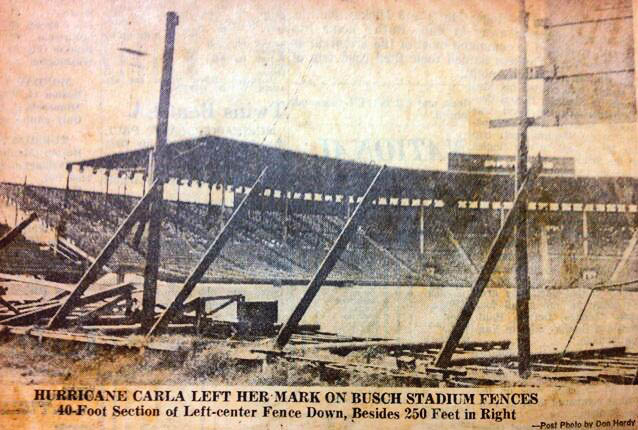
At 2:00 PM CST on Monday, September 11, 1961, Hurricane Carla slammed into the Texas coast near Port O’Connor as a Category 5 storm with winds of 173 MPH. By nightfall, it had made its way through Houston, leaving a mass of destruction in its wake, including the outfield fences at “Busch” Stadium.

The demons of nature had done something that no serious baseball game scheduler would have ever put forth as a plan. By necessity, Carla had forced the Houston Buffs and the Indianapolis Indians to play their entire first round playoff series for the 1961 American Association pennant in the Indiana city. Tied at a game each when Carla struck, the Buffs played Games 3, 4, and 5 at the Indians home park with some powerful winds of their own, winning Game 3 by 5-4 on a 9th inning solo HR by Jim McKnight, taking Game 4 by 4-3 on a deciding HR by J.C. Hartman, and finishing Game 5 with a 10 scattered hits shutout by young Dave Giusti. Pidge Browne and Jack Waters both homered in the 6-0 Game 5 as last Buffs Manager Harry Craft put one more feather in his “H” cap on his way to becoming the first major league manager of the new Houston Colt .45s in 1962: Harry Craft was the last Houston Buffs manager to lead the club to a post-season series victory in their long minor league history. The 1961 Houston Buffs had defeated the Indianapolis Indians, 4 games to 1, in Round One, playing all five games away from their home base because of the hurricane.

It was also the end of the line for minor league success in Houston’s last season prior to becoming a major league city. Even though local community spirit abounded for better results against Louisville in the finals in response to the Buffs counter-attack upon adversity by their capture of an all road game playoff series.

“Busch Stadium fences have been restored and the park is in first class condition ready for the Buffs return.” – Baytown Sun, 9/18/61. Proud “old Buff” Stadium had weathered the storm, but the Buffs themselves were about to get blown away by a talented Louisville club. In effect, the series between the Buffs and the Louisville Colonels signaled the end of Houston’s road dominance. Louisville took Games 1, 2, and 3 at home, creating a hole from which the Buffs would not recover.

But they did make it interesting.

On Tuesday, September 19, 1961 the Buffs returned to their restored fence home and took the Louisvillians in 12 on a game-winning single by Pidge Browne in the bottom of the 12th.

On Wednesday, September 20, 1961, the Buffs came out blasting, using a 2-HR game by Pidge Browne to crush the Colonels by 10-5 and narrow their deficit in the Series to 2-3. One more game of hurricane magic and the Buffs would be back into a winner-take-all game for the pennant.

It was not to be.

On Thursday, September 21, 1961, Louisville was unstoppable on offense and Houston forgot what gloves and arms were for on defense. The Colonels bombed the Buffs 11-4 on 13 hits while Houston committed 7 errors in the field – 5 alone by shortstop J.C. Hartman. The Kentuckians had prevailed as the 1961 American Association Champions of 1961.

The wonderful now late Fred Hartman of the Baytown described this last hurrah of the Houston Buffs best:

~ “DEFEATED BUFFS BOW OUT” by FRED HARTMAN, BAYTOWN SUN, FRIDAY, SEPTEMBER 22, 1961 ~

Twenty-one years ago at the end of the 1940 baseball season, the Baytown Oilers were fighting for the Houston Post tournament semi-pro championship.

They fought their way into the semi-finals and the promoters of the tournament stupidly forced the Oilers to have to win three games in one day to win the title. They won the first two in brilliant fashion. Then their weary muscles failed them, and they fell apart in the finale.

It was a sad thing to see – just as sad as the complete fall apart of the Houston Buffs Thursday night as the were shellacked, 11-4, by the Louisville Colonels.

It was a historic defeat for it came in the last game of minor league professional baseball ever to be played at Busch (formerly Buff) Stadium. Next spring, the fledgling Houston Colts will play on a new South end field in the National League.

Busch-Buff Stadium has been the scene of some great events and now they are gone.

It was at home plate that Dizzy Dean and his bride were married. It was there that Joe Medwick  used to rattle the boards as 1961 first baseman Pidge Browne has been doing. It was there that Carey Selph battled to the death as a great inspirational star.  It was there that Bill Hallahan’s southpaw plans won him big league opportunities. It was there that Kenny Boyer won his climb to fame.

And all that is left is memories and the ignoming (sp) of the final game when the Buffs, trying too hard, fell apart. How else, for instance, can you explain the seven errors, five by the hustling shortstop J.C. Hartman.

If you want lingering memories of better things, Mrs. Calabash, wherever you are, you can always remember the home run stroked by Jack Waters in the ninth with a Buff aboard and the homelings behind, 11-2.

In Jerry Witte fashion, Waters hit a circuit clout far over the left field wall. It soared high and far, and Jack took only three steps from home plate before he knew he had the big one. He trotted around the bases with the feeble applause of those faithful who were there at the end.

And the last record play was a brilliant one.  Jim Campbell slashed a hard hit ball through the box. The Colonels second baseman had been edging that way. He made a great play on the ball, and an even greater throw on the ball to first to beat the Buff catcher by a step. 

Thus did Buff Stadium – we never did like the Busch appellation – stumble in(to) the past on a sour note that never could replace the sweeter moments that victory and sensational plays had produced in the 33 years since that opener in the summer of 1928.

Baytown is now a live and highly expectant major league suburb. It couldn’t have happened until that final out wrote finish Thursday night.

~ Fred Hartman, Baytown Sun, Friday, September 22, 1961.

——————————-

Thanks to Mike Acosta and Darrell Pittman for supplying the image that invited the search that led to the material that made this article possible as a product of fresh research. Every ounce of fact and truth we discover and save together is mighty in its importance to the aggregate big picture in the long run.

Now we know that Houston won its last minor league game on 9/20/61. We know that Jack Waters hit the last home run in Buffs history. And we know that Jim Campbell‘s 4-3 groundout on a sharply hit ball up the middle was the last play in Buffs minor league history.