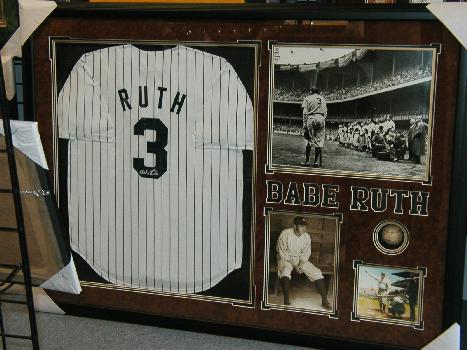
What was Babe Ruth’s number? The first two guesses that weren’t “3” don’t count, but don’t expect the giveaway answer portrayed in this photo. Ruth only wore the number “3”. They weren’t putting names on uniforms back in the late 1920’s and early 1930’s of MLB history. The number itself was assumed to be enough to connect the fan to a player name on his or her scorecard.
It seemed like such a simple idea. Why didn’t someone think of it, or execute it earlier, especially in those fresher days of baseball, when there was no electronically amplified sound system to broadcast the lineups or identify players in the field? Uniform numbers that were identified with specific players and then recorded on game programs and scorecards were a key addition to the fans’ enjoyment of the game, beginning in 1929, but not swelling all sixteen MLB teams full circle until 1931.
In 1929, the Cleveland Indians and the New York Yankees of the early 20th century group of stable sixteen clubs were the first to add player ID numbers to the backs of their uniforms.
In 1930, nobody took the dive. We assume the remaining 14 clubs were all stuck in “due diligence mode” as the Yankee and Indian players carried on the job of making ballplayers famous by the numbers.
In 1931, the dam broke. The Boston Red Sox, the Chicago White Sox, the Detroit Tigers, the Philadelphia Athletics, the St. Louis Browns, and the Washington Senators added their six clubs to the two that were already there. All 8 American League clubs were now wearing player ID numbers on their uniforms. Only the stodgy National League still held out from the gates of change.
In 1932, the National league’s 8 clubs joined the crowd when all of their teams (the Boston Braves, the Brooklyn Dodgers, the Chicago Cubs, the Cincinnati Reds, the New York Giants, the Philadelphia Phillies, the Pittsburgh Pirates, and the St. Louis Cardinals) added player ID numbers to their uniforms.
So, here’s an additional easy trivia question for you to insert in your next neighborhood baseball trivia quiz, in addition to all of the other obvious ones that are present in the information just presented:
In what year did both teams wear numbered uniforms in a World Series – and which clubs were they?
One more thing – as most of you already know: The New York Yankees started out in 1929 by also assigning numbers to regular position players on the basis of their places in the batting order. – Can you imagine the 2013 Houston Astros – or any other 2013 club doing that on any kind of sustainable basis?
The 1929 Yankees, of course, had a very special fixed regular position lineup known everywhere as “Murderers’ Row” and here they are, by their numbers, in their 1929 batting order:
1 – Earle Combs, cf
2 – Mark Koenig, 3b
3 – Babe Ruth, rf
4 – Lou Gehrig, 1b
5 – Bob Meusel, lf
6 – Tony Lazzeri, 2b
7 – Leo Durocher, ss
8 – Johnny Grabowski, c
Interesting to note, Mark Koenig was mainly a shortstop who only played a few games at third base in 1929, a year in which the Yankees did not have a strong third sacker. Had numbers been introduced in 1928, Koenig still would have been there at #2, but as the shortstop, and Joe Dugan would have been there at #7 as the 3rd baseman.
For further fun with the baseball uniform numbers historic file at Baseball Almanac, just click away to their site presentation:
http://www.baseball-almanac.com/baseball_uniform_numbers.shtml
 The Pecan Park Eagle
August 17, 2013 at 1:24 am |
The 1929 Yankees didn’t really have a fixed batting order. For example, Gehrig hit 3rd 77 times that year, 4th 35 times, 5th 21 times, and 6th 19 times.
Why do some teams have names AND numbers on their uniforms? Don’t they realize that numbers are redundant if they have names?