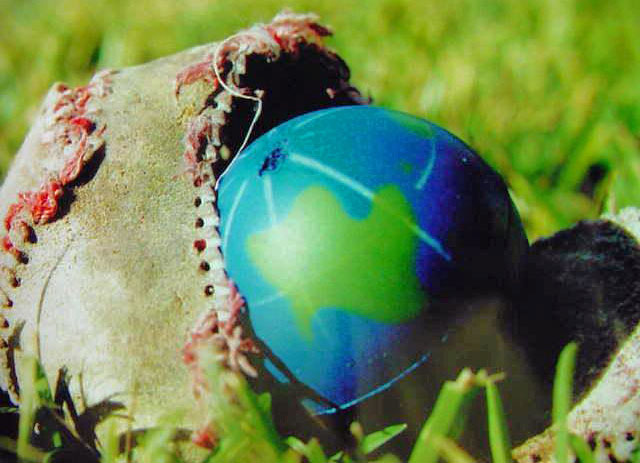
On the sandlots, we used to play with baseballs until we knocked their covers off. Then we taped them up and put them back into play. It was our world and our way of doing things.
Today the Pecan Park Eagle is taking a look at the baseball itself, that little round instrument of rolling, soaring, cannon-fired passion that makes all of our time with the game of baseball itself whatever joy it is we find it to be.
If you are interested, these first three resources will open your mind to numerous observations and questions. The first, which SABR friend Bob Dorrill sent me earlier this week, is a quick video on how baseballs are made today. It is an awesome review of all the thought and effort that goes into the production of a product that is bound tight to stringent physical qualifications before it is ever placed into everyday use.
The second feature is a short article on the production of baseballs today in Costa Rica. Points of economic and worker health consideration jump off the page. Does a ball stamped with the name of Bud Selig upon it really justify a multiple 6 increase in the retail price of the product?
The third item simply states the precise sizing outcomes that are both expected and produced as a result of the manufacturing process.
(1) How Baseballs Are Made, A Brief Video …
(2) Where Baseballs Are Made, A Brief Article on the Costa Rica Workers …
(3) The critical size and weight of the official MLB baseball are as follows …
The rules of Major League Baseball, section 1.09 states: “The ball shall be a sphere formed by yarn wound around a small core of cork, rubber or similar material, covered with two stripes of white horsehide or cowhide, tightly stitched together. It shall weigh not less than five nor more than 5 1/4 ounces avoirdupois and measure not less than nine nor more than 9 1/4 inches in circumference. …”mincirc = 9 inches
maxcirc = (9 + 1/4) inchesminweight = 5 ounces
maxweight = (5 + 1/4) ounces”
maxcirc = (9 + 1/4) inchesminweight = 5 ounces
maxweight = (5 + 1/4) ounces”
Each baseball shall also be finally assembled by exactly 108 stitches to the two pieces of leather that join all of its contents together.
Moving forward, the mysteries and ironies of the baseball shall most likely go on forever. Each ball is a precisely weighted and sized item that mysteriously comes in at 5 ounces in weight and 9 inches in circumference more often than not at the end of the manufacturing day. Each baseball is made by skilled pittance-pay workers, many of whom that have no real knowledge or interest in the game, and made for billionaire baseball club owners and millionaire baseball players who could not begin to grill themselves in comfort and luxury without the blood, sweat, and tears product of the “little big” men and women of Costa Rica who make the ball itself.
What do you think? And how would we ever fill our endless requirement for new baseballs if we again had to manufacture them in the USA? Americans are not going to become blind-stitch artists for $1.60 an hour and a future in rehab almost guaranteed for the treatment of worn out shoulder tissue.
Tags: making a baseball
 The Pecan Park Eagle
Leave a comment