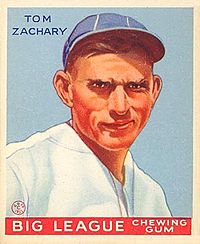
Tom Zachary, BL/TL
MLB, 1918-1936
Why is it so important that our baseball records are recorded as accurately as possible? To me, that answer is simple: If we cannot continually strive to get them recorded as right as rain as possible, we may as well not keep them at all. If they are to tell us anything of what has gone before us, they need to be as correct as possible about the facts that really matter about individual hitting, pitching, and fielding. We don’t need to know at any given moment that a state of 100% accuracy in detail has been finally attained. We simply need to always remain committed to the pursuit of that condition.
What brings records accuracy to mind this morning is another delightful insight into the subject from the great work of Norman L. Macht on the history of the game through the half century career (1901-1950) of Philadelphia Athletics manager Connie Mack in that one position alone. You see, early in his managerial career, Mack established a pattern of awarding tryout career starts to countless young guys who managed to catch his eye or grab his ear for one of these “try me and sign me, if you play me and like me” quick-look opportunities.
The problem often was the fact that the young talent often feared the loss of amateur status that came with making even a one-batter game appearance under his real name. So, he, or Connie Mack, or both would come up with a false name that would protect the young player’s amateur eligibility in the event that the professional tryout plan didn’t pan out.
Such was the case with famous lefty pitcher Tom Zachary, whose 19-season MLB career (1918-1936) was highlighted by him becoming the 1927 season pitcher for the Washington Senators who gave up Babe Ruth’s 60th home run. The more intriguing truth was the fact that Zachary started his career as one of Mack’s re-named pitching minions.
In 1918, “Jonathan Thompson Walton (Tom) Zachary” was a young man cooling his heels in Philly as a World War I “conscientious objector” awaiting assignment to Red Cross duty in Europe when his baseball pitching skill came to the attention of Connie Mack. Zachary was offered a tryout pitching opportunity with the A’s, but he was one of those kids that wanted to protect his amateur college eligibility for after the war, just in case.
No problem.
Either Zachary or Mack, it isn’t clear which, publicly changed his name from “Tom Zachary” to “Zach Walton” and he proceeded to pitch and win two games for the A’s in 1918 before shipping out overseas.
In 1919, Tom Zachary returned and signed with the Washington Senators under his real name. I’m not sure how many years it took for the two 1918 wins to slide under his credit too, but I would imagine they were a more recent correction to the record. Perhaps, Norman Macht can shed some light on how the correction took place in the case of Zachary and also comment on the wild guess wonder about other false name players who either remain on the books as failed short-term players – or whose early false name records remain disconnected in the record books from the famous real name players they later became.
Ain’t baseball history wonderful?
 The Pecan Park Eagle
March 24, 2013 at 1:40 pm |
To me this is the real value of groups like SABR. Though the term “sabrematician” has been born from a segment of members who prefer numbers over history the real reason for the birth of the group was researching history. It is that segment of the organization like you that digs up interesting facts for fans and non fans.
March 25, 2013 at 1:02 am |
Those two games were attributed to Zachary at least as early as the first edition of the Baseball Encyclopedia in 1969, although that book showed him with only one win, since in the other start he only went three innings. How does a starting pitcher get a win when he pitches only three innings? You’ll have to wait for the new Baseball Research Journal to find out.
May 7, 2013 at 3:54 am |
Good article about the evolution of the 5-inning win. So well researched.