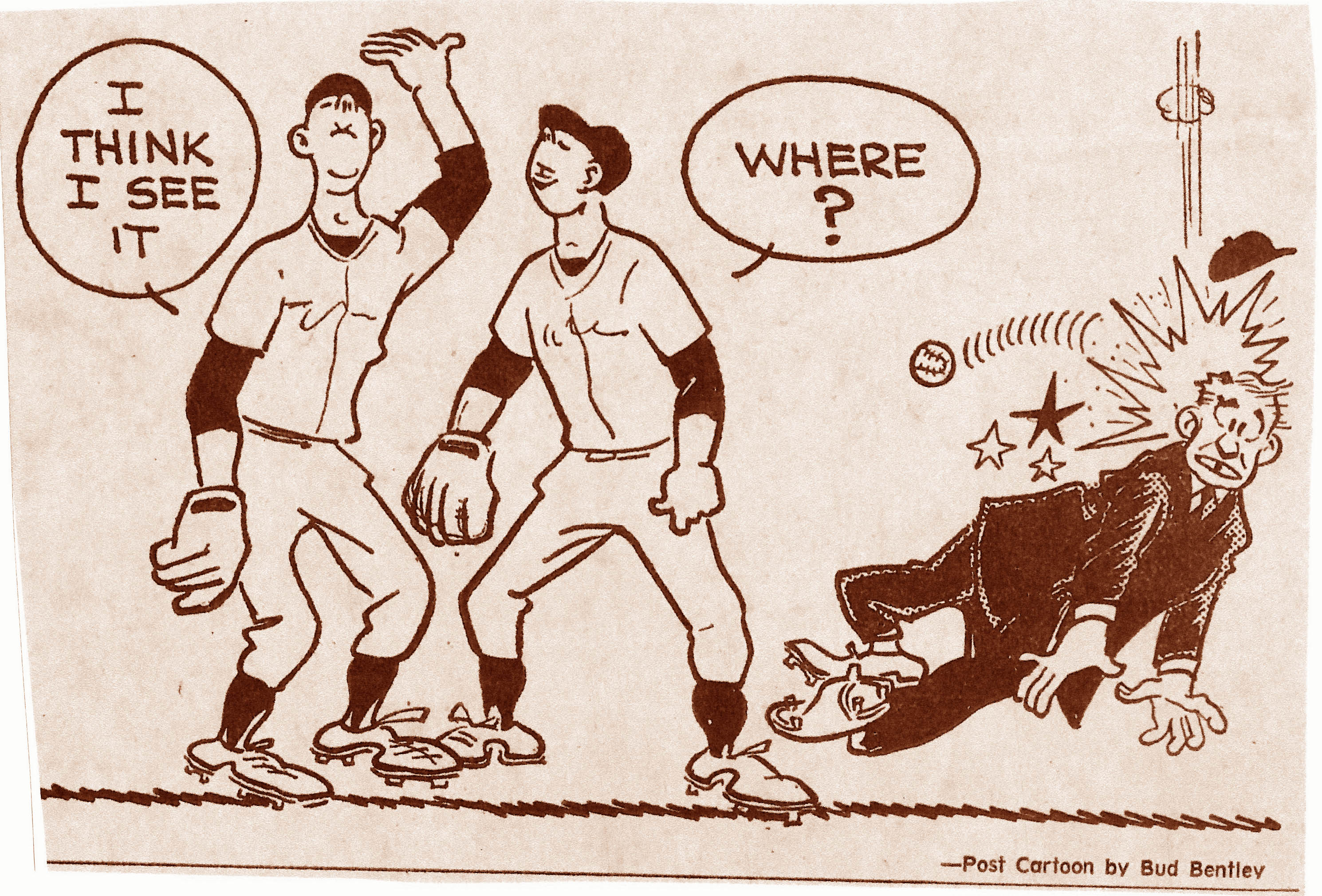
Bud Bentley contributed this cartoon to Mickey Herskowitz’s article in the Houston Post on April 10, 1965, entitled: “Dome Puzzle Deepens: As Advice Pours In.”
We recently wrote our first Astros “ROOTS” column on “The Day it Rained Baseballs” because of day game visual problems for outfielders particularly with fly balls at the new Astrodome. Today we go at the subject again, this time from a Houston Post perspective on the first weekend of play, April 9-11, 1965.
Forty-eight years later, every Houston baseball fan who was around when the Astrodome opened is both aware of the original problem of seeing fly balls during day games and its eventual solution a little thing called paint the ceiling, kill the grass, put in “Astroturf” as our human contribution to nature’s mutating design, but on April 11, 1965, the answers, results, consequences, and the boon that this issue eventually would become for Monsanto wasn’t quite so clear.
Here’s how Houston Post Sports Editor Mickey Herskowitz described the status of things in the Houston Post on Saturday, April 10, 1965: “The keenest intellects within and without baseball were still dumfounded Friday by the plight of the Houston Astros. – No solution had appeared yet to that one great mystery in the sky, namely how to apprehend a fly ball in the daytime in the Domed Stadium. – During the afternoon hours the sun and the Dome’s grand design reduce an outfielder to the status of a helpless pedestrian.”
According to Herskowitz, the “DuPONT COMPANY, developers of the Lucite (Astrodome) ceiling, rushed a research team here (to Houston) by plane to study the problem. ‘Just be patient,’ said one engineer. ‘We’ll think of something.'”
Charles Finley, owner of the Kansas City Athletics, informed the Astros that he was sending them six dozen orange baseballs for game use with him compliment. Hmmm! WOnder what happened to them, if he did mail them, for they were never used in a real game, but would make great historical artifacts from those times, if they were not eaten in time by the Astrodome rats of the current mausoleum era of the great structure’s declining health life span.
An Atlanta artist called to offer a rather oblique opinion that “the problem was one of tones and colors.” Say what?
Another random suggestion included the use of blue floodlights that could be shined upon the Astrodome roof, which we are compelled to view as little more than a “blue sky answer” to a far more complex riddle.
How about changing out the problematic clear light panels into ones which are tinted as polarized orange in color.
The eventual solution was nowhere near home that first weekend, but there was plenty of embarrassment to go around for everyone who had a hand in the final design and construction of the world’s first indoor stadium.
“How could they not see this coming?” That was the question on everyone’s minds. It lives on today as just another reminder that we are never quite as smart as we think we are.
The whole thing could have been avoided by just giving up the idea that daylight baseball was an option for the Astrodome. The National League was even willing to allow the Astros to shift its 21 regular season day games to night contests in 1965. The downside? According to Herskowitz, the club would have been forced to give up its $300,000 share of the TV revenue to be collected from the Game of the Week telecasts by moving to a “nights only” existence.
A 2013 Retrospective …
Problem Solved. Cheap as possible. Paint the clear roof opaque. Block out the sun. Now see the ball. Now also see the grass die. Now see us paint the grass green. Next year, see us replace the painted dead grass with grass that cannot die because it has never lived. It’s fake grass from Monsanto that seemed destined previously o serve mainly as a back yard door mat collector of dog poop and mud from the boots and shoes of homeboy grilling dads. Let’s now call it “Astroturf” as a way of glorifying and identifying its new greater status function to the whimsical distraction needs of western civilization. Problem solved better. Make the roofs of new domed stadiums mobile to sliding open. That way, we get to have opaque roofs that will co-exist with real grass because they can be opened to sunlight when there are no games in motion.
Thank you, Mickey Herskowitz, for being there to cover the onset one of the great technological challenges in American sports – the hazardous art of catching an invisible baseball in flight at the original Astrodome.
 The Pecan Park Eagle
Leave a comment