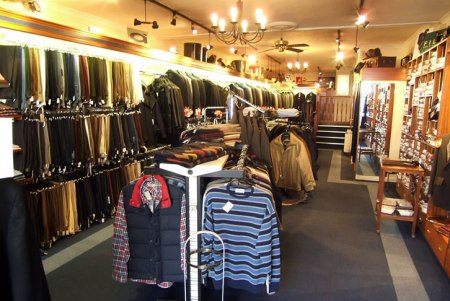
Merchant’s Wholesale Exchange in Houston was similar to this place, but not quite as fancy.
For the first three of my four undergraduate years at the University of Houston, I worked after class every weekday and all day Saturday at a little downtown men’s clothing store on San Jacinto Street called Merchant’s Wholesale Exchange. I guess you could call it work. It turned out to be one of the most entertaining and educational jobs I would ever have. The store and its retail era are long-gone now, but the fond memories of the family who ran the place and the stuff that happened there will last with a smile and a few laughs forever.
My biggest customers from that era were a an old wrestler named Blackie Guzman, a young crime photographer named Marvin Zindler, and a new singer from Houston named Kenny Rogers.
Merchant’s Whole Exchange (MWE) was nothing less than a little time capsule on how things were in the late 1950s (1956-59).
George and Esther Golden, both in their late 50s, and their 30-year old son, Stanley Golden, owned the place and they often provided their own intramural show of how families can sometimes disagree generationally over how a business should be run. In the first place, George and Esther were old style ethnic city folks from Philadelphia and they each had their own styles when it came to dealing with the world.
George was tall and portly, with shocking white curly hair and big brown eyes. He ate fruit all day under the fairly constant admonishment from Esther that dropping juice on his shirt was “not a very good way to greet people.”
“I have to tell you, George,” said in Esther from a constant state of redundant frustration, “you absolutely amaze me! – You’d think a man your age would know how to behave in the presence of customers!”
Some of George’s favorite new customer greeting salvos included these general snippets”
(1) Any time a man came in alone with a 10 years old and under son, George liked to say to the kid: “Good day, young man. How are you today? – Are you going to stay single like your daddy did?”
(2) If a stranger came in looking for a particular color suit, George loved to bellow a command to one of his “college boy” clerks: “Turn on the blue light, the man wants a blue suit.”
(3) One time, George tried to sell a one-of-a-kind, way too big for most people, way too heavy suit to a too passive tall, but not fat man who was shopping MWE for the first time. George got the man to try on the pants that just swallowed him. “Look at these pants in the back, Mister,” the man exclaimed. “When I pull both sides together in the back to where they would have to be hemmed, the two back pockets come together as one.
“Don’t worry about it,” George responded. “You will be out there with the brand newest style in the world. The one big pocket in the back of the pants is now called ‘The Kangaroo Cut.'”
Almost needless to add, most people took George with a grain of salt, but he did come close at times to catching a mouthful of fist, especially, with that “single like your daddy” crack.
Esther, on the other hand, was the lady who watched the money and the cash register for the business. “Mrs. G,” as we called her , watched everything and everyone, and, when she wasn’t tilling the register and looking over her shoulder to check on who was watching her, she sat in a chair that faced the front with a full view of any new person who may have walked into the long shotgun-house shaped building.
Mrs. G. may have been 4’9″ tops. She had bright red hair, dark brown eyes, a clownishly rouged face, bright red lips, and a perfumed presence that masked everything else. “Come sit next to me while I finish this Limburger cheese sandwich for lunch, Esther,” George once said. “I don’t want the smell to offend any customers.”
Payment at MWE was easy: Cash or an approved Houston bank check. Once a man came in from Freeport and piled up about ten suits in front of Mrs. G. in preparation for his checkout. Well, Mrs. G. somehow knew the man was from Freeport and she was ready. She didn’t even bother to ask ow he planned to pay.
“Sir, I think you need to know something,” Mrs. G. stammered, as she always did when the subject was money, “we don’t take out of town checks.”
“Well,” said the man as he opened his wallet and dumped out a snowfall of one hundred-dollar bills on top of his pile of purchases, “you do take out-of-town money, don’t you?”
I thought Mrs. G. was going to choke on her chewing gum as she groveled over the green resting before her.
Mrs. G. was an avid movie fan and authority on feminine beauty: “That Kim Novak. She’s not so special. We had lots of girls in the neighborhood where I grew up who looked just like her.”
Son Stanley was a whole other story from his dad. Stan Golden was the ethnically cleansed, college educated business degree prepared graduate from the University of Texas who battled long and hard with his father over the store’s need for a more professional relationship with the store’s customers. He just didn’t battle too deeply. He knew his dad was a good man, but not one who was likely to change.
“That suit fits you just like a glove. Too bad it doesn’t fit like a suit.”
“You say you need some handkerchiefs? Well, what for? Blow or show?
Those kinds of greetings were not going to go away – not as long as George Golden was around.
I was sort of wise-acre at age 19. One time, I asked George a very fundamental haberdashery question:
“Mr. Golden,” I asked, “have you ever smelled moth balls?”
“What kind of question is that?” George answered, with some irritation. “Of course, I’ve smelled moth balls!”
“Then tell me,” I further asked, “how did you hold them when you did smell them – by the wings? Or the tail?”
Silence fell. Then guffaws of knee-slapping laughter followed. I thought George was going down for the count on that one, but oh no. That would have felt awful. I really loved the old man.
George recovered. He reached out red-faced to another old man shopper friend in the store and pointed to me.
“Come over here, Ed,” George spat out the words. “I’ve gotta tell you this joke this college boy here just told me: – Have you ever smelled camphor balls?”
“Yes, I have,” replied Ed.
Silence. Sputtering. Frustration. Appeal to original source.
“Hey, Bill,” George cried out, “how did that joke go?”
The Golden family is gone now, but their memory, and the memory of Merchant’s Wholesale Exchange (MWE), will live within me forever.
 The Pecan Park Eagle
December 10, 2012 at 4:21 pm |
This is great. 🙂
December 10, 2012 at 5:34 pm |
Sounds like the joke about “crab balls” (how DO they castrate those crabs?). But my favorite line is to go to an Italian restaurant where there is a bottle of “extra virgin olive oil” on the table and, if the waitress is young and cute, I’ll ask her what “extra virgin” means. I’m sure she expects some crude joke is about to be unleashed so there is usually relieved laughter when I say “That means these are from olives that have never even thought about being with a salad.”
Oh, by the way, customer service skills have come a long way since the 1950s, some for the better and a few for the worse.
December 10, 2012 at 6:19 pm |
I purchased clothes from MWE, and remember one suit especially – it was a pin-striped brown and heavy wool – last me for years, but could only wear it in the colder months in Houston.
December 10, 2012 at 6:25 pm |
Did it contain a Kangaroo-Cut pocket in the back of the suit pants, Patrick?
January 2, 2013 at 5:54 am |
Great story Bill. Reminds me of places like Harold’s in the Heights, and an old shop in the Rice Village, name now escapes me. Incidentally, Harold’s son, Michael, just opened up a shop in my office building on Bellaire at the West Loop – Frost Bank Building.