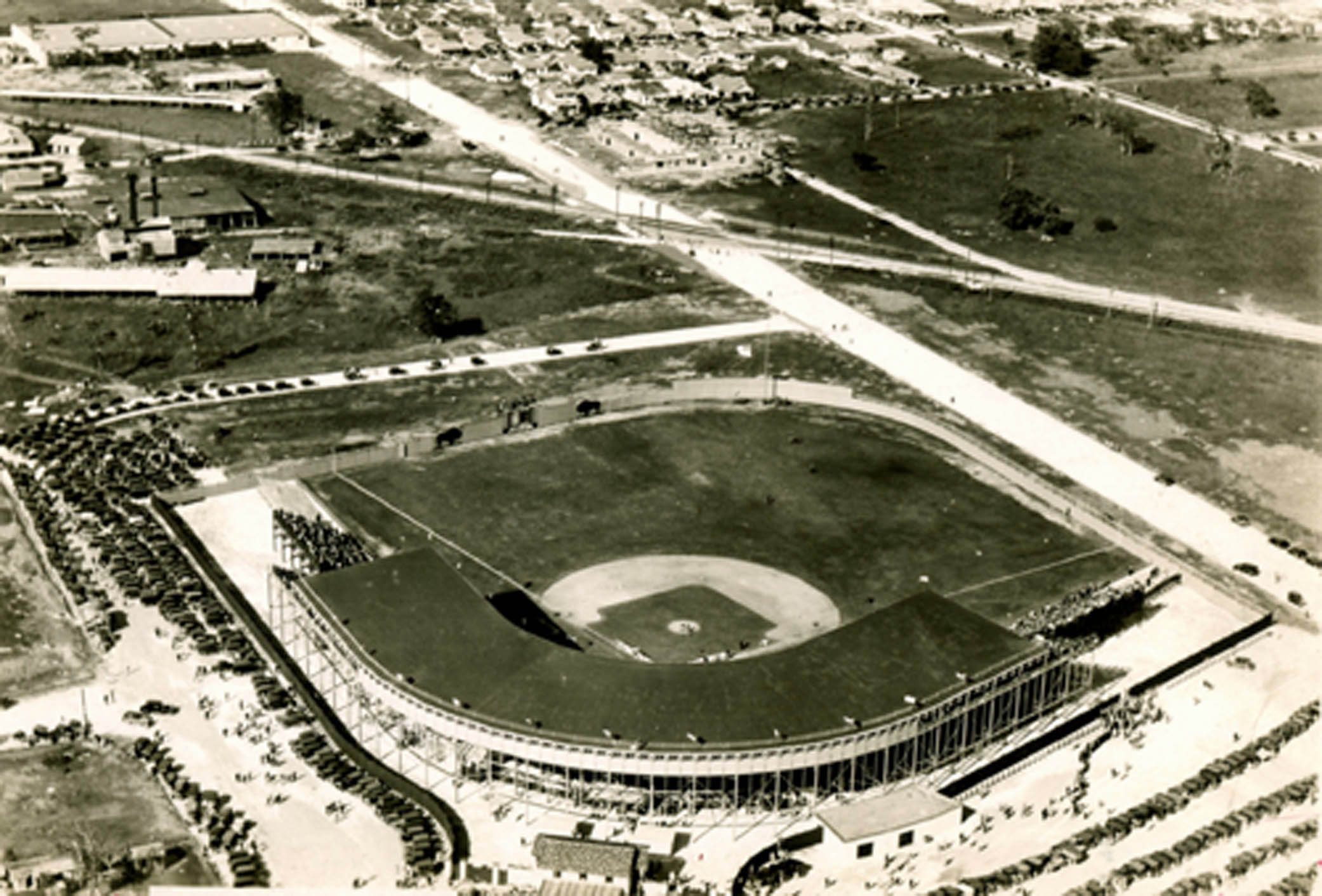
Buff Stadium, Houston (1928-1962): The Houston Buffs played all of their home game dates here over all eight of their pennant year appearances in the Dixie Series.
The day was coming, long before its growing voice was clearly heard. As the Texas League began to stabilize, near the end of World War I, the hunger for other hills to climb on the field and at the turnstiles was bound to grow – and so it did.
At the same time, the Southern Association league of eight clubs that played in cities stretching from New Orleans to Atlanta was reaching for the same quality increase in competition, income, and recognition.
The Texas League and the Southern Association were like the two proverbial sticks that came together to start a fire – and this one was a fir of competitive desire.
Prior to the 1920 season, ownership groups from the two leagues came together to plan a post-season playoff series between the champions of the Texas League and the Southern Association. It would be modeled after the major league World Series with the championship going to the first team to win four games in head-to-head, home and home based competition.
They picked a name for the competition that fit the mindset then of the two league cultures and the spirit of those early twentieth century times: The Dixie Series would annually pit the southeast and southwest sections of the country against each other over an area that covered only territory that once made up the old Civil War Confederacy.
The Dixie Series thrived continuously from 1920 through 1958, only missing three seasons (1943-1945) due to World War II when there was no play in either league.
Houston played in eight Dixie Series competitions, winning four and losing four.
Some of those outcomes were a little surprising, as per always is the case in baseball, if you play enough teams over the course of enough games over the time span of several years.
Things happen.
Dixie Series 1928: Houston Buffaloes defeat Birmingham Barons, 4 games to 2. (Houston’s Dixie Series Record is 1-0.)
The 1928 Buffs had a lot going for them. Their brand new ballpark, Buff Stadium, had been praised by many as the finest venue in minor league baseball; they had a pitching staff that included four 20-game winners; and they had a starting lineup that boomed from the bats of five men who hit over .300 for the entire season. Few in Texas, if any, were surprised when the Buffs won. Some may have been shocked that Birmingham actually captured a couple of games.
Dixie Series 1931: Birmingham Barons defeat Houston Buffaloes, 4 games to 3. (Houston’s Dixies Series Record is 1-1.)
The 1931 Houston Buffs were the club of future Gashouse Gang members Dizzy Dean and Joe Medwick. Dean had a pitching mark of 26-10 for the Buffs and Medwick hit .305. They were the young heart of a club that has been rated as one of the 100 best minor league clubs in history. Overall the Buffs had three 20 plus wins pitchers and three .300 hitters. They simply weren’t the best team in Game Seven of the Series.
Dixie Series 1940: Nashville Vols defeat Houston Buffaloes, 4 games to 1. (Houston’s Dixie Series Record is 1-2.)
Future St. Louis Cardinal manager Eddie Dyer is the field mentor of the Buffs. Howie Krist (22-9) and Howie Pollet (20-7) pace a staff that includes 7 pitchers with ERAs under 4 and 2 with ERAs under 2. Three players, including Danny Murtaugh, hover in the area of .300, and a couple of guys show some homer pop. The club just doesn’t have what it takes to get past a more talented in-that-moment Nashville team.
Dixie Series 1947: Houston Buffaloes defeat Mobile Bears, 4 games to 2. (Houston’s Dixie Series Record is 2-2.)
Two future St. Louis Cardinal managers, Johnny Keane and Solly Hemus, are on board as manager and second baseman for the Buffs. Clarence Beers (25-8) and Al Papai (21-10) pace the Buffs pitching as center fielder Hal Epps (.302) and first baseman John Hernandez (.301) provide a lot of the hitting and defense.
Dixie Series 1951: Birmingham Barons defeat Houston Buffaloes, 4 games to 2. (Houston’s Dixie Series Record is 2-3.)
First baseman Jerry Witte (38 HR) and left fielder Larry Miggins (27 HR) paced an aggressive and powerful batting order and Al Papai (21-10), Octavio Rubert (19-5), Vinegar Bend Mizell (15-13), and Freddie Martin keep opposition scoring way low. Illness to Mizell limits his productivity and availablity in the Series and the Buffs collapse at home, losing the Series to Birmingham.
Dixie Series 1954: Atlanta Crackers defeat Houston Buffaloes, 4 games to 3. (Houston’s Dixie Series Record is 2-4.)
Strong for-average and power hitting, good starting pitching, good defense, and great relief work carried the 1954 Buffs. Third baseman Ken Boyer ( .319, 21 HR) was busy cutting his teeth for a long MLB career. Bob Boyd was on board as the first black player in Houston integrated professional baseball history, but his contributions (.321, 7 HR) were on the field. Willard Brown also joined the Buffs after playing most of the year with Dallas and he, Eddie Phillips, and Don Blasingame also contributed. Willard Schmidt (18-5) was the mound ace and relievers Luis Arryo and Bobby Tiefenauer were the superglow that kept an average starting rotation boat afloat. They just couldn’t do it in Game 7 versus Atlanta.
Dixie Series 1956: Houston Buffaloes defeat Atlanta Crackers, 4 games to 2. (Houston’s Dixie Series Record is 3-4.)
With Harry Walker on board as manager, Bob Mabe (21-10) and Tom Hughes (18-6) are the dual carb aces of another solid Buffs pitching staff. Pidge Browne breaks out at first base with hit math and power (.328, 29 HR) – and he is ably supported by people like third baseman Benny Valenzuela (.314, 18 HR) and center fielder Russell Rac (.289, 19 HR). Having Ruben Amaro, Sr. at shortstop also seals the defense as the Buffs avenge their 1954 loss to Atlanta.
Dixie Series 1957: Houston Buffaloes defeat Atlanta Crackers, 4 games to 2. (Houston’s Dixie Series Record is 3-4.)
Catcher Nelson Burbrink (.308, 0 HR) is the only full season .300 hitter for the Buffs, but his total lack of power and the decline in production from Pidge Browne leads to the acquisition of first baseman Edwin Little (.243, 30 HR) from Oklahoma City for more pop on the long ball in late-season play. Adequate pitching that rises to special occasions carries the Buffs through to victory and an all-time even record in Dixie Series play.
After the 1958 season, the Dixie Series ends. The end coincides with the city’s last season as a member of the Texas League as the Houston Buffaloes move up in 1959 to face AAA competition in the American Association under independent ownership by Marty Marion and his group of investors.
Here is a concise graph that depicts the results of 36 series that occurred over the course of the entire chronological period of the 39 years that the Dixie Series existed:
The Dixie Series 1920 – 1958
1958 was the last encounter in the Dixie Series between the Southern Association and Texas League. Beginning in 1959 it was replaced by the Pan-Am Series, the Texas League vs. the Mexican League.
SOURCE: The Encyclopedia of Minor League Baseball, Volume 2
Retrieved from
“http://www.baseball-reference.com/bullpen/Dixie_Series“
Tags: Dixie Series History
 The Pecan Park Eagle
August 3, 2014 at 5:52 pm |
I want to start a blog to highlight the history of the AAA and AA leagues and would like for you to write entries on it highlighting the Texas League and Houston Buffs.
Would like to focus on the minor league cities that became major league cities later on. If you are interested please let me know.