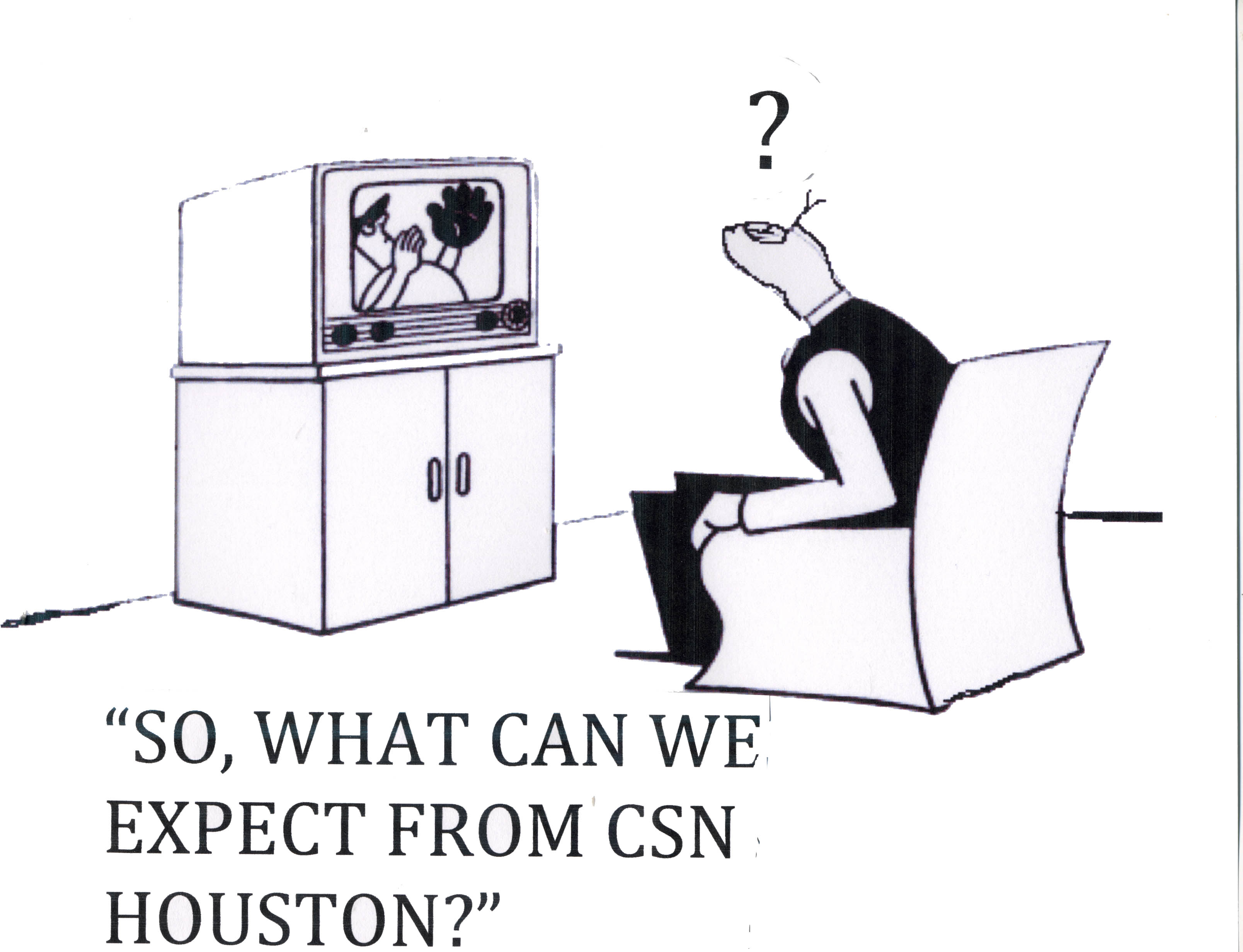
I guess the only good answer to out title question is – we’ll have to wait and see. For now, the Astros and Rockets are the two paying client/subjects and the distribution for the new Houston-hub sports network is mainly or completely through Comcast. Those of us who use DirectTV or other satellite television service will have to wait and see if the new project work out distribution plans through a wider body service providers.
The company word, if we go by what they are saying in current articles, is that CSN Houston plans to bring back the best of the old HSE network with the focus on Houston sports and the local teams that people care about.
Good plan – but how do they measure caring? Are we talking about local teams that draw big crowds, just those that contribute to the underwriting of the new network’s operations, local professional teams only, or local college and amateur sports as well? As far as I know, the football Texans are not an underwriter of the new network, but I will presume that something like the little hope “blip” that they are creating on the local scene will get some coverage. I also presume that UH, Rice, TSU, HBU, and St. Thomas are local schools with major feet to minor toes in athletics that could qualify each of them as Houston entities that people care about and that worthy foreign (out-of-town) schools like UT, A&M, Baylor, TCU, and LSU would not quality as local sports groups deserving of central focus attention from CSN Houston.
Maybe I’m wrong.
Back in 1956, when I was starting my undergraduate work at UH as a radio-tv major, the fairly new world of commercial television was a whole lot simpler than it is today. It was only simpler because our cultural understanding of its potential was so limited, Back then, it seems that most of my professors were treating television as though it were simply “radio with pictures.”
The goal was to develop interesting programs that people would watch through the minefield of advertising that sponsors put out there much as they always had done on radio. We lacked all the technical apps of videotape, satellite immediacy to live events, digital advancements in sight, sound, and special effects, and the Internet that would transform the medium into the “monster creative force on the loose creature” that it has now become.
In a way, I see “reality tv” as a manifestation of our narrative deficit at the good storytelling bank. Because we cannot keep up with the demand for more and more quality materials, we turn the technology over to everyday idiots, allowing same the time and space to make idiot-ass-celebrities of themselves.
CSN Houston has my best wishes for a successful expansion on the sports narrative coverage of local sports, but not as “radio with pictures.” Even home-based, we need more than the faces of disgruntled sports fans on camera to achieve that end. All the life lessons and deeper human interest components are located in these places: the backstories of our athletes and other local sports figures and entities; the data, artifacts, people, places, and events of local sports history; and the relevance of sports lessons to our larger life as the Houston community.
In brief, it is my hope that CSN Houston can become a breakthrough digital age narrative informer that does not settle completely for the same hackneyed “soundbites at ten” format that characterizes most others.
Tags: CSN HOUSTON
 The Pecan Park Eagle
October 1, 2012 at 1:58 pm |
I was invited to tour the new CSN-Houston studios in the Houston Pavillions and did so with the help of Rich Bocchini, the Communications Manager. Jason Phelps of Astros Country and myself were taken through the studios and got to see a practice run where Kevin Eschenfelder and Jerome Solomon discussed a segment on the Texans.
A lot of what they will do is as yet undecided but they plan to take over the local programming from Comcast SportsNet (the larger network that services Chicago, Philly, the Bay Area, etc.) at 5 p.m. everyday and provide local talk up to the beginning of that night’s live event (most likely Rockets or Astros) along with coverage of college and local high schools.
So, yes, there will be a lot of talking heads, particularly at first, but their goal is to give their viewers a thorough Houston-flavored programming every night of the week, except for a late night highlight show provided by the network.
As for carriage, that’s going to be tough in some areas (like Central Texas where the Rockets must be blacked out for the Spurs) but they will probably be available in most of Texas, Louisiana and Oklahoma within 1-2 years.
I, too, wish them the best and hope to help them have some programming that helps us remember the NL days of the Astros going forward.