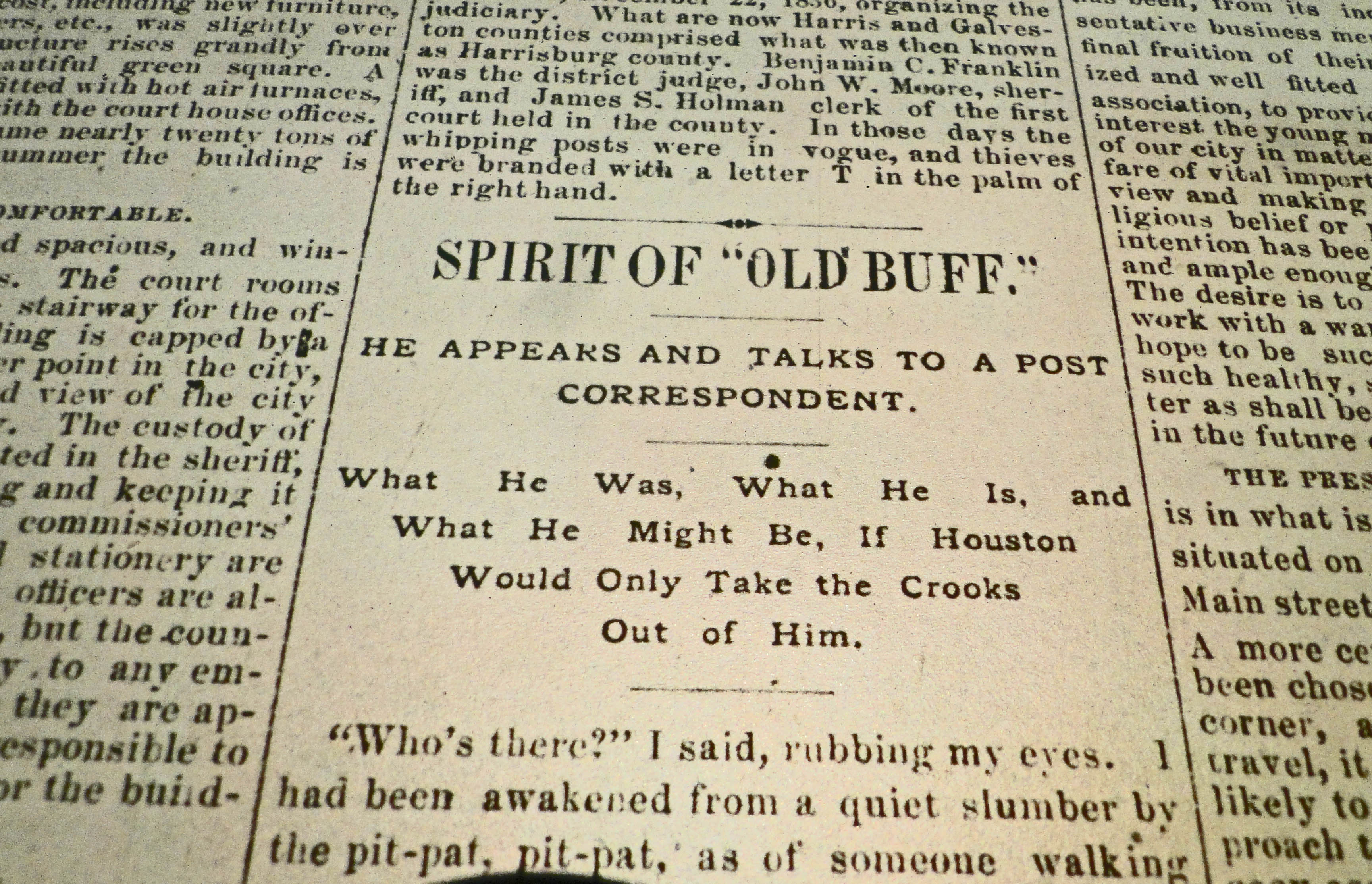
See the last paragraph of this article for an explanation of this item’s inclusion as our story’s visual of the day.
Newspaper reporters don’t write for history, they write to sell newspapers, but they still often leave us over time with the only surviving active voice on history we are likely to find, unless someone from the same period has written a personal letter or observation that pertains to our subject and we are lucky enough to find it. The precious quality of old news stories only increases as we go back in time to the turn of the late 19th century when there were no radio, television, or recordings of public comment.
Our relentless SABR research team drilling into the news files on the early history of baseball in Houston from 1861 to 1961 has been a ride to both teach and remember both the value and pitfall effect of old newspaper stories. I will not steal the thunder of our major previously unknown findings on early Houston baseball here, but I do want to talk briefly about the major methodological problem that anyone doing this kind of research needs to keep in mind:
News writers, especially those from the 19th century, often assume that readers know the full names of people and places, and also the names and locations of certain sites, so they simply write their stories on top of these assumptions. (Fictional Example: “Mayor Bob spent the afternoon watching the game at the ball park.”)
Problems for Research: What was Mayor Bob’s last name? Was Mayor Bob really an elected official – or was that simply a nickname that had been placed upon some local character who behaved as though he had more personal authority than he actually possessed? What was the name of the ball park? Or did it even have a formal name? And where was this field of play located?
This is where the research fun begins. You would check the list of Houston mayors to see if the city ever had a leader whose first name was Bob or, more likely, Robert. If you found nothing there, you might check the names of mayors for Galveston or other local communities. Or, if you were not concerned that the identity of a game patron dubbed as “Mayor Bob” was not that important to the history of baseball, you could simply put it aside and press forward in the search for more direct information about the actual games and their social and administrative developments, still noting yourself to watch for the name coming up again in the volume of stories that lay ahead of you on the reading list.
There is no one-way to resolve hard to answer questions that come up in social history research. A researcher has to be able to imagine all kinds of cross-referential avenues for finding answers that lay hidden or buried in the printed records of history. And with wonderful researchers like Mike Vance leading the way in this area, we have come up with a number of significant early findings that were previously unknown. You will have to wait until our SABR book on the early history of baseball in Houston comes out in 2014 to see what some of these discoveries have been for us. All I will say for now is that they have been considerable.
(Wink! Wink!) Some of us have talked about how wonderful it would be if we could actually travel back in time to see some of these things for ourselves – and maybe spend some time also talking with some of the anonymous writers from the Houston Daily Post of the 19th century about why they wrote what they wrote. – Our starting plan was to send a 2012 research team member by the code name “Old Buff” back to 1887 to talk with a Post writer about the coming of the new Texas League in 1888. In deference to all any of us had ever seen or read in sci-fi works, our “Old Buff” would ask the Post writer to promise he would not write about our visit from the 21st century. – We had not come to alter history. We had come only in search of the truth. (See the storyline photocopy and it’s inscription for a full understanding of this paragraph. (Wink! WInk!)
 The Pecan Park Eagle
Leave a comment