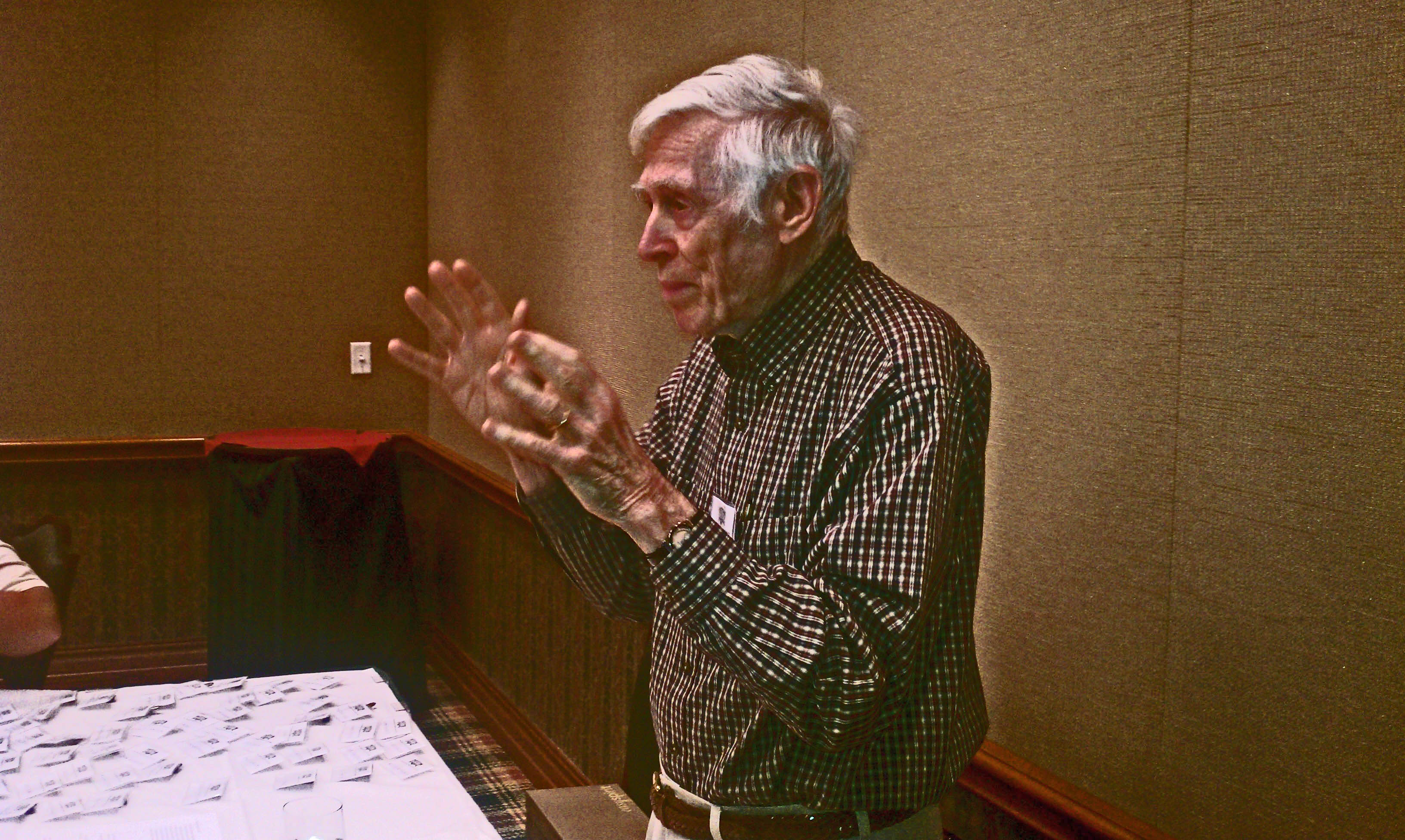
Norman Macht is the author of "Connie Mack: The Turbulent and Triumphant Years, 1915-1931. This work is Volume II in a three-part planned biography of the iconic owner/manager of the Philadelphia Athletics that Macht has been working on for over 30 years. Based on his talk to the Houston SABR Chapter last night (4/16/12), one could only conclude that Macht's search for the truth in all places large and small is nothing short of relentless.
Norman L. Macht has been one of my favorite baseball researcher/writers since he first published Volume I of his landmark work on the life and times of the great half century owner/manager of the Philadelphia Athletics, the legendary Connie Mack. Macht published his first treatment of Mack in collaboration with the grand old man’s grandson, Connie Mack III, in 2007. That starter kit to Macht-addiction was entitled “Connie Mack and the Early Years of Baseball.”
It was high honor to simply meet the man for a light meal prior to hearing him speak before the monthly meeting of the Larry Dierker Chapter of SABR, the Society for American Baseball Research, Monday night, April 16th, at the Inn at the Ballpark across the street from Minute Maid Park in Houston. Macht was the third of three wonderful speakers on the evening and he was preceded by sports media writer David Barron of the Houston Chronicle and former third baseman and current administrative employee of the Houston Astros, the great Enos Cabell, who each serially brought news of the Astrodome’s demise and the Astros’ plans to rise. Both were very good in their own rights, but it is Macht who draws my attention here today because of what he represents as a role model to our own current research into the first one hundred years (1861-1961) of baseball history in Houston.
The man is totally dedicated in all his searches to a pursuit of verifiable truth – and that’s not easy when the subject matter is baseball, a game that has sewn its seeds plentifully and often on the wings of stories by sportswriters that weren’t “necessarily so.”
Macht best describes his pursuit of the truth in a mere few words as the one-sentence second paragraph of his opening acknowledgement section of his new book. In lamenting the loss of a valuable research colleague, Macht writes the following:
“Without Jim ‘Snuffy’ Smith’s zealous pursuit of the truth and accuracy in all matters, I would have fallen further short of the holy grail of getting it all right.”
“Pursuit of truth and accuracy in all things” is the active operant ticker heart of this man, Norman Macht.
Working on any history in the baseball world, one must wade through a culture that has already built a thriving self-image around a plentiful supply of lies and legends about events that most probably never happened. (Uh, “The Babe Calls His Shot in Chicago, 1932,” for example). Sports writers learned early that baseball stories don’t have to be true to sell newspapers. They simply have to be entertaining – “funny” helps and “magical” transcends.”
As one example of the stories that Macht has taken apart, he told the story of a column written by the esteemed Dave Anderson in the New York Times, I believe, back in 1975. Anderson wrote a story, one supposedly told by Joe DiMaggio at a banquet arouned that time. (I may get some facts wrong here. i wasn’t taking notes last night.)
In the tale, DiMaggio of the Yankees hits a home run off a fastball thrown by BoBo Newsom of the Philadelphia Athletics. The next time up, and before he bats, A’s manager Mack tells pitcher Newsom: “DiMaggio teed off on your fastball last time, Bobo. This time, show him your curve. Newsom did the curve, but it didn’t break much. DiMaggio hit it into the upper deck in left at Shibe Park. As DiMaggio is rounding third on that second homer of the day off Newsom, Bobo supposedly walks off the mound to yell into the dugout to his manager: “Hey! Mr. Mack! Guess what? He hit your pitch even further than he hit mine!”
Great baseball story. Full of breakfast table smiles for the avid readership. But there’s just one thing. Was it true?
Norman L. Macht took the story and did what few will do. He researched the hard-core record books: Was there ever a game in which Joe DiMaggio hit two runs in a single game against the Athletics? If so, did he ever do the deed against Bobo Newsom.
Macht found that the first set of answers were “yes” and “no.”
If memory serves, “yes,” DiMaggio had three double homer games against the A’s in his career, but “no,” none of these games occurred against Bobo Newsom.
Those results don’t settle things for a relentless searcher like Norman Macht. He carries it further to the possibility that maybe the story is right, but the facts are wrong. Of the three double homer games, Macht rules out one game in which the two homers came against two different men. Then he methodically eliminates both of the separate pitchers who did surrender double homers in games against DiMaggio for psychological reasons. One was shy and retiring; the other was shell-shocked into a quiet state from service in World War II. Neither was a candidate for shouting from the playing field to their manager,
The story did not pass the Macht smell test. It was just an amusement, but not worth the ink on the pages of actual history. So Macht put it to sleep until some boob like me jumps on it for its entertainment value and repeats it here. How many of you out there who now act to share the DiMaggio story with others will also go through the steps of explaining that it’s not true, clarifying that it’s just a funny story, one that probably fired off the pistons that once cranked off the entertaining mind of a writer named Dave Anderson? * (See footnote at end of column.)
Answer: Probably not too many.
Forgave me, Norman. You still have my utmost respect for all you do in the name of historical truth.
I came away from the evening in even greater awe of Norman L. Macht, but with a new perspective on his characteristic role in baseball research. It was a new image for me of the man – and one helped greatly on the transferential level by his physical similarity to another great historical man who found himself captured tightly by his obsession with rightful purpose.
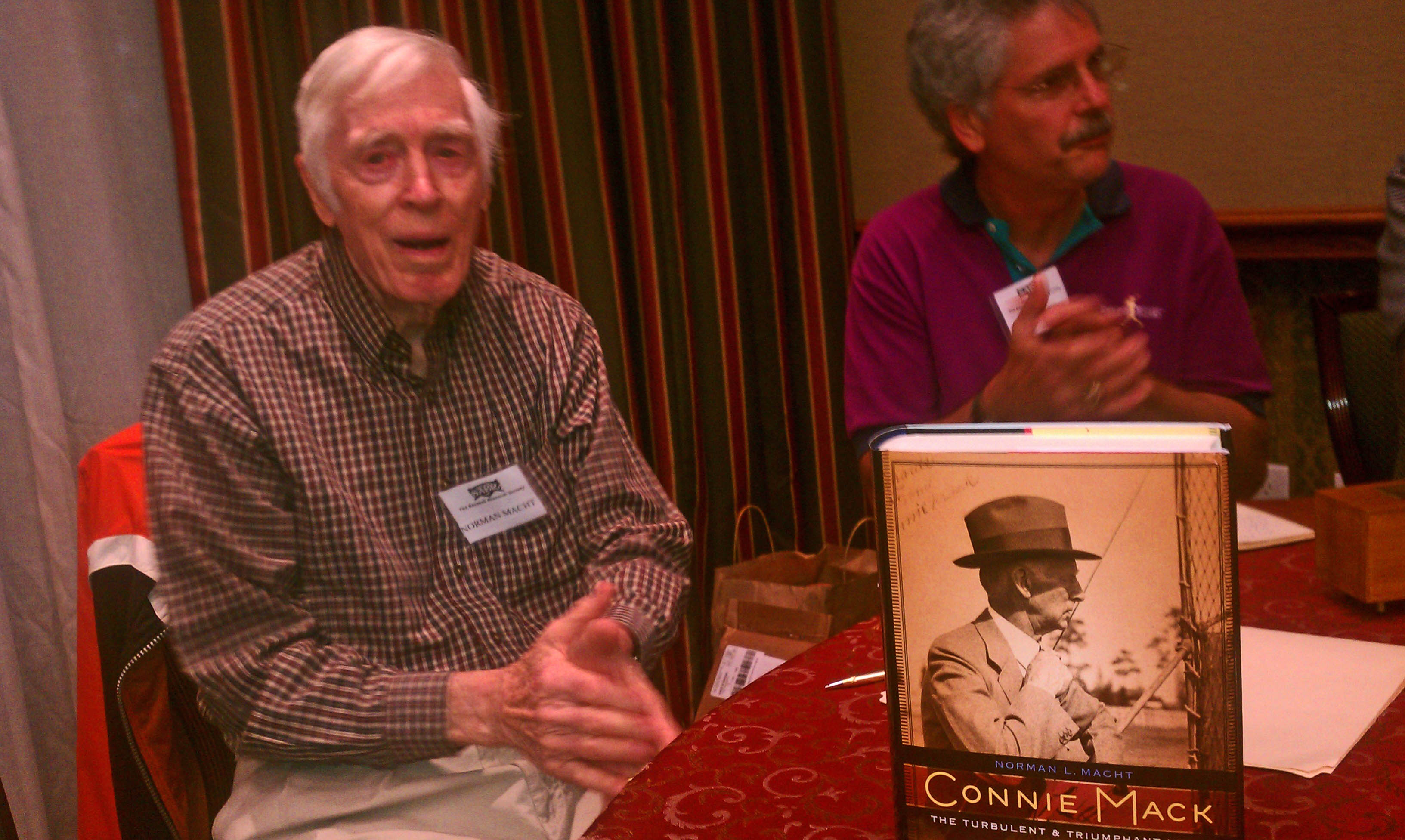
Norman L. Macht and Volume II of his Connie Mack story.
It finally came to me this morning. Norman L. Macht is the Jack Kevorkian of baseball research. He is totally dedicated to the goal of assisting all untrue stories in baseball to the cemetery of the unpublished waste pile. If they are not verifiable in some hard copy form, he will not use them in his own work, He is, and I think rightfully so, distrustful of what others write in blogs, books, and sports columns and articles that offer no hard fact support as the truth.
Keep up the good work, Norman. The truth needs you as much as you need the truth.
* Footnote, 4/18/12: As the result of word from Norman Macht in response to this column (see his comment below), I have been duly corrected that it was Dave Anderson, not Red Smith, who told the DiMaggio story used in this piece. Because it both stands as bonus proof of Mr. Macht’s desire for truth, and my propensity for human hearing and memory error, I have replaced Smith in the story with the correct name of Anderson. I share Mr. Macht’s desire for getting all things right, even when my human capacities sometimes get in the way. Thanks you again, Norman Macht, for calling this error to my attention. – Bill McCurdy.
Column Addendum, 4/18/12: Here’s a better shot of Norman Macht as he personally euthanized the “Two Homers off Bobo Newsom by Joe DiMaggio in the Same Game” story for being untrue at the 4/16/12 meeting of SABR’s Larry Dierker Chapter on Monday Night at The Inn at the Ballpark next to Minute Maid Park in Houston:

Historical Euthanization in Progress: "Way to go, Norman! You metaphorically put the whole DiMaggio-Newsom Two Homer tale to its eternal rest away from the big book of history as untrue on Monday night. And we thank you for so acting."
Thanks again, Norman Macht, Baseball research needs more people on board who are as careful with the truth as you are.
Tags: Connie Mack, NNorman L Macht
 The Pecan Park Eagle
April 18, 2012 at 1:17 am |
I’ve been a Macht fan since I saw him at the 1990 SABR Convention. Great post.
April 18, 2012 at 2:36 pm |
Bill: Thanks for your kind words. Sorry — but I gotta live up to them — it was Dave Anderson on The New York Times, not Red Smith, who reported DiMaggio telling the Newsom story.
Norman
April 18, 2012 at 5:15 pm |
Norman: Thanks. Your correction is more than OK. I will make the change in the story text and even footnote the explanation that my actions are a direct result of your call for change and our shared desire to get all our stories right.
April 23, 2012 at 6:17 am |
Bill, great column.
I’m sure you meant this line – >>Uh, “The Babe Calls His Shot in Chicago, 1932,” for example<< – as an example of how some stories take on a life of their own without proper examination, as opposed to being a story proven to be untrue.
But for readers who may have thought you meant that the called shot story has been debunked, I'll offer the clarification that in recent years, the discovery of home movie film footage taken at the game by two separate individuals and viewed publicly clearly shows Ruth pointing with one finger and his right arm fully extended in the direction of center field, right past pitcher Charlie Root. In that moment Root's back is to Ruth, and catcher Hartnett's back also is turned towards Ruth. So Ruth apparently is gesturing for the benefit of players razzing him in the dugout.
There also is audio tape of a game broadcaster who verbally informs listeners that Ruth pointed towards center field before hitting the home run, and someone (I'm thinking it was Gary Gillette but my memory isn't what it used to be) on SABR-L noted that the tape appeared to be authentic game-day audiotape and not a dramatic re-enactment. Several day-after newspaper stories also reference the event, and there is a still photo in Lawrence Ritter's coffee table book about the Babe showing Ruth pointing. In an adjacent photo, Gehrig is congratulating Ruth as he touches the plate while Hartnett stands with his head down and umpire Van Graff gazing at Ruth with a huge grin on his face. (Too bad nobody ever got a quote from Van Graff.)
What does seem more debatable, however, is whether or not Ruth said, "I'm going to hit a homerun right over there over the center field wall on the next pitch." Hartnett is quoted as insisting all Ruth said was, "It only takes one to hit it." But, as noted, his back was turned to Ruth at the time, and memory is a fallible thing. I think the sheer audacity of even pointing so dramatically in a situation like that is enough to cement the legend. After all, who does something like that? It's beyond astonishing.
Good stuff.
Mark