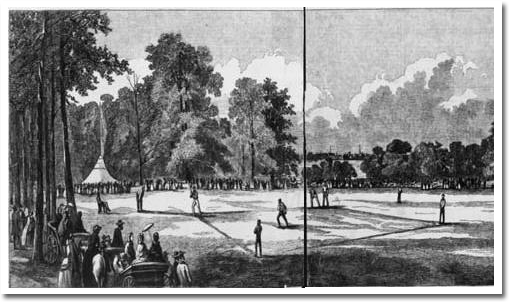
Elysian Fields, Hoboken, NJ, 1845
Preeminent baseball historian John Thorn, the Editor of Total Baseball, has now written a masterful book entitled “Baseball in the Garden of Eden: The Secret History of the Early Game.” If you don’t mind in-depth intellectual explanations that clearly define baseball’s rise from the cultural ooze of numerous influences, this is the book for you. Just be forewarned: This is not a book to lull your brain to sleep as bedtime fare. It’s the kind that kindles reconstructed thought on the issue of baseball’s beginnings.
Thorn clearly points out the names of individuals and groups that have been forgotten, along with those who’ve probably been given too much credit for the evolution of rules that basically continue to govern baseball through the 21st century. He also credits Alexander Cartwright and the Knickerbocker club for coming up with the twenty rules that gave the game its point of play. Thorn acknowledges the great probability that all of these rules came from various sources and that the Knickerbockers simply spelled them out as successful ways to define play, winning, and the preferred attitude for players of the game. If you want further explication of each, I recommend you read the book. Thorn covers them pretty thoroughly from pages 71 to 77.
The interesting evolution rope is to watch baseball evolve as Thorn sees it. It begins on many levels by many separate, but similar forms of bat, ball, and base play by disconnected groups of children in the colonies. By the 1830s, up and coming young New York men of money and letters in Manhattan begin to form clubs to play some kind of stick ball games that they prefer to stage on the open meadows of the Elysian Fields across the Hudson River in Hoboken , New Jersey.
The Knickerbockers, Gothams, New Yorks, Magnolias, and Eagles are all variously successful and similarly remembered as clubs that formed to play internally among their own memberships. Rules began to form from the experiences of all, by trial and error, and these comprised the heart of the 1845 Knickerbocker Rules. As the way to winning and the point of the game sharpened, it became easier for more young men to play the game in justification of the time they spend on the activity. Interest in winning also began to attract gamblers, increasing “fan” interest and pushing for extra-mural play between clubs and the rapid growth of the sport from amateur to professional status.
How did baseball grow into a professional sport? Just follow the money. Ask John Thorn.
Tags: History of Baseball, John Thorn
 The Pecan Park Eagle
March 30, 2012 at 4:52 pm |
Vintage Baseball at it’s best in Sealy, Texas this Saturday. Good chance to go out and see the wildflowers mixed with a good game of Vintage Baseball with the Houston Babies. Got to love a game where the umpire is called a “Blind Tom”
http://www.sealyhistoricalsociety.org/index.html
Hope to see you there, Longball