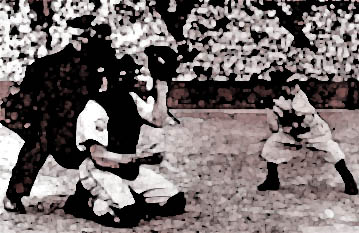
August 19, 1951: Vertically challenged Eddie Gaedel came to bat as a pinch hitter for Frank Saucier of the St. Louis Browns in Sportsman's Park, St. Louis, and drew a four-pitch walk from pitcher Bob Cain of the Detroit Tigers. He was immediately replaced by pinch-runner Jim Delsing and retired from his one-at bat career with an all-time OBP of 1.000.
The great Satchel Paige and the little unknown midget named Eddie Gaedel were teammates for one day on the 1951 St. Louis Browns. Neither man, especially Gaedel, would likely have been there at all, had it not been for club owner Bill Veeck and his PT Barnum level commitment to boosting the anemic gate attraction that was the drubbing wagon that the Browns had become in American League history through this time. By 1951, as a matter of fact, the wobbly wheels of that creaking old boneyard cart were only two years away from falling off forever and the remaining riders taking flight east as orange-breasted Orioles.
Still, the great ones never forget, even if they fail to show up or stay awake for the most secretive off-the-wall stunt ever pulled off in baseball history. For a man who wanted to goose the gate, Bill Veeck had done everything he could to keep the use of his little midget in an actual game a secret until it happened. As much as he might have preferred a big advance ballyhoo that could have attracted a larger crowd, Veeck also knew that too much advance publicity might result in either the Commissioner or the American League coming down to halt the plan before it ever happened.
Veeck settled for the element of surprise – and the hope that it would spawn a new awareness among St. Louis fans, one that would promote the idea that “I had better go see a few Browns games; there’s no telling what I am liable to miss seeing if I don’t go.”
Veeck thought of everything. He had even gotten Gaedel to sign an AL approved player’s contract prior to the day of the game in anticipation of the umpire challenge that was sure to come, which it did, but a presentation of the written document ruled over all short-term arguments by the Tigers when the Browns sent up Eddie Gaedel as a pinch hitter for lead off man Frank Saucier in the bottom of the first inning.
Once play began, the Tiger battery, pitcher Bob Cain and catcher Bob Swift, pretty much handled Gaedel as though they were facing a child by throwing his lob pitches that they hoped would move through the strike zone as such – or an easy to field come-backers to the infield. But Gaedel was no child – and he was batting under mock death threat (we think) from Bill Veeck not to swing at anything. Veeck had actually told Gaedel that he planned to watch his performance with rifle in hand from atop the stadium roof. Veeck had made it clear that he planned to shoot Gaedel if he dared swing at anything.
Eddie Gaedel did not swing at all. He walked his way into baseball history on four pitches and then departed for a pinch runner. Within hours of his triumph, his contract to play baseball was rescinded as a sham, but I’m not really sure how prejudicial the aborting language was against all the vertically challenged people in this world. I just know that he had played his one and only hand into baseball history.
But as we said earlier, the great ones never forget. And Satchel Paige was indeed one of the great ones.
Years later, as reported on page 721 of “Satchel” by Larry Tye, Satchel Paige was engaged in one of his many barnstorming trips to Canada and was pitching in a small town called Kindersley in western Saskatchewan. It was one of those days in which Paige still felt like going a full nine innings, but something happened in the seventh inning that was purely designed to bother Satchel. The manager of the local club opposition put a four-year old boy who stood only three feet tall into the lineup as a pinch hitter.
Hey! At three feet in height, the Canadian kid was a full one foot shorter than Eddie Gaedel.
“Everyone thought that Satch would lob the ball, or perhaps walk him,” remembers Bob Joyce, who was calling the balls and strikes that day. “But he threw three perfect fastballs, knee high, and I had to call the kid out. Imagine the strike zone at 60 feet, 6 inches.”
And while we’re at it, let’s recall all those stories about Satchel Paige’s ability to hit the middle of a gum wrapper paper when he needed a strike. In that kind of situation, there was no way that the great Satchel Paige was going to Eddie Gaedel this little kid to first as a free base runner.
Maybe Satchel wasn’t even at Sportsman’s Park on the day of Eddie Gaedel’s famous plate appearance of August 19, 1951. In fact, I’d like to think he wasn’t. I’d prefer to think that the real Satchel Paige would have mowed down the little kid years later up in Canada, no matter what. Anybody who steps in to hit in the game of baseball should be ready to take on all the consequences of that decision – or said person shouldn’t even be there in the first place.
Tags: Eddie Gaedel, Satchel Paige
 The Pecan Park Eagle
October 16, 2011 at 5:30 pm |
I thought it was going to say Paige would have drilled him in the ribs.
October 16, 2011 at 6:33 pm |
Didn’t baseball adopt a new rule against such shenanigans as a result of this incident?
August 28, 2014 at 12:23 am |
Satchel Paige WAS there on the day that Eddie Gaedel came up to bat. He played the drums during the show between the two games, and while Eddie jumped out of the cake. August 19, 1951 marked a historic intersection between baseball and humor, with the greatest prank ever devised on a baseball diamond!