
Arthur Richman (L) & Marty Marion, 2003.
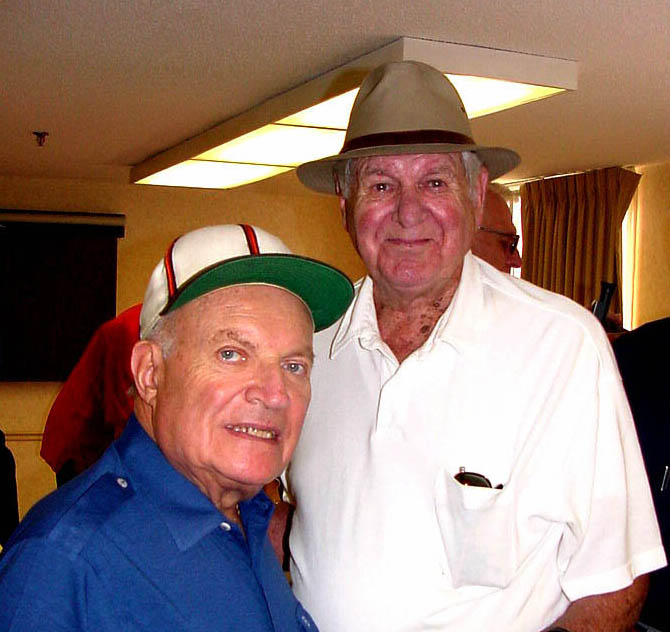
Marty Marion is dead at 93. He passed away Tuesday night, March 15, 2011, in St. Louis, and leaving this world with the reputation of having been one of the greatest defensive shortstops in baseball history and a Cardinal icon. Over the course of his 13-season career (1940-1950, 1952-1953), Marion batted only .263, never hitting .300, but his defensive ability won him the National League’s 1944 Most Valuable Player Award and eight selections for the NL All Star team. Known as “Slats” for his long and limber frames – and as the “Octopus” for his ability to reach and stop just about every ball hit his way, Marion was respected as the greatest shortstop in Cardinals history until Ozzie Smith came along and, even then, some of the old-timers still hung around to argue his case.

Bud Thomas, Marty Marion, & Stan Musial, 2003.
As a player, Marion was an 11-season Cardinal (1940-1950) and a 2-year limited service guy for the old St. Louis Browns. Marty managed the 1951 Cardinals and then took his talents down the hall at old Sportsman’s Park/Busch Stadium I as the playing manager of the 1952-1953 Browns and the last mentor in that club’s history. He later took over as manager of the 1954 Chicago White Sox during the season and then stayed on to mentor the Sox through the 1955 and 1956 seasons.
In the late 1950s, Marty Marion served as president of a group that purchased the Houston Buffaloes of the AA Texas League and their stadium property from the Cardinals and moved the franchise up to participation in the AAA American Association for three final seasons (1959-1961).
Marion and Company hoped to use their position in Houston to gain the first major league franchise awarded to that booming area, but that 1960 nod went instead to a group led by Judge Roy Hofheinz and their commitment with Harris County to building baseball’s first domed stadium. The competition created enough acrimony to make the subsequent and MLB-required purchase of the minor league territorial rights from the Marion group a tense and expensive proposition for Hofheinz and his Houston Sports Association. The unpleasantness killed any hopes that some of us held for our town going into major league baseball as the “Houston Buffaloes” or “Buffs.” Once settled, Hofheinz then ditched the whole decades old club identity as Buffs in favor of their new his-ego-blessed name, the “Houston Colt .45’s.” Three years later, the club would Hofheinz-morph again into the “Astros,” and the new ballpark would transform into the “Astrodome,” Eighth Wonder of the World.
Very quietly, and little known to most people, Marty Marion was the straw that stirred the drink on Houston’s new Major League Baseball back in the early 1960s.
And now he’s gone. As a player. As a manager. As an entrepreneur. As a living icon of St. Louis baseball history.

Marty Marion & Bill McCurdy, 2003.
Old teammates like Red Schoendienst and Stan Musial will argue forever that Marty “Slats” Marion belongs in the Hall of Fame anyway for his defensive ability and winning baseball savvy. A story that the late Red Munger once told me strongly suggests that the part about the “savvy” is nothing less than 100% true.
Back in 1947, according to Red Munger, he was pitching against the Brooklyn Dodgers at Ebbets Field when Jackie Robinson reached second base on a double down the left field line and began that little hop-hop dance off the bag in an effort to distract the Cardinal pitcher. All of a sudden. Marty Marion had called a quick timeout and was standing behind Munger with his glove covering his lips as he spoke.
“Hey, Red,” Marion whispered, “I’ve counted the hops this guy takes when he leaves the bag and how many steps he takes going back. We can pick him off. When you hear me sneeze out loud, just turn and throw a low hard one to the third base side of the bag. OK?”
“Gotcha,” Munger whispered into his own glove, as he never even looked in Robinson’s direction. “Let’s pick this guy off!”
Before he could even throw another pitch to the plate, Munger heard the Octopus sneeze. “AH-CHOO!”
Munger stepped off the rubber and wheeled a perfect throw to second. Marion’s glove awaited. ‘YOU’RE OUT!” The umpire called.
Not even close. Munger and Marion had caught Robinson a step off base he could not regain. The embarrassed, but fiery Robinson got up, but he didn’t run straight to his dugout. He first trotted by Munger on the mound, just slow enough in passing to leave a teeth-clenched message:
“You will never get away with doing that again!” Robinson spouted.
“And you know what?” a smiling Red Munger added. “Jackie was right. We never did it to him again, but that one time it worked was worth a lifetime of good memories, – Are you asking me if Marty Marion belongs in the Hall of Fame? Hell fire, man. Open the doors this afternoon.”
Tags: Baseball, History, Marty Marion
 The Pecan Park Eagle
March 17, 2011 at 4:44 pm |
Another great article, Bill; I learn so much from your essays! Thanks!
March 17, 2011 at 6:40 pm |
Hi Bill,
As a kid growing up in Lebanon, Illinois, I was a die-hard Brownie fan. The Cardinals were everybody’s darlings then, but I loved the old St. Louis Browns. From the days of George McQuinn, Don Gutteridge, Sig Jacucki, Chet Laabs, Denny Galehouse on up to Ned Garver, one-armed Pete Gray, Jim Rivera until they left in the year I graduated from college. I traveled around the world with Shell Oil Company for 36 years – and Houston has been my home for almost 36 years, also. But they can take the boy out of the country, but they can’t take the country out of the boy. Keep me posted.
March 18, 2011 at 9:45 am |
Dad said he was the best Shortstop he ever saw-God Bless-They’re
getting that ’46 Cardinal Team back together, it seems.
March 18, 2011 at 6:09 pm |
Hi Bill
I had the pleasure of visiting with Marty at the Brownie reunions. He was a very kind and gracious man in addition to being great shortstop. I can remember as a kid watching him play with the cardinals. I especially remember the clutch hits in important games.
Bll if you happen to have any extra prints of the three photos you sent in this email, I would appreciate adding them to my collection. I would gladly reimburse you for any expense.
I enjoy your emails and your candid observations. I hope we meet again soon.
Sincerely,
Bud Thomas
March 19, 2011 at 2:26 am |
My first glove was a Rawlings, Marty Marion. I had no idea who he was. I took it to one of my first games, I was either 5 or 6. I had it by the fence on the first base side, it was stolen. My Dad was upset. Probably, because it must have cost him close to a days pay back then. He bought me another Marty Marion though and I kept it until I was a teenager. The name has always been special to me.
Mike
March 20, 2011 at 8:42 pm |
Bill, are those Marty Marion-authored books he’s signing on the table in front of him in one of those photos? If so, can you tell me the name of the book?
Thanks.
Mark
March 20, 2011 at 9:25 pm |
Mark:
Those books on the table were copies of “A Kid From St. Louis,” the autobiography I helped former Brown and Houston Buff Jerry Witte write. Jerry died in 2002, but we didn’t reach publication until 2003, the date these photos were taken.
March 21, 2011 at 5:49 pm |
Hi Bill,
Re your reply to Mark Wernick, I always thought that Jerry Witte played first base for the Cardinals – not the Browns. I know he played for the Buffs before moving up to the big leagues. What do you think?
March 21, 2011 at 6:33 pm |
Walter:
Jerry Witte and I were best friends in his later life. I helped him write his autobiography. “A Kid From St. Louis.” In this case. I don’t just think he played for the Browns, I know that he did. Jerry was briefly with the Browns at the end of the 1946 season and again shortly at the start of the 1947 year. He hit poorly both times and never got another shot at the majors, in spite of a monumental year in 1949, when he hit 50 homers for Dallas. Jerry had come through the Browns’ minor league system. He only reached the Cardinals organization through a minor league trade between the Houston Buffs and Dallas Eagles in June 1950 and then finished his career here in Houston at the end of the 1952 season. He never had so much as a single time at bat with the parent Cardinals. Check it out at Baseball Reference.Com.
March 21, 2011 at 8:49 pm |
Hi Bill,
Thanks for the quick reply. I apparently missed his times with the Browns – although I should have known that he played for them in the late 1940’s. A correction from my earlier blog concerning Mr. Shortstop. The Browns left St. Louis the year I graduated from High School – not College. A minor mistake, but it needed correction. Thanks again for giving me the straight scoop on Jerry.