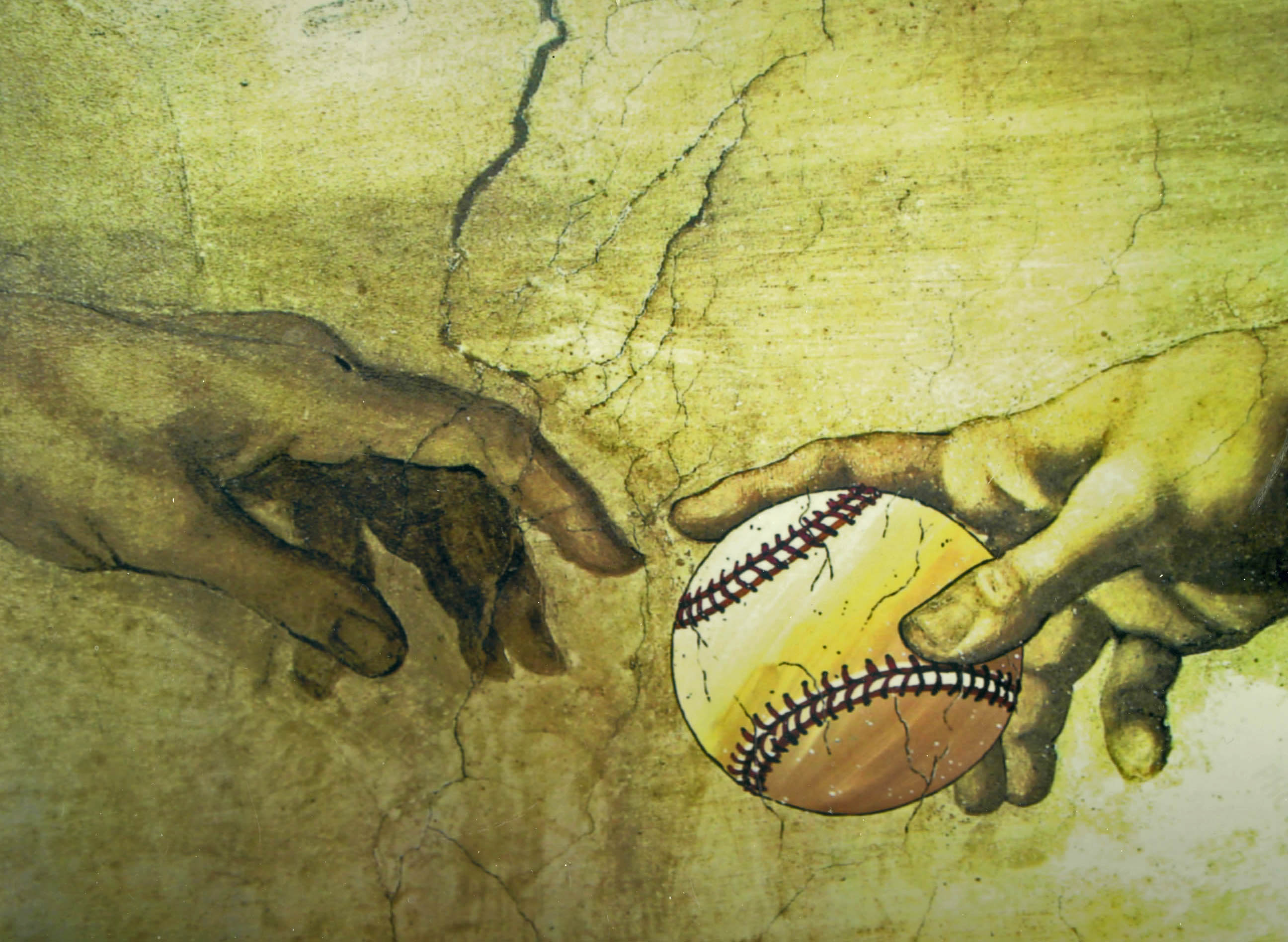
Saves are an expression of Baseball's belief in Divine Intervention.
“Saves” have been around as a recognized statistic in organized baseball since 1969. The following description from Wikipedia explains them for what they are as well as any other I have read or could write:
In baseball statistics, the term save is used to indicate the successful maintenance of a lead by a relief pitcher, usually the closer, until the end of the game. A save is a statistic credited to a relief pitcher, as set forth in Rule 10.19 of the Official Rules of Major League Baseball. That rule states the official scorer shall credit a pitcher with a save when such pitcher meets all four of the following conditions[2]:
- He is the finishing pitcher in a game won by his team;
- He is not the winning pitcher;
- He is credited with at least ⅓ of an inning pitched; and
- He satisfies one of the following conditions:
If the pitcher surrenders the lead at any point, he cannot get a save, but he may be credited as the winning pitcher if his team comes back to win. No more than one save may be credited in each game.
If a relief pitcher satisfies all of the criteria for a save, except he does not finish the game, he will often be credited with a hold (which is not an officially recognized statistic by Major League Baseball).
Save rules have changed over the years; the above rules are the current as defined in Section 10.19 of Major League Baseball‘s Official Rules. The statistic was formally introduced in 1969,[1] although research has identified saves earned prior to that point.
You may also find the other information about “saves” from this page equally helpful. Just click the following link to go there:
http://en.wikipedia.org/wiki/Save_(sport)
Trevor Hoffman and Mariano Rivera, both still active, are the pulling away leaders in career saves and the just retired former Astros saves leader, Billy Wagner, places high in fifth place on the list. All three of these men are prime candidates for the Baseball Hall of Fame once they have retired and become eligible for consideration beyond the five-year retirement waiting period.
Members from the Top Twenty-One Career Saves list already inducted into the Hall of Fame include # 6 Dennis Eckersley, #10 Rollie Fingers, # 18 Goose Gossage, and # 21 Bruce Sutter.
Why certain others, notably # 3 Lee Smith or # 4 John Franco, never made it into “The Hall” with comparable or superior save totals to the others is beyond my ability to explain or defend. I will say this much: Sometimes baseball achievement is denied recognition if a player takes “too long” to do whatever it is he’s doing. At other times, however, baseball rewards players who achieve certain cumulative records over time.
On the objective side, here’s how the current leadership list stacks up through the 2010 season:
Career Leaders in Major League Baseball Pitching Saves
Player |
Saves |
Years(s) |
|
|---|---|---|---|
| (1)Trevor Hoffman* | 601 | 1993–present | |
| (2) Mariano Rivera* | 559 | 1995–present | |
| (3) Lee Smith | 478 | 1980–1997 | |
| (4) John FrancoL | 424 | 1984–2005 | |
| (5) Billy Wagner*L | 422 | 1995–2010 | |
| (6) Dennis Eckersley† | 390 | 1975–1998 | |
| (7) Jeff Reardon | 367 | 1979–1994 | |
| (8) Troy Percival | 358 | 1995–2005, 2007–09 | |
| (9) Randy MyersL | 347 | 1985–1998 | |
| (10) Rollie Fingers† | 341 | 1968–1985 | |
| (11) John Wetteland | 330 | 1989–2000 | |
| (12) Roberto Hernández | 326 | 1991–2007 | |
| (13) José Mesa | 321 | 1987, 1990–2007 | |
| (14) Todd Jones | 319 | 1993–2008 | |
| (15) Rick Aguilera | 318 | 1985–2000 | |
| (16) Robb Nen | 314 | 1993–2002 | |
| (17) Tom Henke | 311 | 1982–1995 | |
| (18) Goose Gossage† | 310 | 1972–1994 | |
| (19) Jeff Montgomery | 304 | 1987–1999 | |
| (20) Doug Jones | 303 | 1982, 1986–2000 | |
| (21) Bruce Sutter† | 300 | 1976-1986, 1988 |
 The Pecan Park Eagle
Leave a comment