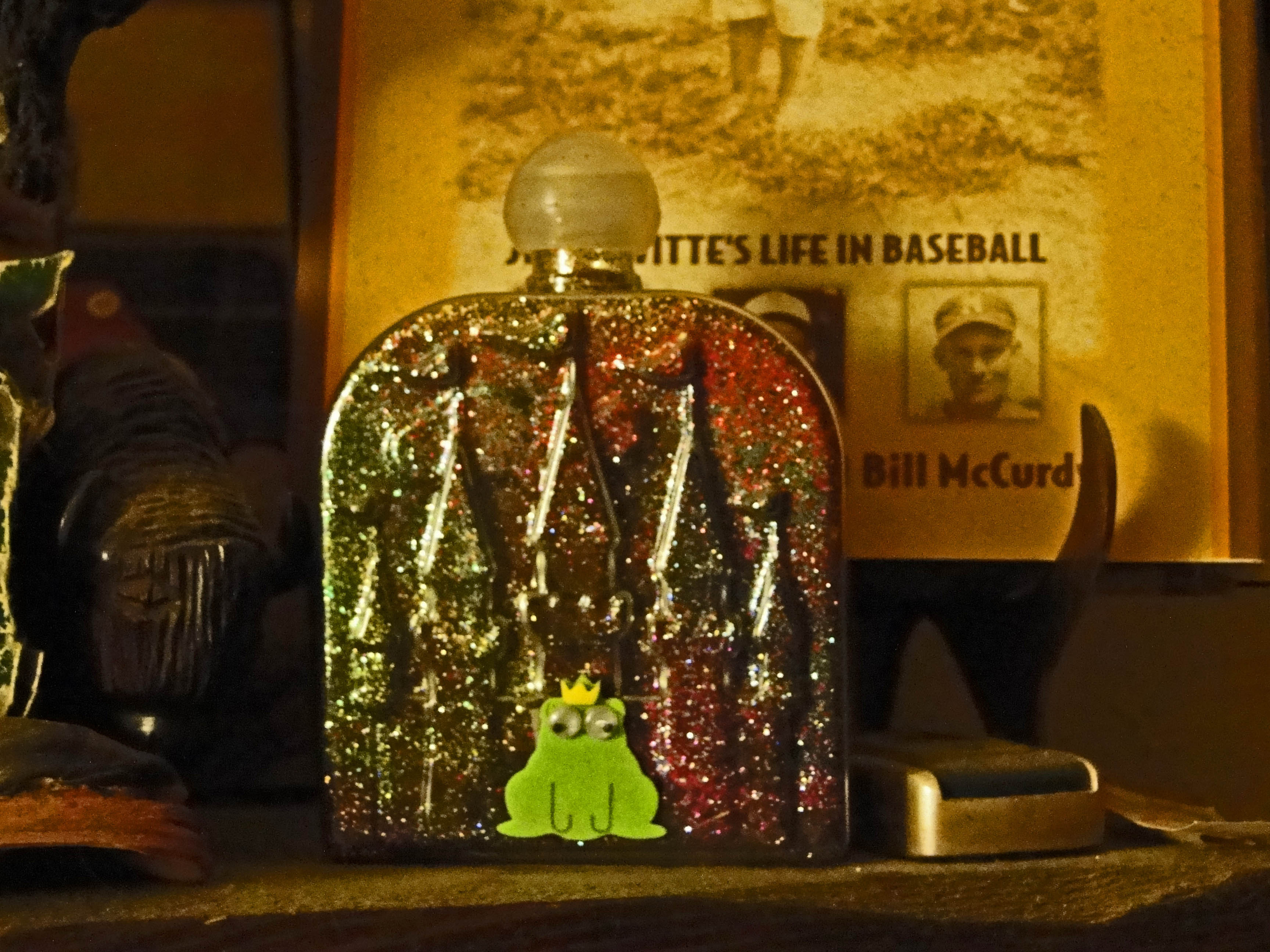
Soil collected from the old home plate area of yesterday's Eagle Field in Pecan Park. It still glitters with magic promise of great games and good times to come. Even the the ghosts of croakers in nearby Frogtown still stop by to pay their respects to the joy that once covered all the free-standing earth of American cities and towns in the form of sandlot baseball.
I confess. I never “outgrew” my emotional attachment to the old dedicated city vacant lot in the east end of Houston that once so faithfully served as home to our sandlot baseball games – and to the dedicated club we Japonica-Myrtle-Kernel street kids called the Pecan Park Eagles. The critical time for me was 1947 to 1953. Before that time, I had yet to awaken to baseball. After that period, work took over much of my summer month and after school time. I had to help pay for my upkeep and I was also playing a little organized baseball away from Pecan Park by that time.
From 1954 forward, “the song had ended, but the melody lingered on.” I didn’t realize it at the time, but none of us really did: As some of you have heard me say, those sandlot baseball days were far and away the greatest era of joy in life that most, if not all of us, would ever again know. None of our dreams and plans for tomorrow would ever be so fulfilling, everyday fresh, and so free of stress and disappointment as any day on the sandlot.
Even losing didn’t hurt for long because there was always tomorrow. And tomorrow’s game could start at sunrise, if we wanted it to begin with the dawn. And tomorrow was nothing more than an extension of today. It was all wrapped up in our non-stop time, adult expectation-free time zone of our united summer love for baseball. From the end of school at Memorial Day to the return of school on the first Tuesday after Labor Day, all of the boys and a couple of the girls in our east end Houston neighborhood, like kids all over town, were playing sandlot baseball.
The two girls that played sandlot baseball with us back then were distinguishable for different reasons. Eileen was a cute little blonde, but she didn’t get there on her looks. Eileen could hit as well and just about out-pitch any guy on the field. Eileen got to be one of us on merit alone. Sissy, on the other hand, had very little ability, but she was overrun with a battling heart. Her two older brothers played with us, but that only got her on the field. She stayed there by trying her damnedest to overcome the crippling effects of some childhood illness we never discussed. It was probably polio that gave her the limp, but we simply didn’t talk about things like that back in the day. Whatever it was, it didn’t stop her heart. When Sissy played, she gave it her all.
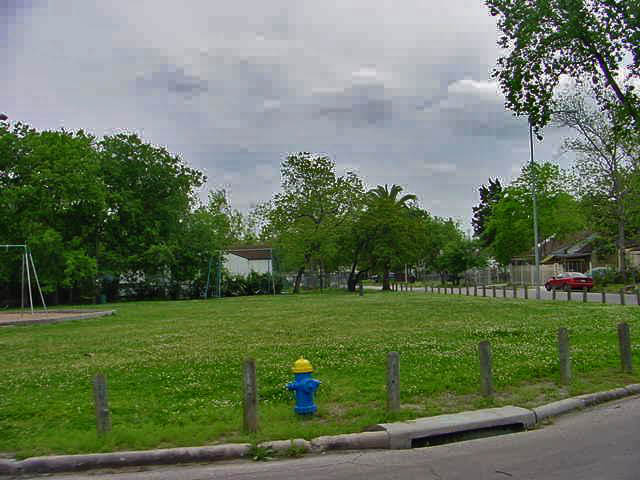
Eagle Field (Japonica at Myrtle, Houston) lives on forever in my heart.
Last spring, when good friend and fellow SABR member Bob Dorrill and I toured a few old ball field sites in Houston’s past, I couldn’t resist adding Eagle Field to the tour agenda. I also came prepared that day to dig up a little dirt from the old home plate area so that I could take it home with me as a physical souvenir of that magical time and space. That’s a small sparkling sample of the hallowed ground you see in the first photo up top.
I found the little frog emblem nearby, the product of a more recent Pecan Park childhood era, but a gentle reminder to me of the once enormous “Houston Toad” population that thrived in Pecan Park back in the day prior to their loss of insect food supplies to Houston’s exterminators. So many toads abounded. We may have been scientifically inaccurate, but we even named one section of the Japonica-Kernel alley “Frogtown” because of all the toads we found there.
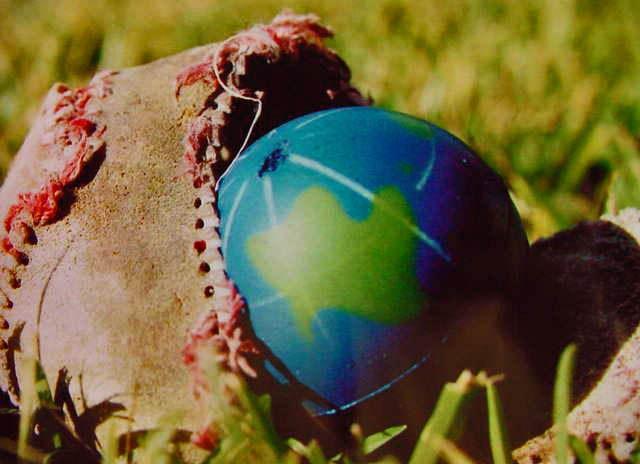
I’ll try to not repeat myself too often on this subject, but it was just that special to so many of us. The loss of the sandlot experience is one of the great losses to our American childhood in today’s generations. For one thing, and from what I both see and sense, the loss of the sandlot stood hard as the demise of the greatest “kids’ court” that ever existed. It was where we kids of the old days learned to both compete and cooperate with others our age without the perpetual direction, control, and rescue of parents and other authority figures. My dad had to get involved once when we started mixing baseball with a pipe gun war, but, for the most part, we kids of that era worked things out without killing each other.
Those were the days, my friends. We can’t live in the past, but I do wish we could revive the sandlot. If only we could build enough safeguards far enough back for kids today to work and play together again, away from the threat of pedophiles and free from the obvious presence of parents or purchased adult supervision.
Under today’s conditions, kids don’t have much chance to find and name their own “Frogtowns” – and that loss of free play and safe exploring opportunity in childhood should sadden us all.
Postscript: Speaking of special days, Roy Oswalt goes for the Astros against Pittsburgh today with a chance to tie Joe Niekro at 144 wins for the greatest number of pitching victories in franchise history. Either way, this sure would be a great day for the Astros to announce that they are retiring Joe Niekro’s number 36 next Saturday, July 24th, when Roy O. has his next shot at home to either tie or break the record.
If you support the idea of the Astros retiring Joe Niekro’s number 36 as a long overdue no-brainer, please go to that column site through the following link and post your opinion there. It’s important that we all speak up for Joe.
Here’s the Niekro comment link:
https://thepecanparkeagle.wordpress.com/2010/07/13/its-time-to-retire-joe-niekros-astros-36/
Have a nice Sunday, everybody!
 The Pecan Park Eagle
July 20, 2010 at 5:36 pm |
“The loss of the sandlot experience is one of the great losses to our American childhood in today’s generations.”
You’re absolutely right about that, Bill.
I have fond memories of what could barely be called a ball park in Graham, a small oil field town about 100 miles northwest of Fort Worth. My father worked for an oil company there for a good part of the 1950s, and much of that time the area was plagued by drought.
The summers were miserably hot, and with no rain there was no grass on the field. The chain-link backstop had holes in it, rocks substituted for bases, and the pitcher’s mound was not worthy of the name. But we played some great baseball there.