
Hope he's not a pinch hitter with the game and his job riding on what happens this time up..
Those of us who grew up in the baseball sub-culture don’t hold a copyright on superstitions. We simply invented most of them.
Who do you think came up with the two basic superstitions about stepping on long white lines on the ground? Depending on their point of view, a player, and especially a pitcher, may decided that it’s bad luck to step on the white foul line when he’s running, walking, or jogging to his position on the field. On the same team, another guy my believe that it’s bad luck not to step on the line. Other teammates may be working with “white line ideas” that are variants on each touch/don’t touch thought – ideas that they are too embarrassed or superstitious to even share with their best friends. Example: You have to avoid the line while taking the field, but step on it when you come back to the dugout. Mind-boggling.

The rally cap is supposed to also "turn the game around."
The rally cap is a fairly new collective superstition in baseball. A variant on the old “cross-your-finger-for-good-luck” behavior, players are hoping that the reversal of their caps will also result in a reversal of fortune on the field when their club is trailing in the later innings. Whatever works.
I’m not sure if Hall of Fame shortstop Rabbit Maranville ever personally carried any rabbit’s feet for good luck, but I’m willing to bet you that he had plenty of teammates over his long multi-team career that felt lucky to have a guy with a name like rabbit joining their lineups. Superstition runs silent and deep in baseball. It exists at levels that don’t get talked about openly in baseball.

"You've just been traded to Pittsburgh!"
Sometimes you can’t take a road trip somewhere without running into a sign that suggests good or bad luck. Other times you just have to pass through certain days that are associated with bad luck, notably Friday 13th, but I knew a guy once who was convinced that nothing good could ever possibly happen on the “29th” of any month. He also felt that players should avoid wearing the number “29” at all costs. If a relief pitcher wearing #29 came in and gave up a grand slam, he would just say something like, “What did you expect?” and move on. If the same pitcher got his club out of the jam with a two-out “K” and the bases loaded, he would simply shrug and say, “he was lucky that time.” There is no arguing with the “BIG S!” When superstition exists, it rules. And reason goes on permanent holiday in the area covered by the superstitious belief.

Malevolent Superstitions
The mala ojo, or evil eye, may be more prevalent in baseball countries that also practice voodoo, but that doesn’t mean that players would not try to use it an American-based baseball game. The evil eye is simply based on the superstitious idea that ill fortune can be transmitted from one person to another through a powerfully evil look that has been charged with all kinds of bad wishes. It is nothing to play around with and, as far as I’m concerned, it does all its harm to the would-be sender. Negativity always finds a way to fall back on the sender. You don’t have to be an historian of Captain Marvel comic books to get how that works, but it helps. SHAZAM!
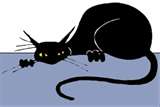
Maligned from the Middle Ages
In this so-called enlightened 21st century, it may be time to put aside the enemies of reason that have haunted society from the dawn of civilization and tortured everyday life for black cats since the Middle Ages. Just don’t count on it happening over night. And don’t jump to any conclusions that it’s gone when people stop admitting that is still has a home in the game of baseball. Superstition is also more of an old-fashioned word for a form of obsessive-compulsive behavior – and those skins of human affinity are long, strong, and powerful.
This subject is like the game of baseball. Theoretically, it could go on forever. I’ll take rain check on coming back to it at any time, as long as it’s not the 29th of the month. (Just kidding.) For toady, I’d like to comment on a couple of superstitions that haunt our Houston Astros. These are superstitions that some feel may explain our difficulties in reaching and winning the World Series
Just remember. I do not believe in either of these ideas, but some people do:
(1) The Apache Junction Curse. Because the franchise originally trained in Apache Junction, Arizona at the base of the Superstition mountains, some people feel that the Houston club fell victim to the same curse that befell prospectors who came to this area in the 19th century searching for the gold they hoped to find in the famous “Lost Dutchman’s Mine.” Because the region had been cursed by the Apaches for the disturbance to their scared mountains, seekers would be pulled to the area as though drawn by an invisible magnet. – They would seek, but they would not find! CONCLUSION: The curse rubbed off on the Astros in their 48-year fruitless search for a World Series championship.
(2) The Astrodome Indian Burial Grounds Curse: Similar to the Apache Junction idea, the belief behind this one is that the Astrodome was built on land that once served as a Karankawa or Comanche Indian Burial Ground. I remember discussing this theory with former Astros pitcher Vern Ruble back in the early 1980s, when we were all still recovering from that tough loss in the NLCS to the Phillies at the “Dome. Vern had not heard the legend previously, but his eyes lit up when I told him about it. “That’s it,” Ruhle exclaimed, “That’s got to be it! Otherwise, there is no other good way to explain how we lost to the Phillies in 1980!”
Superstition is mighty, allright. It’s just sometimes mighty wrong.
Beyond superstition, don’t forget to weigh in on the “Retire Joe Niekro’s # 36 Discussion.” Please write your thoughts on the matter in the comment space beyond the following article:
https://thepecanparkeagle.wordpress.com/2010/07/13/its-time-to-retire-joe-niekros-astros-36/
Tags: Baseball, History, superstitions
 The Pecan Park Eagle
July 16, 2010 at 2:13 pm |
The great U of H football teams played in the Dome….Curses…..
July 16, 2010 at 9:04 pm |
Bill:
I have not heard about the Apache Junction or Astrodome curses. Thanks again for more of you great baseball history and such.
fyi…
The one “fun” paper that I wrote in college was about “Superstitions of Athletes”. Around that time (early 70s), Sports Issustrated had written an article about some of the most notable believers, including Mike Cuellar and his quirky routine when pitching. I used that as one of my references, along with many other personal ones from my UH baseball teammates and others that I had played with growing up. I’m sure my English teacher had not seen one of his students use this topic before…gave me a good grade, as I recall.
Damon Leonetti