
At East End Park in August 1926, the Houston Monarchs defeated Southern Pacific for the City Championship in Negro League Baseball. (Compliments of Houston Metropolitan Research Center, Houston Public Library – All the photos used in this column.)
When Frank Liuzza died suddenly of heart failure on January 2, 2010, many of us lost a good friend, but the greater potential loss fell upon the City of Houston. You see, Frank’s father and uncle, John and James Liuzza, had been the Fathers of Negro League Baseball in Houston with the 1924 founding of the Houston Monarchs, a team that would come to be known as the Houston Black Buffs in the 1930s. The entire operation lived on to about 1954, when racial integration brought about the end of the talent flow through the previously all black baseball leagues across America. By the 1950s, even the Negro League clubs were integrating in self-defense, employing a few white players for the sake of filling out their rosters.
It was left upon the shoulders of young Frank Liuzza to shut down the operation that his family once started and sustained through the hard times of segregation and economic depression. In that less sentimental era, few artifacts were preserved for history. To our limited knowledge, no Monarch or Black Buff uniforms were preserved. No equipment was spared. And hardly any names or records of the player had been saved by the Liuzza family or the media.
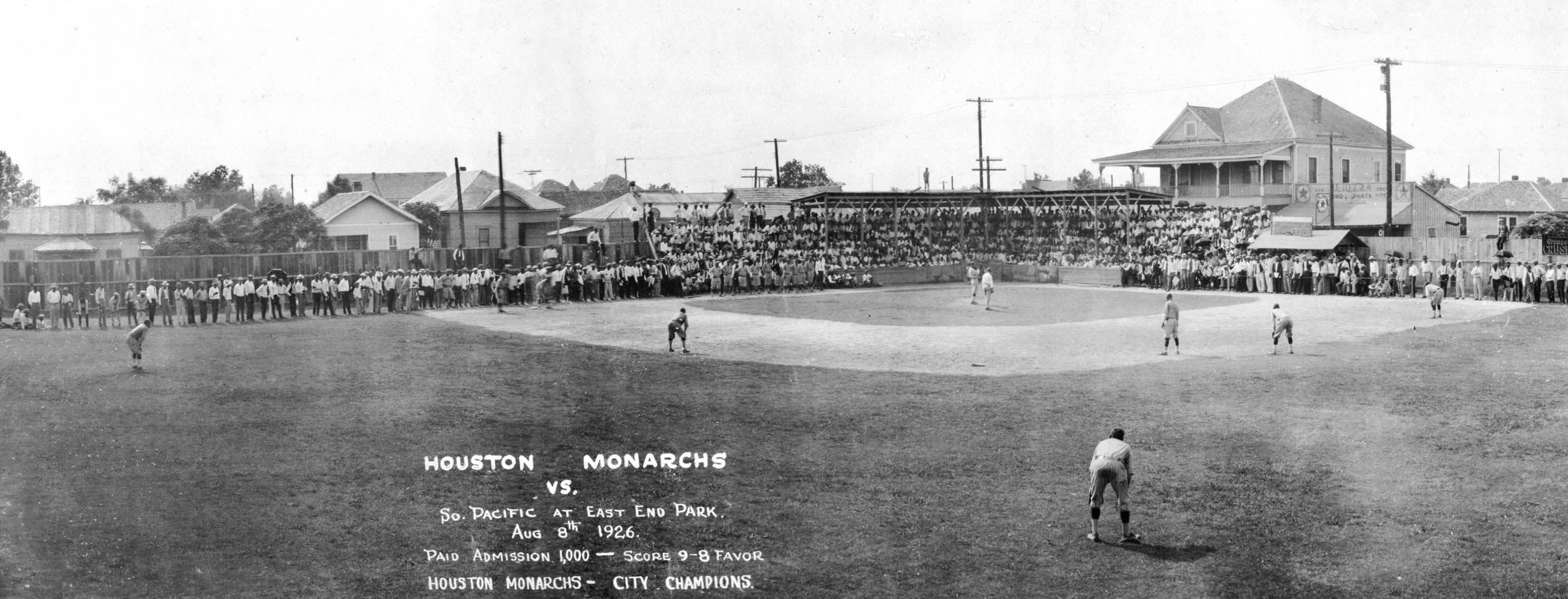
A closer crop view from the panorama shows that the championship game date was August 8, 1926 and that 1,000 fans showed up to watch the Houston Monarchs defeat Southern Pacific, 9-8. That two-story place behind the main grandstand was the Liuzza family home.
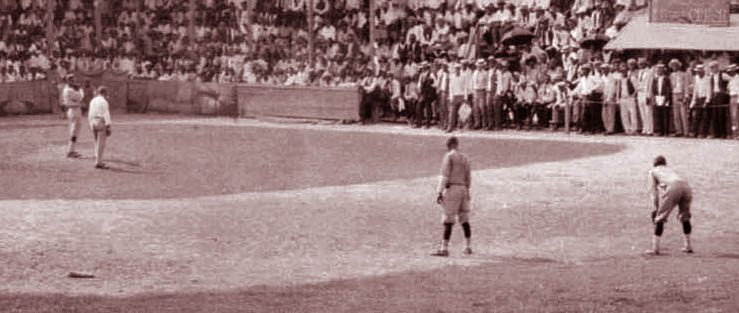
AUGUST 8, 1926, EAST END PARK, HOUSTON: We are not really sure which team is batting in this segment from the panorama, but check out the runner’s lead off second base. Also note that the umpire appears to be calling balls and strikes from behind the pitcher.
What did survive was precious. The three main photos on display in this article might have been lost to the public forever, had it not been for the will of Frank Liuzza and the willingness of his loving widow, Dr. Sue Hepler-Liuzza, to follow through with a donation that now makes them available to those who research and write for history at the downtown Houston Public Library.
Thank you forever, Dr. Hepler-Liuzza. Houston is fortunate that you brought your big Chicago heart with you when you moved here years ago. I will always celebrate the fact that we have shared a close friendship over the course of our entire adult lives – from Tulane in New Orleans to black baseball in Houston – and always made the best of it. Even if we don’t see each other that often, I shall always consider you to be one of my closest friends in the world. Shared interest and affinity make for some broad and deep bonds, even when frequent physical contact doesn’t happen. Got me on that?
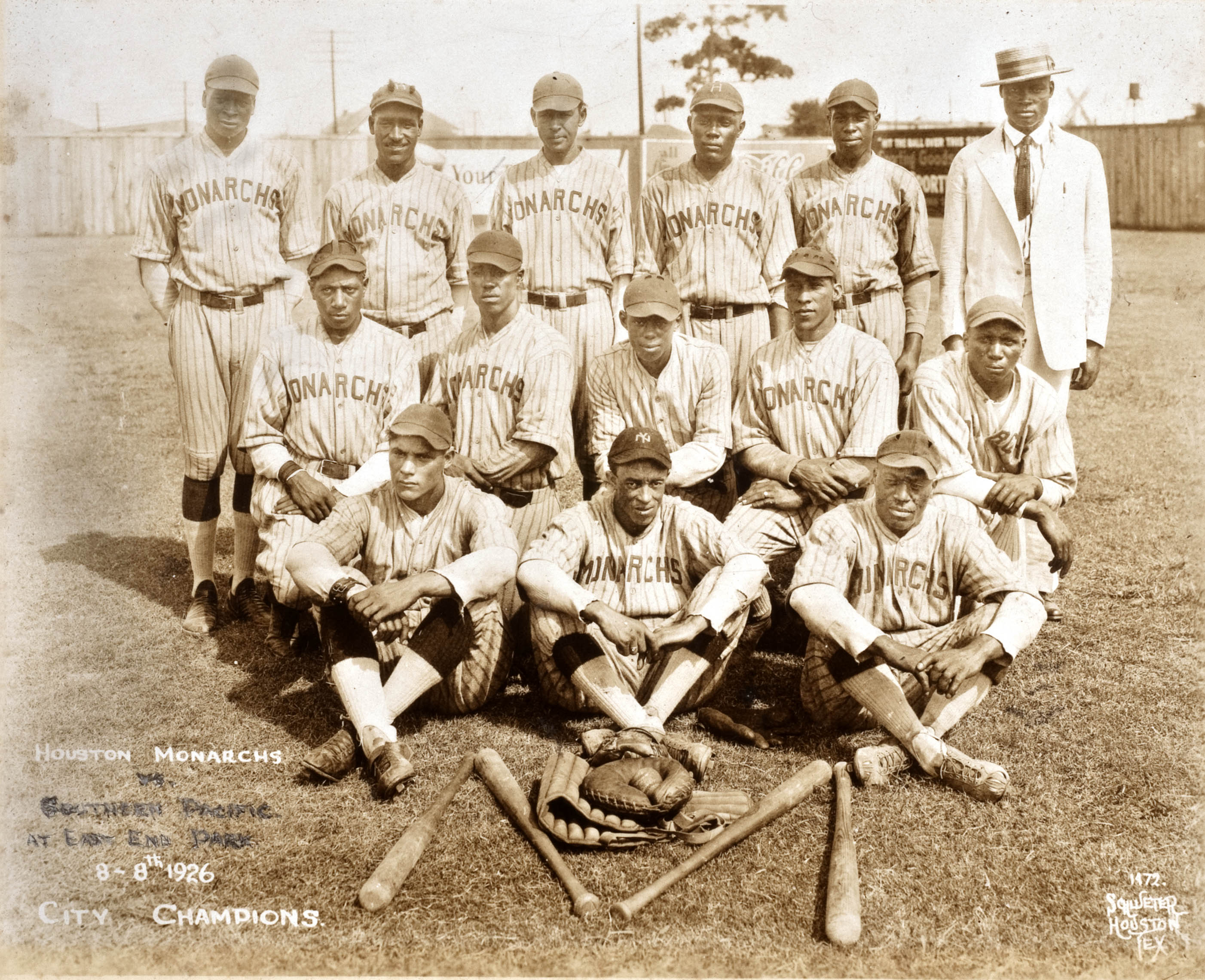
The 1926 City of Houston Champion Houston Monarchs and their only manager for 30 years, Mr. Arthur Lee Williams. None of the players in this photo are currently identifiable.
Photo purchase for framing and use in publications is now available to those who may be interested in any of these three works. Contact the Director of Photographic Collections, Mr. Joe Draut, at the downtown library for further details. The phone number for Mr. Draut is 713-213-1391.
It’s a shame that records of individual player identities have been lost over time, but, at least, we now have these photos for comparison to others we may find buried by accident in the pages of Houston’s newspaper past. Of course, if you recognize anyone in either of the two team photos shown here, please pass that information on to Mr. Draut or me. One of my ongoing jobs, by avocation, is filling in the cracks of lost history, however small, wherever possible. Now, if you happen to still have a uniform that your great-grandfather wore, please step forward and make that precious item known to the history of Houston Negro League baseball history as well. This isn’t about money. It’s about the records of those old Monarch players as contributions to our local culture and its history. And that’s much bigger than the almighty dollar.
Somebody connected to the Negro League Past in Houston needs to speak up. For now, we hardly even know the players’ names, let alone their batting averages and pitching records. And that fact, my friends, is a bloody, crying shame.
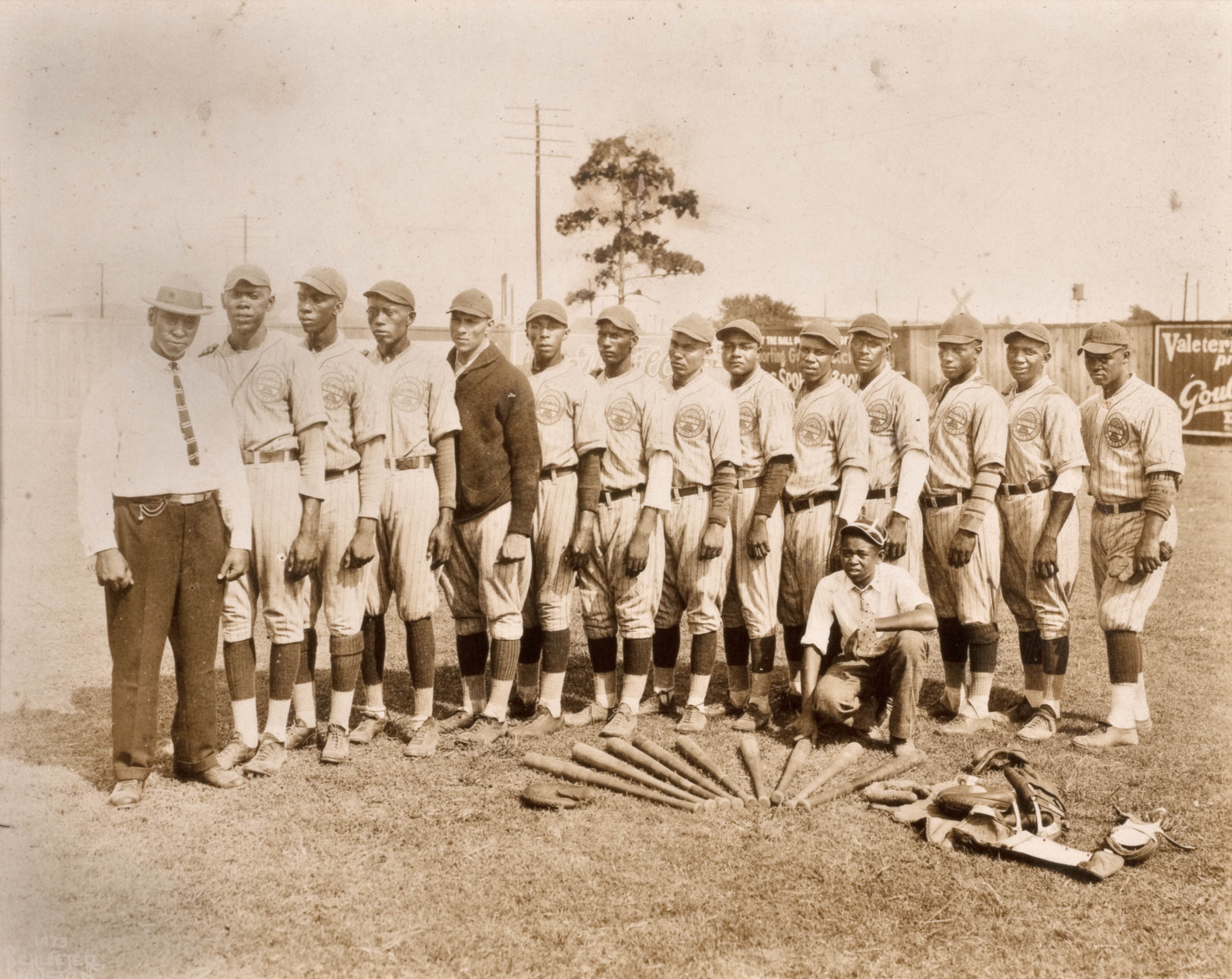
Southern Pacific lost to the Houston Monarchs on that hot day in August 1926 at East End Park on Clines, just off Clinton Drive, in the near east area close to downtown in the Fifth Ward. Even the name of the SP manager hs failed to survive over time.
Houston’s early record in historical preservation wasn’t too good, but we do have a number of groups and individuals in town now working to put together all the shattered pieces of it that were torn down in the past to build literal and figurative parking lots on our landscape.
We could always use more people in the search. More time. More money. And more caring. It’s a fight that needs to go on forever, whether we are talking about the histories of our many varied Houston sub-cultures, anciently forgotten baseball players, decimated architecture, churches of large and small impact upon the everyday lives of Houstonians, entertainment venues, or businesses that saved or spurred the local economy in the past. The era for simply tearing something old down and putting up another new strip shopping center needs some brakes.
Think about looking around for what you might do in behalf of historical preservation and go after it. This great city both deserves and needs your help. Think about what’s in your attic, or better yet, your grandmother’s attic. Check these places out. And never throw away an old box that’s been collecting dust and cobwebs for a hundred years without checking out its contents first. The contemporary “experts” who advocate that people remove the clutter from their lives by simply throwing old boxes away un-inspected for the sake of order are not historians.
Take responsibility for inspecting what you may have stored in boxes for years. And, hey, if you run across an old “Monarch” uniform, keep it, but tell somebody about it after you’ve secured it somewhere else and have now identified it for what it is. Then throw the other stuff out. If you’re not real sure what’s valuable, go through your stuff with someone who may be able to help you make the call on certain items. Then toss the other “junk” away.
End of soap box address. For today, anyway. I’m going to have to do a whole article on sports artifact searches in the near future.
 The Pecan Park Eagle
July 2, 2010 at 1:54 pm |
Bill: Would a local newspaper such as the Houston Defender help with the identication of these great ballplayers?
July 2, 2010 at 2:18 pm |
Tony:
I’ve been through a number of the Defender files from 1934 forward. To my initial surprise, I found very little about black baseball – and whole lot about about black social clubs and special dance cotillions. I concluded that the Defender preferred to cover status-enhancing activities in the black community and that baseball wasn’t viewed as one of these.
July 2, 2010 at 6:36 pm |
East End Park. The most important image in Houston sports history. Arguably the most importanat image in Houston’s cultural history.
June 18, 2014 at 4:13 pm |
I am an educator interested in using one of these images for curriculum materials. Do you know they appropriate way to cite these? Thank you!
June 18, 2014 at 9:40 pm |
“Compliments of Houston Metropolitan Research Center, Houston Public Library”