 My grandfather was a small town newspaper man. He founded and ran the Beeville (TX) Bee back in 1886 until his death in 1913. When he started, he counted a lot upon readers sending in local news to fill in some column space, but he also never gave up his eye for the fact that anything that wasn’t timely wasn’t news.
Back in 1889, when Grandfather Will McCurdy was only 23, some readers in Port Lavaca sent him a write-up on their Christmas celebration. Trouble was, Grandfather Will received the story only two weeks prior to the following Easter Sunday. It led Grandfather to the obvious conclusion that “old new was not news.” All he could do was try to explain to his contributor/consumer readers why the article would not appear.
“The Bee is sad to report,” Will McCurdy wrote, “that the story of how Port Lavaca celebrated Christmas will not appear on the pages of our little weekly newspaper. Although we appreciate the effort, we need our contributors down in Port Lavaca to keep in mind this fact: The hoary hand of time has quite a different effect upon local news than it does upon wildcat whiskey. – Local news does not get better with age.”
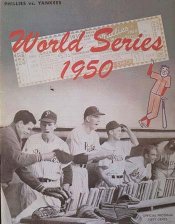
With my grandfather’s advisory in my mind, I thought I’d better get about my intended business of writing a short story on the first 1950 Yankees-Phillies World Series before the current New York bullies make history out of the 2009 Phils. Down three games to one now, the Phillies face the tall order of needing to defeat the Yankees three games straight to fulfill their hopes for a second straight World Series crown. That isn’t likely now, especially with the last two games, if needed, coming in New York. Of course, if the Yankees win tonight in Philly, it’s all over.
In 1950, the New York Yankees and the Philadelphia Phillies met for the fist time in the World Series. Back then it was the Yankees seeking their second World Series win in a row and their 13th World Series victory in 17 total appearances. For the ’50 Phillies. it was then a search for their first World Series victory in only their second appearance in baseball’s big show. The 1915 Phillies lost their only previous World Series in five games to Babe Ruth and the Boston Red Sox.

Robin Roberts: One of Several Future Hall of Famets in the 1950 World Series.
In 1950, Eddie Sawyer was in his third season as manager of the Phillies. A guy named Casey Stengel was in his second full season as manager of the Yankees.
Because Roberts had pitched in three of the last five games of the regular season, he was unavailable for the Series opener on October 4th at Shibe Park in Philadelphia. Sawyer surprised the baseball world by starting 33-year old relief ace Jim Konstanty in the Series opener against Stengel’s choice, 31-year old ace right hander Vic Raschi (21-8, 4.00). Konstanty had appeared in 74 games in 1950, but only in relief, on his way to 22 saves in a tight-inning stopper role – and long before baseball ever used the term closer.
Game One: NY 1 – PHI 0 (Shibe Park, 10/04/50). Konstanty did OK, but Raschi did great, giving up only 2 singles in a 9-inning complete game pitching victory. Konstanty worked 8 innings, giving up the only run of the ball game in the top of the 4th. After Bobby Brown doubled to lead off the 4th, he moved to 3rd and then came home on flies by Hank Bauer and Gerry Coleman.
Yankees led the Series, 1-0.
Game Two: NY 2 – PHI 1 (Shibe Park, 10/05/50). 31-year old right handed Allie Reynolds (16-12, 3.74) of the Yankees squared off against 24 year-pld righty Robin Roberts (20-11, 3,02) of the Phillies. Both men each pitched complete games in a 10-inning contest that ultimately was decided by a solo shot homer off the bat of the great Joe DiMaggio.
Yankees led the Series, 2-0.
Game Three: NY 3 – PHI 2 (Yankee Stadium, 10/06/50. Please note too the absence of a travel day off as the 1950 world Series moved the short distance from Philadelphia to New York. Also note what you cannot see. All these games were played in the daytime – and they were played during an era in which no one had even heard the phrase, pitch count). Game 3 shaped up as a battle between two lefty “wheez kids” as 35-year old Ken Heintzleman (3-9, 4.09) took the mound for Philadelphia against 32-year old Eddie Lopat (18-8, 3.47). Old man Heintzleman did pretty well until late in the day. He had a 2-1 lead over Lopat and the Yankees, but he got into trouble after two outs in the bottom of the 8th by walking the next three batters he faced. The usually sure-handed shortstop Granny Hamner then booted a routine grounder off the bat of Bobby Brown to let the tying run score. The Yankees got no more, but Heintzleman was gone as the Phillies seemed to deflate over New York pulling into a 2-2 tie.
In the bottom of the ninth, and with reliever Russ Meyer now pitching for the Phils, Gene Woodling scored from 2nd base on a single by Gerry Coleman to end the game and put the death rattle on Philadelphia hope. Meyer took the loss for Philly; Tom Ferrick got the win in relief of Lopat.
Yankees led the Series, 3-0.
Game 4: NY 5 – PHI 2 (Yankee Stadium, 10/07/50). 24-year old right handed Bob Miller (11-6, 3.57) carried one last Phillies shot to the mound against 21-year Yankee rookie sensation lefty Whitey Ford (9-1, 2.81.) New York jumped Miller for two runs in the first, driving him from the mound after only one out in favor of Jim Konstanty. Mr. K. settled things down, but Mr. Ford blanked the Phils for most of the day. A home run by Yogi Berra and a triple by Bobby Brown in the 5th tallied three more NY runs, effectively icing the game at 5-0. Ford ran into a little trouble in the 9th, giving up 2 runs that led to his removal with two outs in favor of Allie Reynolds. Reynold struck out Stan Lopata with two men on base to end the game and the Series.
Yankees won the 1950 World Series, 4 games to 0, over the Phillies.
If the Yankees also win the 2009 World Series, their overall record will be 27 World Series championships in 40 World Series appearances. If that becomes the case, the Phillies will drop to 2 World Series titles in 7 World Series tries.
 The Pecan Park Eagle
November 2, 2009 at 5:00 pm |
At least this series–the November Classic–will go at least 5 games.
November 3, 2009 at 1:06 am |
Good stuff Buff. I also had this series on my mind. Here’s my “replay” of the series with the Extra Innings tabletop game:
http://forums.delphiforums.com/n/main.asp?msg=15667&nav=messages&webtag=tabletopsports
November 3, 2009 at 5:03 am |
Good article. That series was similar to the Astros loss in 2005. The games were close and could have gone either way.
I think there are a couple of errors in the caption under Robin Roberts’ picture. The dramatic home run was by Dick Sisler, not Del Ennis and it was not a playoff game. It was the last game of the season on a Sunday afternoon. I listened to it on the radio. As a big Dodger fan at the time, I wasn’t happy with the outcome.
November 3, 2009 at 9:45 am |
To Bill Gilbert:
Bill, Thanks for catching me in a senior moment. You’re right, of course. It was the last game of the season between the Phillies and Dodgers at Ebbets Field and not a playoff – and it was Dick Sisler, not Del Ennis, who hit the dramatic home run that won the game and the pennant for the Phillies. Yes, it was a Sunday afternoon and I too listened to the game on the radio. I remember being happy for the Phillies because I viewed them as the underdog. I once owned facts like these as though they were the back of my hand. Now I need a memory jogger every once in a while. Thanks for people like you and SABR. – Bill McCurdy
November 3, 2009 at 2:13 pm |
The similarities to 2005 are striking. Even though both series were sweeps, in both instances the winning team outscored the losing team by only 6 runs.
December 26, 2009 at 9:19 pm |
The Phillies manager, Eddie Sawyer, had heard the phrase “pitch count”, according to the book The Man in the Dugout by Donald Honig. Sawyer said he used pitch counts regularly, albeit not the way they are used today.