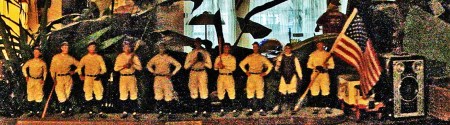
Above (Left to Right): Miller Huggins, Manager; (1) Earle Combs, CF; (2) Mark Koenig, SS; (3) Babe Ruth, RF; (4) Lou Gehrig, 1B; (5) Bob Meusel, LF; (6) Tony Lazzeri, 2B; (7) Joe Dugan, 3B; (8) Pat Collins, C; Herb Pennock, P.
In my mind, at least, they are the unarguably most legendary, fabled, iconic, colorful, and especially productive baseball team in all of major league history. Whether you like the New York Yankees or not, it’s hard to argue that any team anywhere ever bore more lustre and bluster than the 1927 version of the Bronx Bombers because, simply put, the team dubbed rightly so as Murderers’ Row is the only one that ever featured an out of this world one-of-a-kind slugger in his prime named George Herman “Babe” Ruth.
I’m not suggesting that the Babe Ruth of 1927 would certainly out-produce a guy like Albert Pujols if the former were teleported to 2010 with all of the talent he possessed in 1921 or 1927 intact, but I wouldn’t bet against it either. If the Babe had to adjust to the baseball culture of this early 21st century era, I’m betting he could do it, even if he had to spend these winter months at the Betty Ford Clinic getting ready for 2010, but that’s all speculative and unprovable.
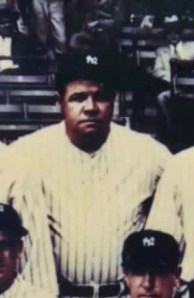 What is demonstrable is the fact that Ruth accomplished things in 1927 that no other hitter, including Prince Albert, could ever hope to top. 1927 was the season that Babe Ruth broke his own season home run record by hitting number 60 on the last day of the season. It was a record that turned the digit “60” into an iconic number for baseball’s most glamorous power statistic, and, thirty-four years later, it converted 61* (asterisk included) into the new record for Roger Maris, who needed 162 games to best by one homer what Babe Ruth had done in 154 contests.
There isn’t much that can be added to what’s already been written about Babe Ruth’a recording-breaking, phenomenal 1927 season. His 60 homers alone were more than any of the other seven clubs in the American Leaguue could muster as whole teams.
Although many of us like to remind that Babe Ruth’s 1921 offesive season was superior overall to his individual 1927 season total output, there’s no argument that the total Yankees result in the latter season was simply the greatest season to come along when it came down to winning with power, winning by a big margin, and winning by a runaway few laps in the final standings. The ’27 Yankees both had it all and did it all.
For the first time in big league history, the ’27 Yankees became the only club through that date to come along with two players that hit over 45 home runs for the same club in the same season. Ruth’s 60 HR were strongly matched and supported by Lou Gehrig’s 47. Tony Lazzeri added 18 HR of his own to the ’27 hitting assault, good enough for third place on the Yankees. And had it not been for teammates Ruth and Gehrig, Tony Lazzeri would have led American League in home runs over the course of the ’27 season.
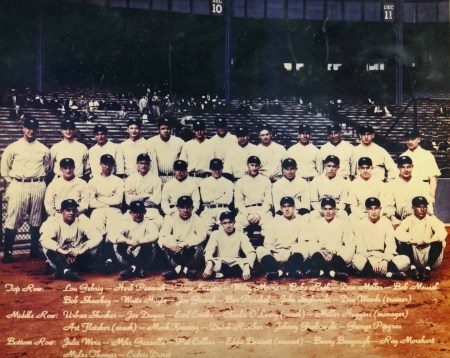
Babe Ruth hit his 60th HR on September 30, 1927 off Tom Zachary of the Washington Senators Senators before a sparse crowd at old Yankee Stadium, which was then only cpncluding its 5th season of operation. Fas weren’t crazy for records so much in those days. Besides, the Yankees had long since wrapped up the American League pennant by that final day and were simply playing out the string against the lowly Sens. Besdies too, Rut already owned the HR record at 59. By hitting 60, he would just be mocing up he own mark by one digit. It’s no big deal. Right?
Ruth also batted .356 with 164 RBI in 1927, but, hey, after all is said and done, the 1927 Yankees still were not all Ruth, It takes more than one killer to build a Murderers’ Row and the Yankees had such a group. Earle Combs was the leadoff man and a .356 hitter on the year. His 231 hits and 23 triples led the American League in 1927. Mark Koenig batted 2nd, hitting a steady .285 for the year. The came Babe Ruth in the 3rd spot. The following year, this batting order would be used to determine the major numbers that went on the backs of each Yankee player in 1928. Lou Gehrig batted 4th, hitting .373, with league-leading marks in 52 doubles and 175 RBI. Bob Meusel batted 5th, hitting .337 with 47 doubles and 103 RBI. Then came the number 6 man, Tony Lazzeri, who, in addition to his 18 homers, also batted .309 with 102 RBI. Jumping Joe Dugan batted a steady .269 in the number 7 hole; and catcher Pat Collins batted .275 in the number 8 spot.
The ’27 Yankees also featured a pitching staff that was a Murdererrs’ Row in its own right. Look at these names and number – and give them all the awe they each deserve: Waite Hoyt 22-7, 2.63 was good enough to lead the American Legaue in wins and lowest ERA in ’27; Wilcy Moore, 19-7, 2.28 didn’t have enough innings to qualify for the ERA title, but his 13 saves would have tied him for the league lead in that category with Garland Braxton of Washington had baseball bothered to keep track of that record in 1927; Herb Pennock went 19-8 with a 3.00 ERA; Urban Shocker went 18-6, 2,84; Dutch Ruether was 13-6, 3.38; and George Pipgras went 10-3 with a 4.11 ERA.
The 1927 New York Yankees finished the season with a record of 110 wins and 44 losses for a winning percentage of .714. Thier killer record put them in first place in American League, a full 19 games ahead of the 2nd place Philadelphia Athletics and a blow-away 59 games up on the 8th and last place Boston Red Sox. Then the ’27 Yankees went out and swept the Pittsburgh Pirates, four games to zip, in the World Series. No wonder so much of the world, especially the part that is Boston, hates the Yankees, but that still doesn’t take away the title earned by the ’27 Big Apple club!
Murderers’ Row. – Any questions about the operational definition of that term?
Tags: Baseball, culture, New York Yankees
 The Pecan Park Eagle
Leave a comment