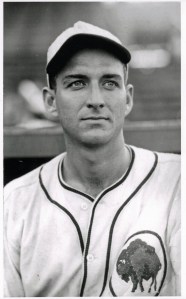
 When a pitcher goes through a season garnering 25 wins against only 8 losses, you have to figure that he’s speaking loud enough alone by his performance on the field. Well, that was exactly how the soft-spoken Clarence Beers played it as the pitching ace of the 1947 Houstons Buffs. His efforts, with some considerable help from the ’47 Buffs offense, plus fellow 20-game winner Al Papai, proved plentiful enough in getting the job done. With good command of his several quality pitches, the cool-tempered 28-year old quiet man from El Dorado, Kansas had done more than enough to draw attention from the parent club St. Louis Cardinals when it came to thinking about 1948 season. Beers had been a late season call up for the Buffs in 1940, but he only got here long enough at age 22 to go 0-1. Now it was seven years later, but even at age 29, and in spite of the fact that his 25-game win season in 1947 was only the first 20 plus wins year since his career began back 1n 1937, Clarence Beers finally had earned a shot at the majors with the Cards.
The opportunity for Beers finally came in relief on May 2, 1948. Unfortunately, Clarence lasted only two-thirds of an inning against the Chicago Cubs at Sportsman’s Park in St. Louis, giving up four runs (one earned) on three hits and a walk. Beers had no strikeouts. A walk and and a wild pitch also didn’t help his cause in an early season game captured by the Cubs, 13-4.
As so often happens, that was it for Clarence Beers in the majors. He was soon assigned to Columbus of the AAA American Association. where he posted a lacklustre 10-12, 5.35 ERA record for the minor league Redbirds. In 1949, Beers was back here to play for a bad Houston Buffs club, finishing the ’49 season with a record of 11-14 and a 3.48 ERA. Clarenece Beers also began the 1950 season with the Buffs, but was soon dealt to the Beaumont Roughnecks, the eventual champions of the Texas League that season under manager Rogers Hornsby. His 7-7, 3.72 ERA in 1950 preceded a return to Beaumont in 1951, where he battled effectively through the season, finishing with a 14-15, 2.80 ERA record. 1952 would prove to be Clarence’s last full season when he went 5-18, with a 4.47 ERA for Toledo-Charleston of the American Association. Beers finished 1952 with no record and a 4.91 ERA for Seattle of the AAA Pacific Coast League. He then went 3-7 with three clubs in 1953 and then hung them up for all time.
When we add up the results of his fourteen year career (1937-42, 1946-53), we find Clarence Beers on the light side of a career record that included 148 minor lreague wins against 158 minor league losses. His statistically exceptional year came in 1947, when he also held the opposition scoring down well enough to finish with a 2.40 earned run aerage.
I only met Clarence Beers once – and that was at the 1995 Last Round Up of the Houston Buffs. I was impressed right away with his calm, quiet, cool, and steady manner. Everything I had ever heard about the man kicked in: He was a good guy to have on your side. He was about winning. He cared about the game – and he covered his teammates’ backs. No bovine bravado flowed from this man. He was just real. And it was my good fortune to have met the man who was one of the first professional pitchers I ever saw work back in 1947, the year of my baseball awakening.
Clarence Beers passed away on December 6, 2002, just three days short of his 84th birthday, in Tucson, Arizona.
Tags: Baseball, Houston, Houston Buffs
 The Pecan Park Eagle
Leave a comment